The Invisible Killer in Your Home Doesn't Announce Itself.
You can't see carbon monoxide. You can't smell it. You can't taste it. And most people have no idea what is actually happening in the air around them — until a detector screams.
There is a moment — most people never notice it — when a home is completely, quietly dangerous.
The furnace is running. The stove has been on. The garage door was left slightly open. Or nothing obviously wrong is happening at all. The room looks normal. It smells normal. The dog is asleep on the couch. The kids are doing homework at the kitchen table.
And carbon monoxide — if it is there — is doing exactly what it always does: nothing you can see. Nothing you can hear. Nothing your body will reliably warn you about until you are already in trouble. That is not a scare tactic. That is the documented nature of the gas. Colorless. Odorless. Tasteless. The reason CO has been called the invisible killer is not poetic. It is simply accurate.
The uncomfortable question is not "could this happen?" The question is: right now, in your home, do you actually know what the CO reading is?
Most people do not. Most people are operating entirely on the assumption that because nothing looks wrong, nothing is wrong. And for the vast majority of days, that assumption holds. But it is still an assumption — and in this particular category of risk, assumptions are the only thing standing between a normal afternoon and an emergency.
The thing that changes when you can see the number is not dramatic. It is not a siren. It is something quieter and more useful: it is actual information, where before there was only a guess.
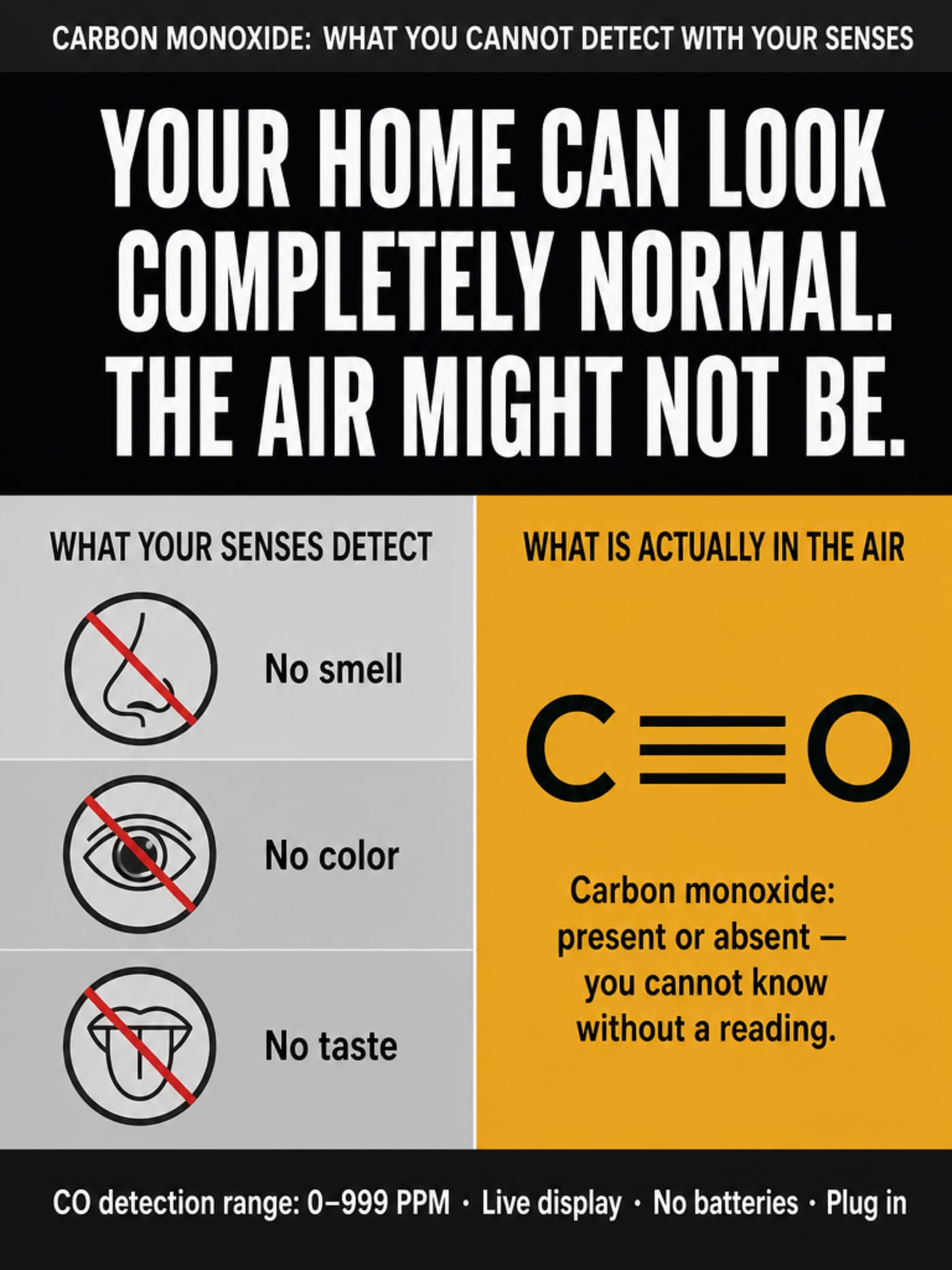
The Danger That Hides in Ordinary Moments
The situations where carbon monoxide can build are not unusual.
A gas furnace cycling on and on through a cold night. A stove burner that did not light cleanly the first time. A generator running in an attached garage — a door left open between them, just a crack. A propane heater in a poorly ventilated cabin on a February weekend. These are not extreme scenarios. They are ordinary ones. They happen in ordinary homes, to ordinary people, on ordinary days.
What makes them dangerous is not their rarity. What makes them dangerous is the absence of any signal you can detect with your own body. A gas leak, at high concentration, at least carries a smell — the odorant added deliberately so people can notice. Carbon monoxide carries nothing. No added smell. No color. No sensation you can reliably identify as CO before the symptoms begin. And the early symptoms — a dull headache, mild fatigue, slight nausea — are the symptoms of a hundred other ordinary things. A long week. A cold coming on. Not enough sleep.
Marcus — a man of 41, close-cropped dark hair, wearing a grey henley over a white undershirt — is in this position more often than he recognizes. His furnace is twelve years old. His garage shares a wall with his kitchen. He has no particular reason to think anything is wrong on any given evening. And he is right, almost every time. The problem is that "almost every time" is doing a lot of work, quietly, in the background.
The absence of a visible signal is not the same thing as the absence of a problem.

Why Your Other Detector Stays Silent Until It's Screaming
Here is what most people do not fully understand about how a standard CO alarm works.
It does not show you a number. It does not display a reading. It monitors the air continuously — that part is real — but it communicates nothing to you until the concentration in the room has reached a threshold high enough to trigger the alarm. Below that threshold, the screen (if there even is one) shows nothing meaningful. The device is running. It is just silent. And silent, in this context, means only one thing: "I have not yet reached the point where I will tell you something."
That is not a flaw in those devices. It is the design. They are built to sound an alarm at a dangerous level, and they do that reliably. But the design also means there is an entire range of CO behavior in the room — rising, falling, holding, changing — that the standard alarm simply does not surface to you. You are not watching a number. You are waiting for a noise.
The difference VIGILOX makes is structural. The display shows a live CO reading in parts per million — a number, updating continuously, visible from across the room. Not an alarm threshold. The actual current reading. That means a user can see a reading sitting at a low level and know it is low. They can see a reading that has been climbing slowly for the past hour. They can notice a number that should not be where it is and decide what to do with that information before the alarm has any reason to fire.
The mechanism is not complicated: the device reads CO concentration continuously and displays it as a number on a 2.0" color IPS screen. What changes is that the reader now has access to information they did not have before — not a prediction, not a guarantee, not a promise. A number.
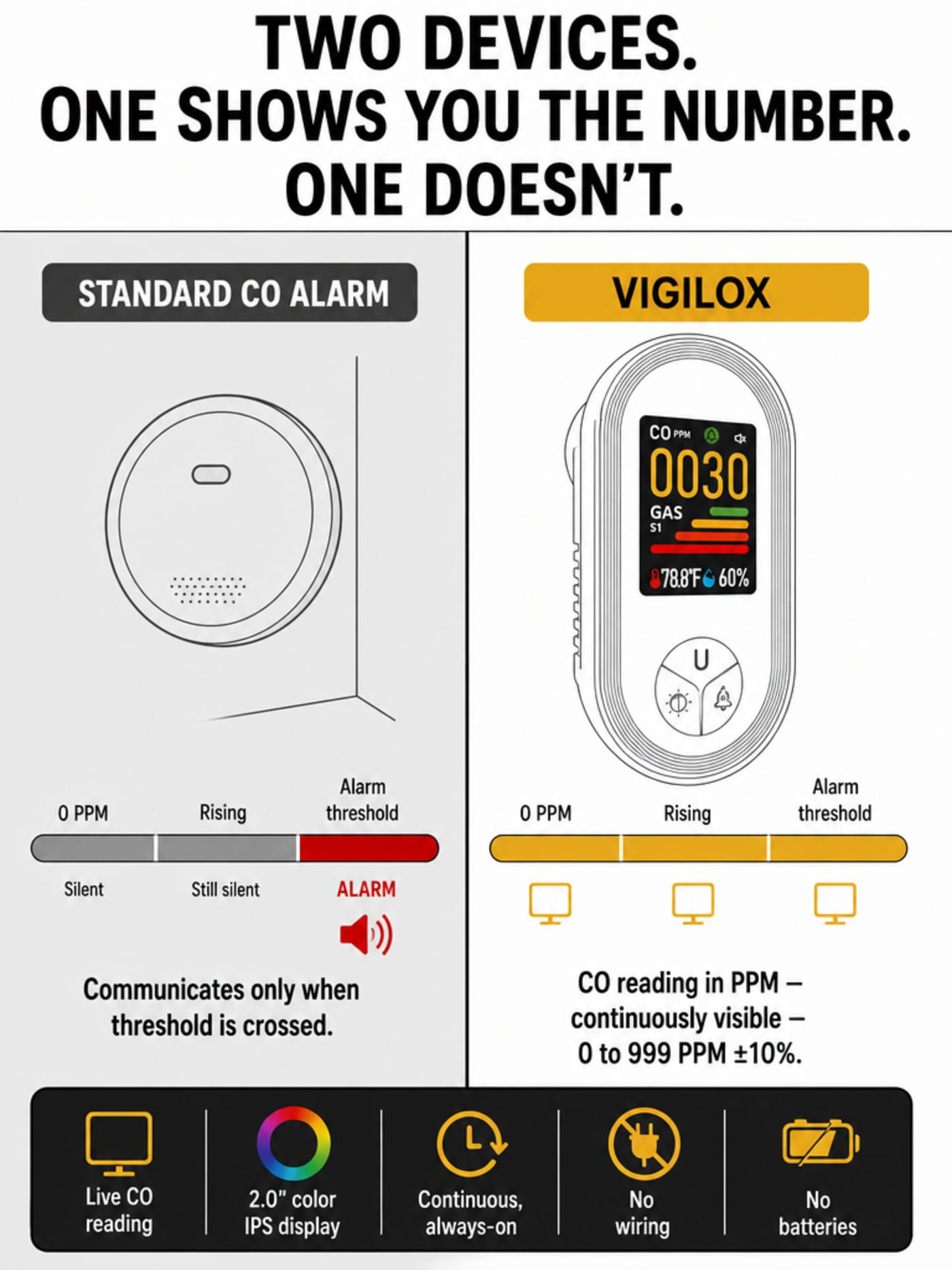
A Number Is Not an Alarm. It Is Earlier Than That.
There is a difference between a warning and an alarm.
An alarm tells you a threshold has been crossed. A number tells you where you are — and where you are heading. Those are not the same thing, and the gap between them is exactly the space in which a person can make a decision rather than react to a crisis.
Diane — a woman of 34, dark hair pulled back loosely, wearing a rust-colored cardigan over a black tank top — lives in a ground-floor apartment in an older building. Her stove is gas. The building's ventilation is whatever it is; she has never had a reason to think carefully about it. She does not have a background in air quality. She is not a scientist. She does not need to be. What she needs is a number — because a number is something she can evaluate with ordinary human judgment. If the number on the wall reads 4, she knows that is low. If it reads 4 in the morning and 31 by noon, she knows something has changed. She does not need a chemistry degree to understand that a rising number is worth paying attention to.
The real-world experience of this device returns to this point repeatedly: the ability to watch the CO reading climb — to actually see the PPM number changing — and to ventilate, or investigate, or simply be aware, before anything reaches alarm level. That is the product doing its job. Not guaranteeing an outcome. Providing information where there was previously no information at all.
This is why the display matters beyond aesthetics. It is not a screen for the sake of a screen. It is the delivery mechanism for the only thing this category has always been missing: a continuously visible number that an ordinary person can actually read.
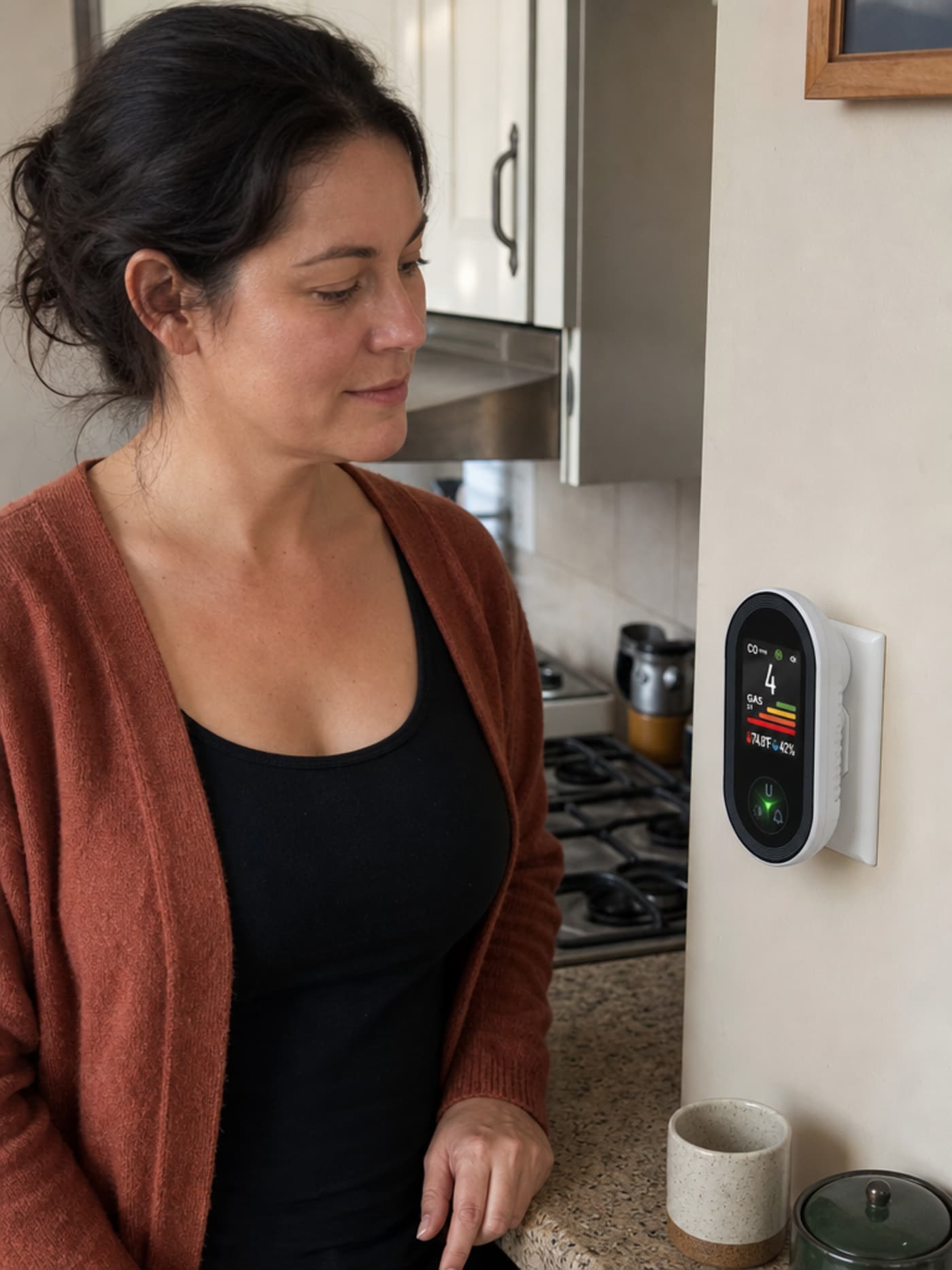
When Everything Looks Normal, the Number Is the Only Evidence
The most dangerous version of this problem is not the dramatic one.
It is not the emergency scenario, the obvious equipment failure, the smell of gas strong enough to evacuate a building. Those situations are frightening, but they are at least visible — something is clearly wrong, and the people involved know something is clearly wrong.
The dangerous version is the quiet one. The reading that is not zero but is not yet at alarm level. The concentration that has been building slowly, over hours, in a poorly ventilated room, while everyone in it gradually develops a headache they attribute to something else. The number that, if someone had been watching it, would have been clearly worth investigating an hour ago.
Marcus — a man of 41, close-cropped dark hair, wearing a grey henley over a white undershirt — is no longer in the kitchen unaware. The device on the wall in his kitchen is displaying a number. It was at 3 when he plugged it in. It has been at 3 for weeks. Tonight it reads 11. He does not know exactly what that means in clinical terms. He does not need to. He knows it changed. He opens the window. He checks the furnace. He turns on the exhaust fan. He does those things not because an alarm told him to — the alarm has not fired — but because the number he can see is different from the number he is used to seeing.
That is not a guaranteed outcome. The device does not promise it will always catch every change in time. No device can promise that. What it promises is something more honest and more useful: a continuously visible number, always updated, always there to look at. What the reader does with that number is up to them. But they are no longer operating in the dark.
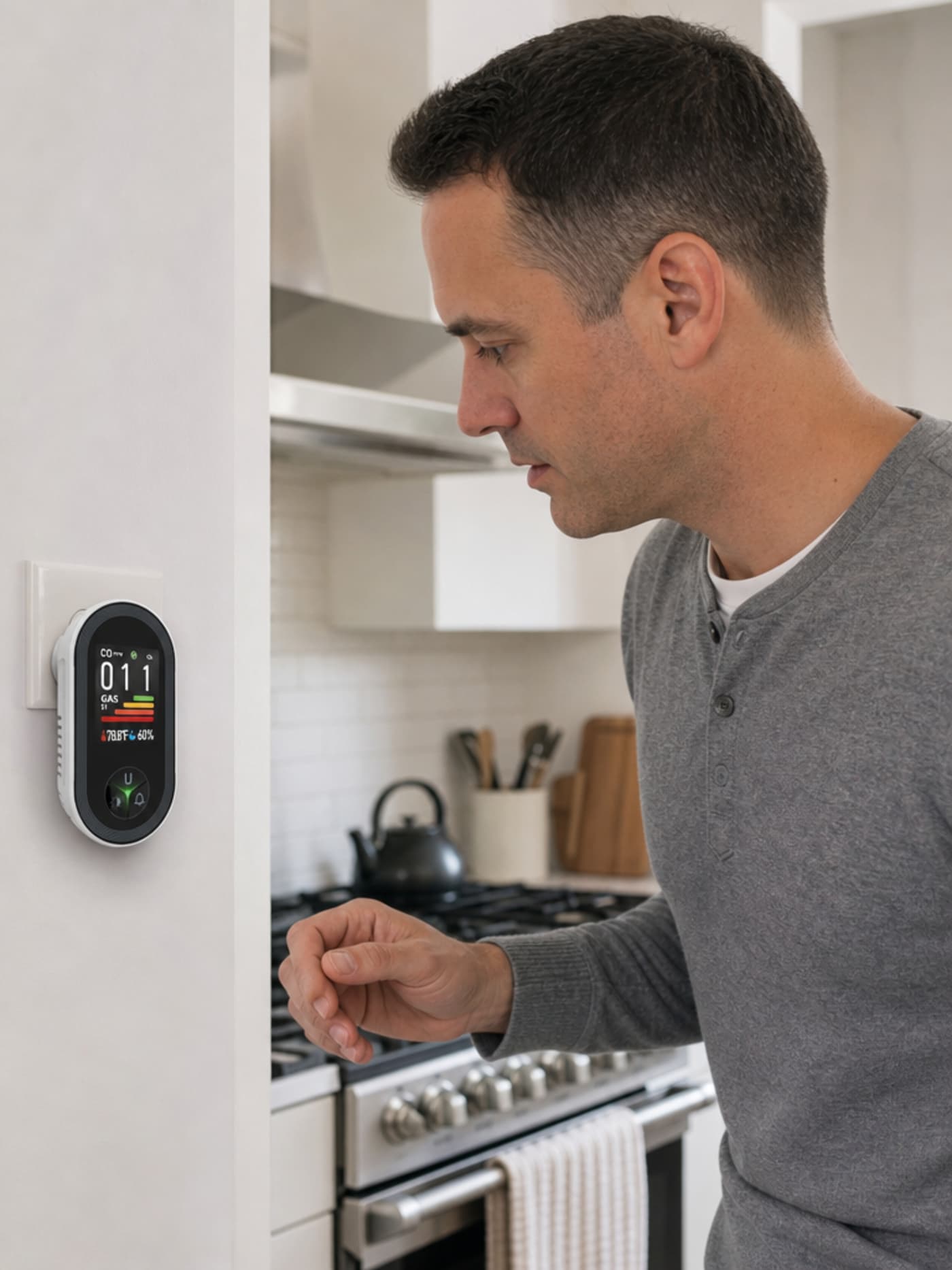
The Places That Are Most Vulnerable Are the Ones That Feel the Most Familiar
Some spaces carry higher CO risk simply because of what they are and how they are used.
Cabins with propane heaters run through the night. RVs with built-in cooking appliances and limited ventilation. Garages where a car idles, or a generator runs, sharing air with a connected living space. Older homes where a furnace has not been serviced in two winters. Utility rooms with water heaters that cycle on and off silently, all day, while the house goes about its business.
These are not exotic locations. They are ordinary ones. And the common factor in all of them is the same: the air is doing something the occupant cannot see, and the occupant's only detection system is the alarm they hope will fire before the situation has already developed.
Ray — a man of 58, grey-streaked beard, wearing a dark navy flannel shirt over a thermal base layer — uses a propane heater in his weekend cabin. He is two hours from the nearest hospital. There is no cell signal at the road turnoff. For most of the year this is irrelevant; the cabin is fine. But the vulnerability is structural. In a space like this — remote, gas-heated, limited ventilation — the gap between "everything seems fine" and "this has already been a problem for an hour" is made of the same material as everywhere else: invisible gas and no visible reading.
A device that shows a live number in PPM does not eliminate that vulnerability. It does not guarantee an outcome in a remote location any more than it does in a city apartment. What it changes is the information available to the person in the room. Where before there was nothing — no reading, no display, no number, just the assumption of safety — there is now something concrete to look at.
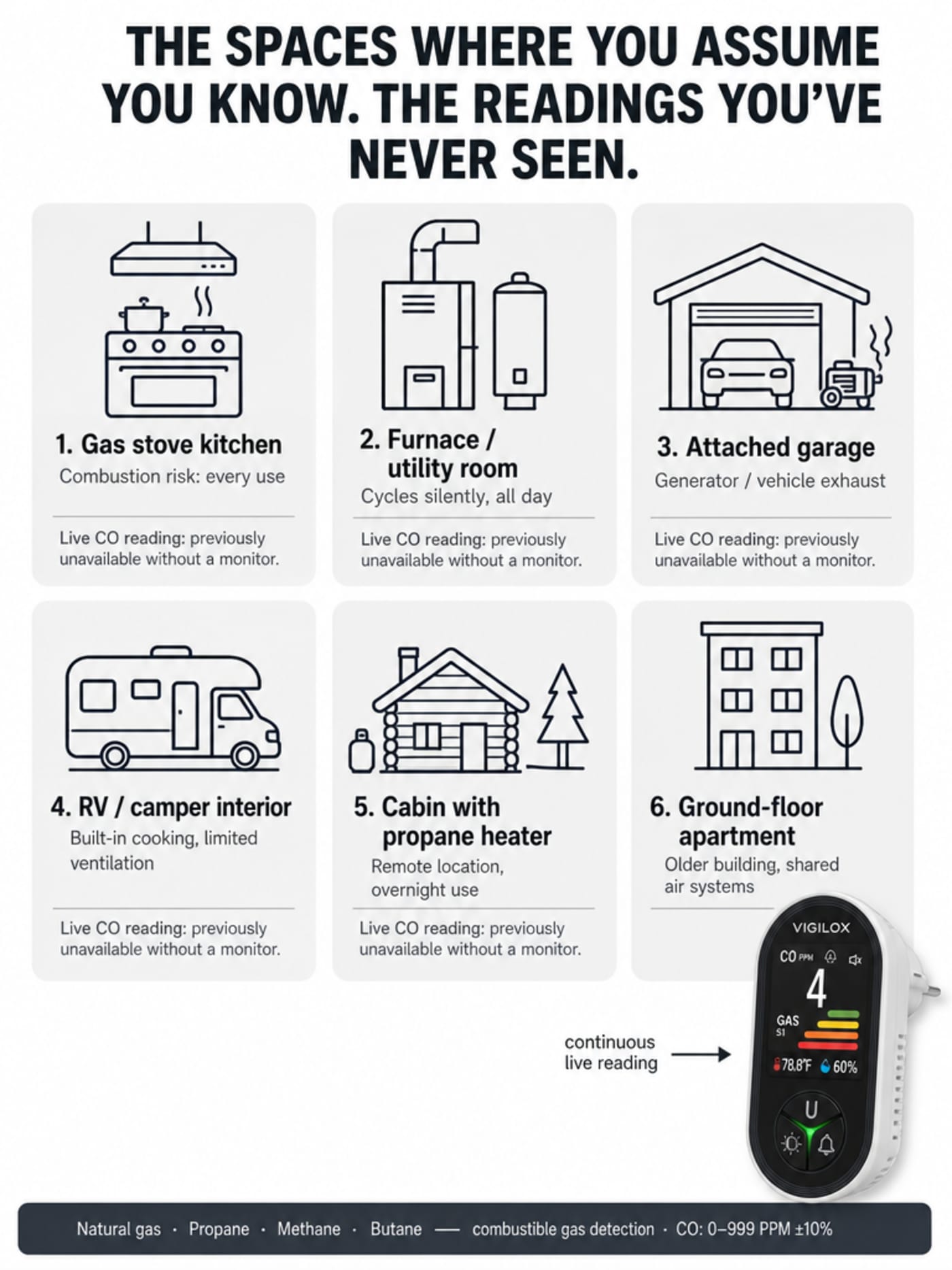
What the Display Actually Shows, and What It Doesn't
A device like this earns its place on a wall by doing one thing with complete transparency: showing a real number in real time.
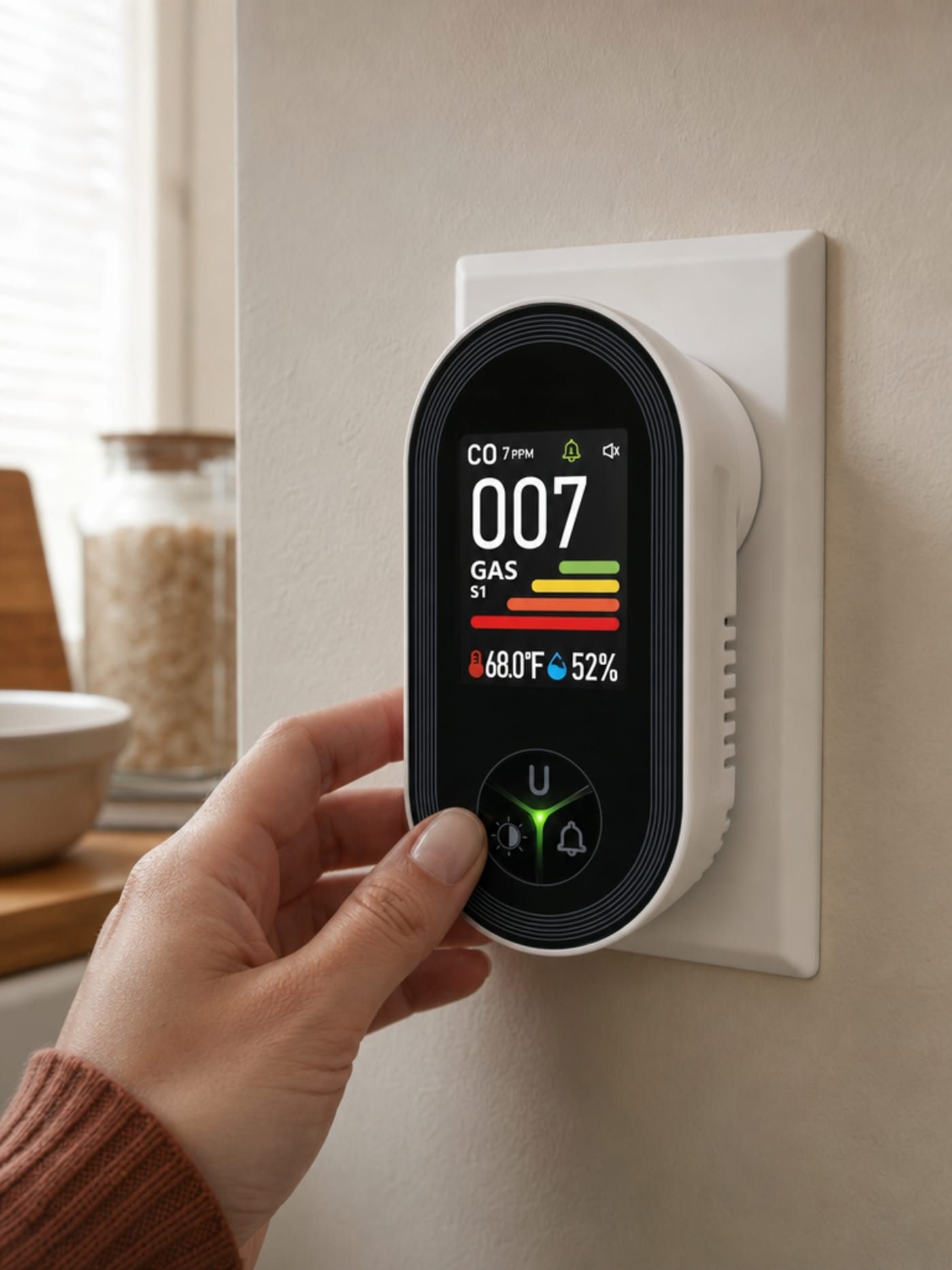
The CO reading on the VIGILOX display runs from 0 to 999 PPM, updated continuously, with a stated accuracy of ±10%. That is a real specification, not a marketing claim — and it is the kind of specification a responsible buyer should ask for and look at before trusting any monitor with this job. The temperature and humidity readings are also live and continuous. The display is a 2.0" color IPS screen, adjustable for brightness, with a night-dimming mode that reduces glare in a dark room without switching off.
There is an objection worth addressing directly, because it comes up in the real-world experience of this product and in the category broadly: does VIGILOX replace a standard certified CO alarm?
The answer is no. It does not, and it does not claim to. VIGILOX is a supplemental monitor — a device that adds a continuously visible reading to a room where a certified UL 2034 CO alarm should already be present. The certified alarm is your primary device. It carries the certification for code compliance. VIGILOX adds something certified alarms typically do not provide: the live number, always visible, between alarm events. Both have a role. Neither replaces the other.
Diane — a woman of 34, dark hair pulled back loosely, wearing a rust-colored cardigan over a black tank top — has both. Her certified alarm is on the ceiling in the hallway, where it has always been. VIGILOX is plugged into the outlet in her kitchen — where she actually spends time, where the stove is, where the reading is relevant to what she is doing in that room. The two devices are not in competition. They are filling different parts of the same job.
The combustible gas detection covers natural gas, propane, methane, and butane. The dual alarm — audible plus flashing visual — is testable via a built-in self-test function, so the user can confirm the alarm tone before they ever need it. The device is plug-in only: no wiring, no batteries, no installation beyond pressing it into an outlet. It runs on wall power continuously, which means it is always on as long as the outlet is live.
What Customers Are Saying
"I had no idea there was anything to look at before this. The number on the screen makes it feel concrete — like I actually know what's happening in the room rather than just hoping everything is fine."
— D.M., Portland OR
"Plugged it in next to the stove and it was up and running in thirty seconds. The display is clear and easy to read from across the kitchen. Practical, does exactly what it says."
— K. Ashworth, Chicago IL
"We use it in our cabin where we have a propane heater. It's good to have a reading to glance at rather than just guessing. Well made for a plug-in device."
— R.T., Bozeman MT
You Cannot See Carbon Monoxide. That Is Not a Problem You Can Simply Decide Not to Have.
The air in your home is doing something, continuously, that your senses cannot report. That has always been true. What has changed is whether you have access to a number that makes the invisible visible.
What VIGILOX provides:
- A live CO reading in PPM — continuously displayed on a 2.0" color IPS screen, updated in real time, readable from across the room
- Combustible gas detection covering natural gas, propane, methane, and butane — with a dual audible and visual alarm
- Live temperature and humidity in the same display — one plug, four readings
- Plug-in operation with no wiring, no batteries, and no installation — always powered from the wall outlet
- A built-in self-test so you can confirm the alarm tone before you ever need it
This is a supplemental monitor, not a replacement for a certified UL 2034 CO alarm. Keep your certified alarm in place. VIGILOX adds the one thing a standard alarm does not give you: the live reading, always visible, in the room where you are.
The invisible killer in your home has always been there, in the sense that the risk has always existed. The difference now is whether you are looking at a number — or simply assuming.
If you want to see how the device works, what it displays, and whether it fits your space, the details are on the next page.