The Number That Could Save You
Carbon monoxide is invisible to every sense you have. Here's what it looks like when you can finally see the reading.
There is a particular kind of worry that doesn't announce itself loudly. It sits somewhere in the background on the nights you're cooking on a gas burner for longer than usual, or the mornings the furnace kicks on hard after a cold night, or the first time you fire up the generator. Nothing looks wrong. The air smells like it always does. The room is exactly the same.
That's the problem.
Carbon monoxide has no color. It has no smell. It has no taste. Your senses — the ones evolution spent millions of years sharpening for exactly this kind of threat — are completely blind to it. The body has no early-warning system for CO. The only physical signal is the poisoning itself.
Standard CO alarms are designed around a threshold. Below a certain concentration, they are silent. That silence is not a reading. It is not confirmation. It is simply the absence of a triggered alarm — which is a very different thing from knowing what is actually in the air. Most people understand this intellectually but live as though the two are the same. The alarm is quiet, therefore everything is fine. The logic is understandable. It is also, quietly, a gap.
That gap is exactly what the VIGILOX live display is built to close. Not by replacing the alarm, but by adding something the alarm was never designed to give you: a number you can actually look at.
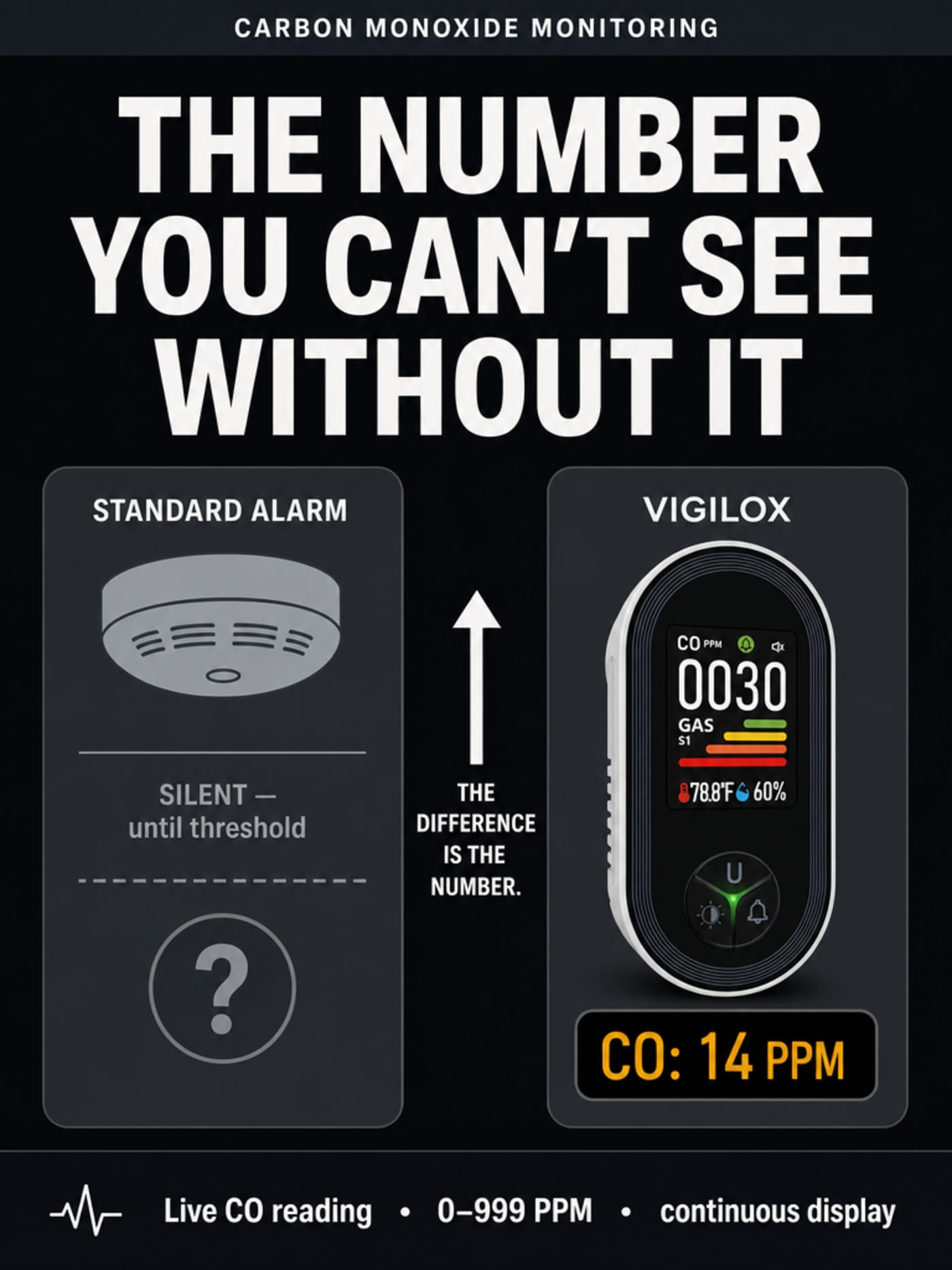
Reason 1 — The alarm's silence is not a reading. It's a gap you've been filling in yourself.
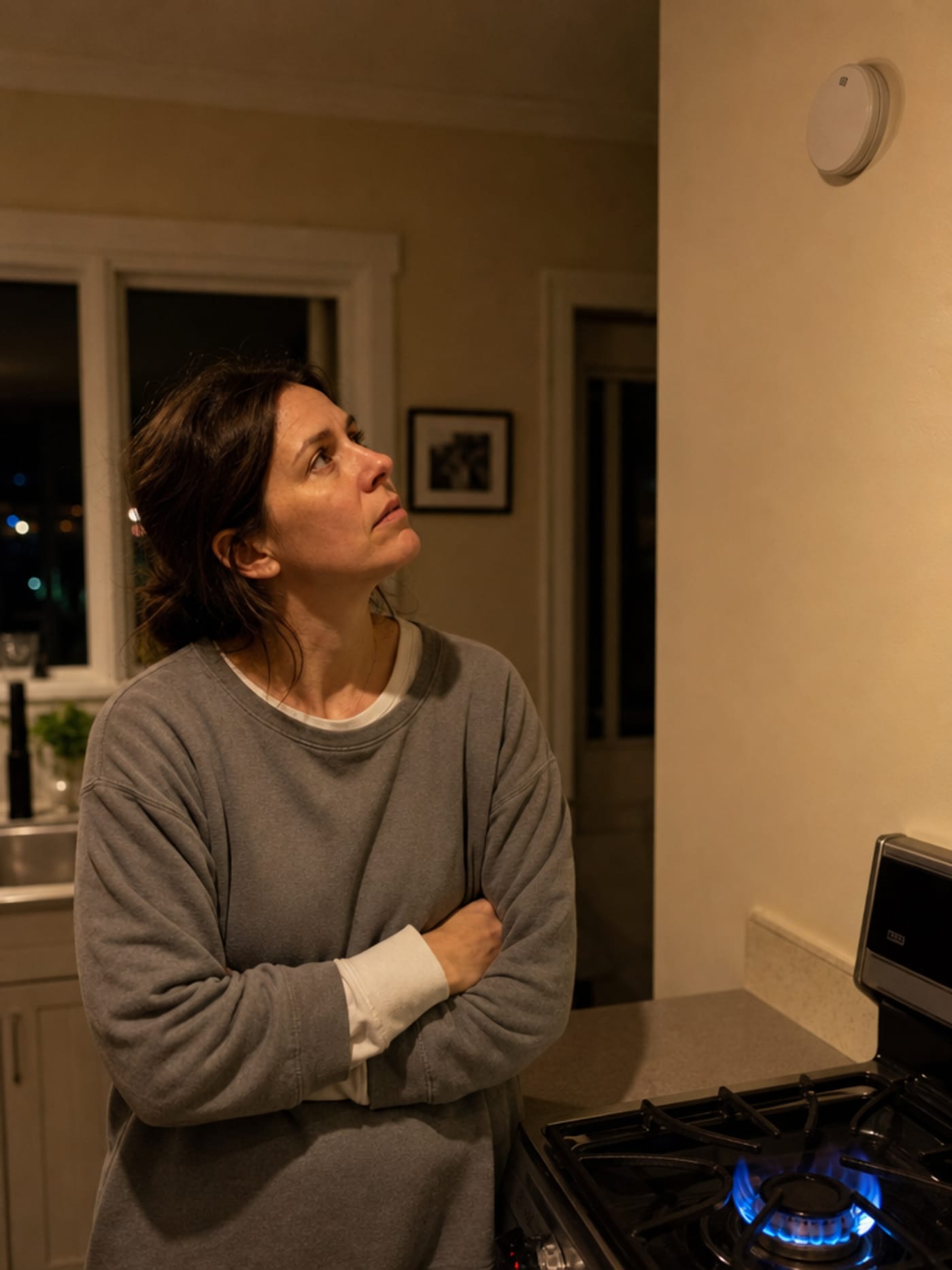
Dana had lived in her house for eleven years before she thought carefully about what the white puck on the ceiling actually did. She knew the alarm would go off if something was seriously wrong. What she had not examined closely was what was happening in the roughly 95% of the time when nothing alarmed.
The answer is: she didn't know. And she had quietly been assuming that not-knowing was the same as knowing it was fine.
It isn't.
Standard CO alarms are threshold devices. Their job is to alert you when a concentration crosses a level that is considered dangerous enough to require an immediate response. They are not designed to display real-time data. They are not designed to give you a number you can read at 7 in the morning before the kids wake up and the stove gets turned on. They are designed to sound when a threshold is reached — and to be silent at every other moment. That silence carries no information about what is actually in the air.
This is not a criticism of certified alarms. It is simply what they are. The gap is real.
What Dana noticed when she first looked at the VIGILOX screen wasn't that the reading was alarming. It was that she had a reading at all. A real number. A visible PPM figure on a bright color display. Something she could check the way you check the thermostat. The uncertainty didn't go away because the number was low. It went away because the number was legible.
That's a different kind of reassurance — and a different kind of alertness. You are no longer waiting passively for a siren. You are looking at data.
"I could see the CO index climbing... I was able to ventilate in time."
Reason 2 — Silence has a cost that's easy to overlook until you think about it directly.

Marcus moved into his apartment eight months ago. The gas water heater is in a utility closet off the hallway. The stove is a four-burner gas range the landlord installed before he arrived. He doesn't know how old either appliance is. He's been told they work fine.
The existing CO detector — a battery-powered unit mounted in the hallway — has gone off exactly once, briefly, and then stopped. He never found out why.
Here's the thing about that: he had two possible explanations. Either the alarm triggered briefly on a genuine reading that then dropped, and his decision to ignore it was a risk. Or the detector malfunctioned, in which case he still doesn't know what's actually in the air of his apartment on any given morning.
The problem isn't the alarm per se. The problem is that a threshold-only device gives you no way to see the space between zero and the threshold. If CO is present at levels below the trigger — either because exposure time hasn't yet accumulated, or because the concentration is genuinely low — you have no visibility into any of it. The device says nothing, and the device's silence is the only information you have.
Marcus now has a second data point. It is not a replacement for his existing alarm. It is something different: a live number on a screen that he can read the same way he reads the temperature on the thermostat. It tells him what the sensor measures. It shows him a PPM figure. It lets him distinguish between a room where the reading is 0 and a room where the reading is climbing through the teens.
That distinction matters in a way that's hard to articulate until you've had it available.
Reason 3 — What visibility actually means: a number on a screen, and why that changes how you think about the room.
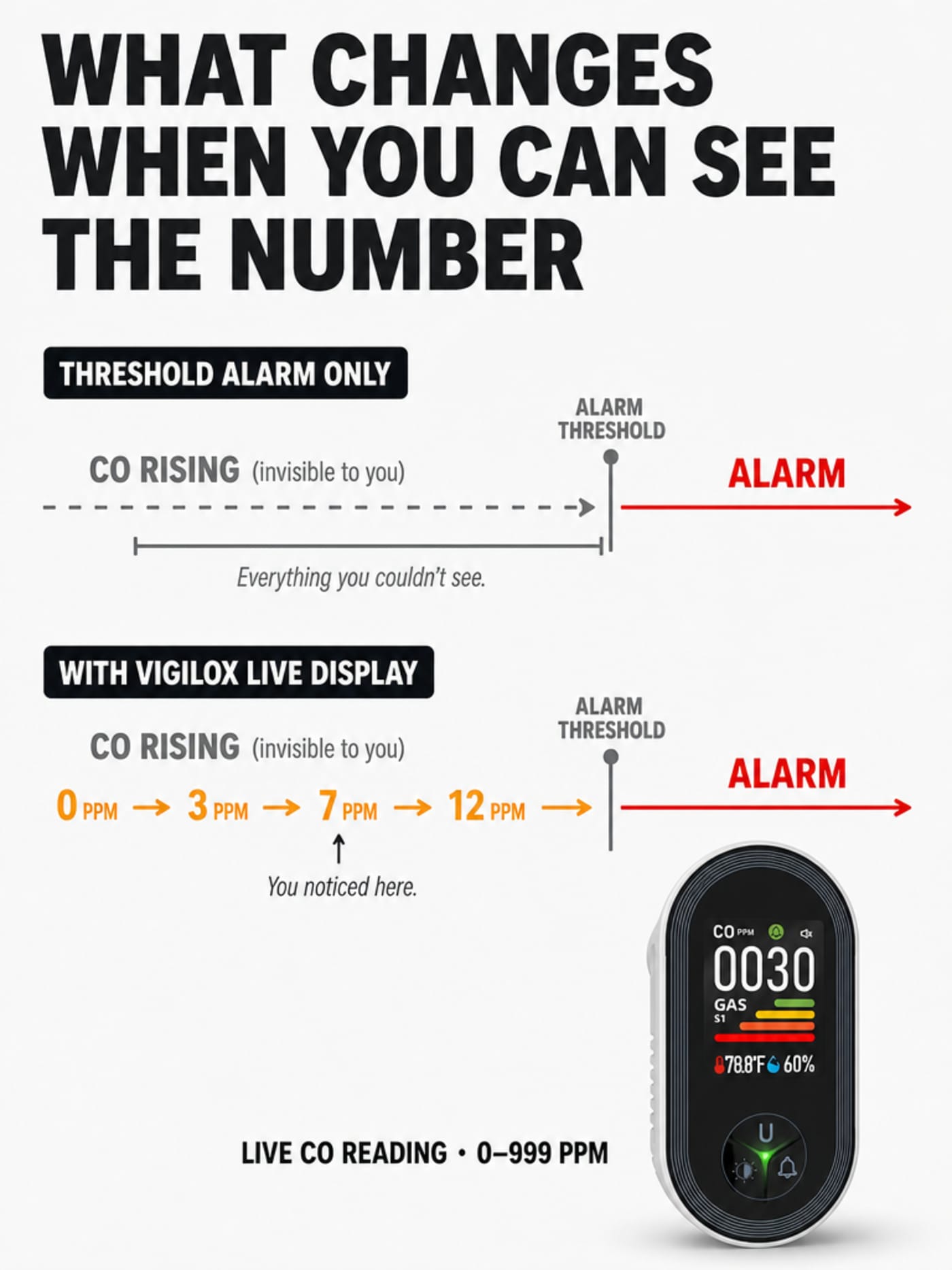
Here is the specific thing VIGILOX does that most devices in its category don't do.
The sensor reads CO concentration continuously. The display shows that reading live — not as a status light, not as an icon, not as silence-until-alarm. As a number. In parts per million. Updated in real time on a bright 2.0-inch color IPS screen you can read from across the room.
The range runs from 0 to 999 PPM, measured to ±10% accuracy. Under normal household conditions with functioning appliances, the reading sits near zero. That's useful information. It means you have confirmed a low reading, not merely assumed the absence of a threshold breach.
When something changes — a burner left on longer than intended, a furnace with a developing issue, a generator running too close to an open window — the number changes first. It doesn't jump to alarm immediately. It moves. From 0 to 3. From 3 to 7. From 7 upward. Those intermediate readings are exactly the information an ordinary threshold alarm has no mechanism to convey.
This is the core of what the device is for. Not to replace the loud alarm — VIGILOX has one of those too, with both an audible alert and a flashing visual indicator, and a self-test function so you can confirm it's working. But to add the layer that the alarm alone was never designed to provide: the visible, continuous, readable number that tells you what is happening in the room before the threshold conversation becomes necessary.
You don't have to interpret silence. You can read the screen.
Want to see how the full display works and what the live readings look like in a real space? The details are on the VIGILOX product page — worth a look before the next time you have a gas appliance running.
Reason 4 — The reading is live because the power never stops.
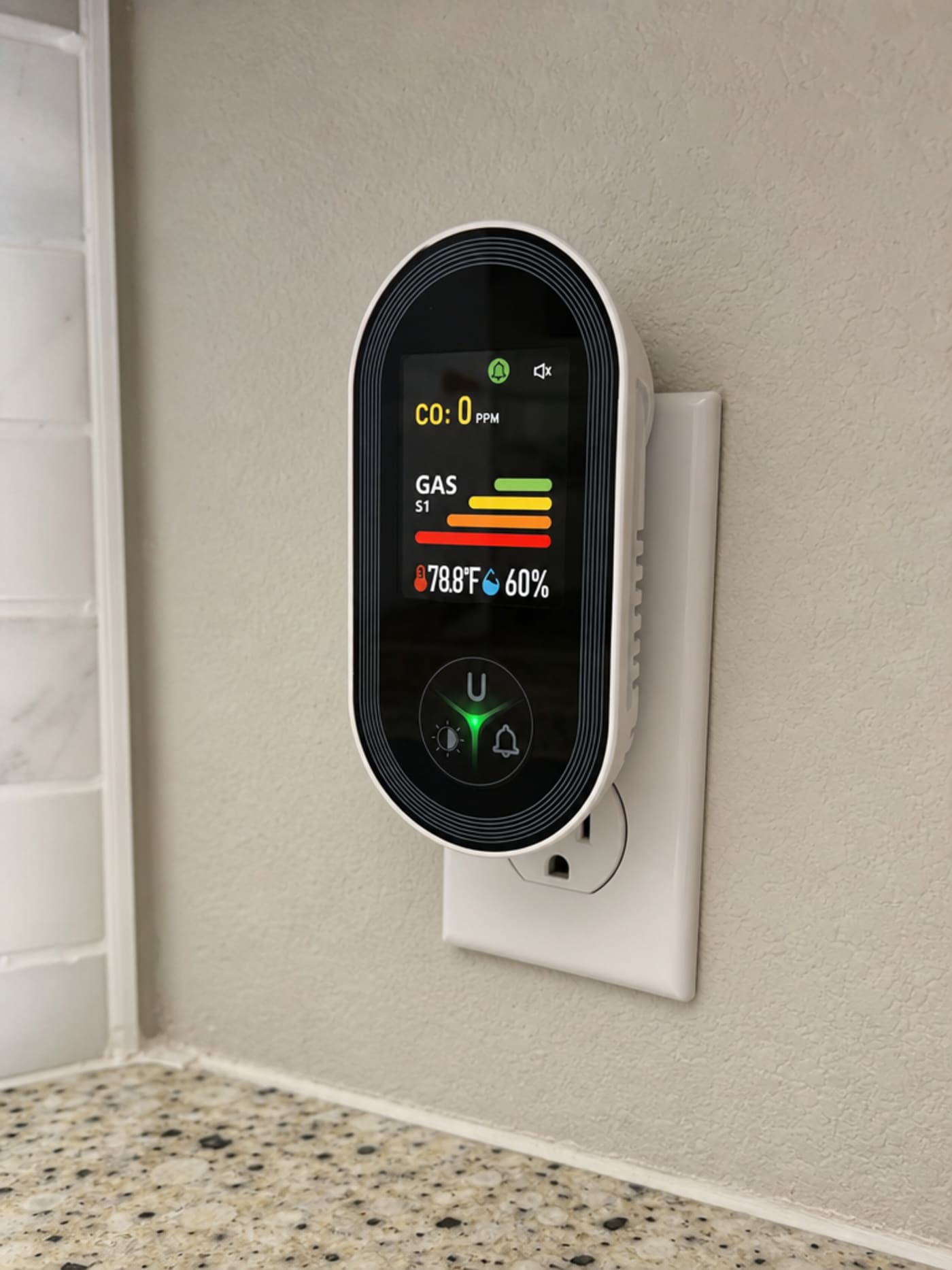
One of the quieter advantages of a plug-in monitor is that it doesn't depend on a battery whose charge you have to track.
Battery-operated alarms are common. They work. But they have a maintenance overhead — the annual battery replacement, the low-battery chirp at 3 AM, the question of whether the battery in the unit you bought two years ago was ever replaced by whoever lived there before you. These are not catastrophic problems. They are friction. And friction is exactly the kind of thing that leads a household to have a CO alarm that is technically present but practically not functioning.
VIGILOX runs directly from a wall outlet. There is no battery to replace. There is no chirp cycle. The device is always powered as long as it is plugged in — which means the display is continuously live, the sensor is continuously sampling, and the reading is continuously updated. You do not have to remember to check the battery. You plug it in and the number is there.
Marcus verified this by simply looking at the screen on his way to the kitchen in the morning. The reading was there. It had been there overnight. It would be there when he came home. No maintenance check required.
The display itself is designed for constant readability — bright enough to read from across a room, with adjustable brightness and an optional night-dimming mode so the glow doesn't become a nuisance in a dark bedroom. The screen can also rotate 180° to accommodate different outlet positions, though it's worth noting the plug prong itself is fixed — so the right outlet placement matters when you're deciding where to put it.
Reason 5 — Every space with a gas appliance is a space where the number matters.
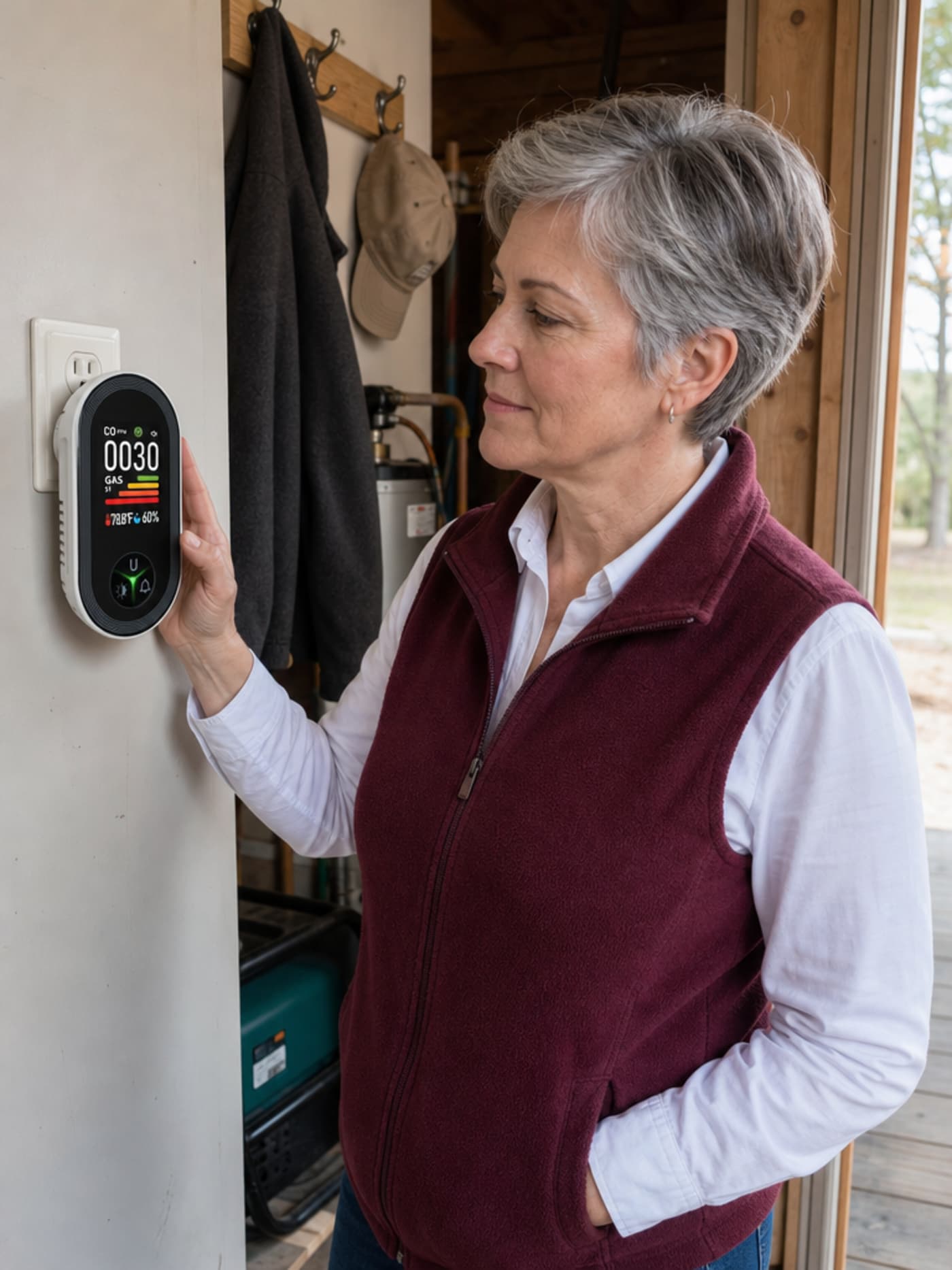
Carol's cabin has a generator. She runs it during outages, which in her area means three or four times a year, sometimes more. She's careful about placement — she knows not to run it indoors. But the garage is attached, the gaps around the door frame aren't perfect, and after a few hours of runtime she has always felt a faint but hard-to-place unease.
The RV community has a version of the same problem. A sealed sleeping space, a propane cooker, a built-in heater — and whatever detector came installed when the vehicle was manufactured. Some of those detectors are old. Some have expired sensors. None of them display a reading.
The plug-in format makes VIGILOX genuinely portable across these spaces. Kitchen. Utility room. Garage with an attached entry. Cabin. RV. Any space where an outlet is available and a gas appliance, furnace, water heater, or generator is in operation nearby. One device shows CO in PPM, combustible gas presence, temperature, and humidity — four readings on one screen, in one outlet, with no installation, no wiring, no setup beyond plugging it in.
Carol plugs it in near the door that connects the cabin to the garage. The reading is on the screen before she's unpacked the car. If the number is where it should be, she has confirmed it, not just assumed it. If it moves, she has time to act — not because VIGILOX is a certified safety device, but because she is looking at a number instead of waiting for silence to tell her something.
That is the specific, honest thing the device does. And in a space where you have had no number at all, it is not a small thing.
What Customers Are Saying
"Finally I can actually see a number instead of just hoping the alarm doesn't go off. Makes the whole thing feel less like guesswork."
Karen T. — Denver, CO
"Plugged it in next to the gas stove and it's been running steadily. The screen is clear and easy to read from the other side of the kitchen."
R.M. — Portland, OR
"Practical and does exactly what it says. I appreciate being able to check an actual reading rather than just waiting for silence to mean everything is fine."
David L. — Atlanta, GA
VIGILOX is a supplemental monitor and is not a replacement for a certified UL 2034 CO alarm. Keep your certified CO alarm in place. This article is editorial in nature and reflects product features as documented. Individual readings may vary based on placement and environmental conditions.