You Wash the Strawberries. You Rinse Them. So Why Are You Still Wondering If They're Actually Clean?
Every parent who's ever hesitated with the knife before the second piece knows exactly what this is about.
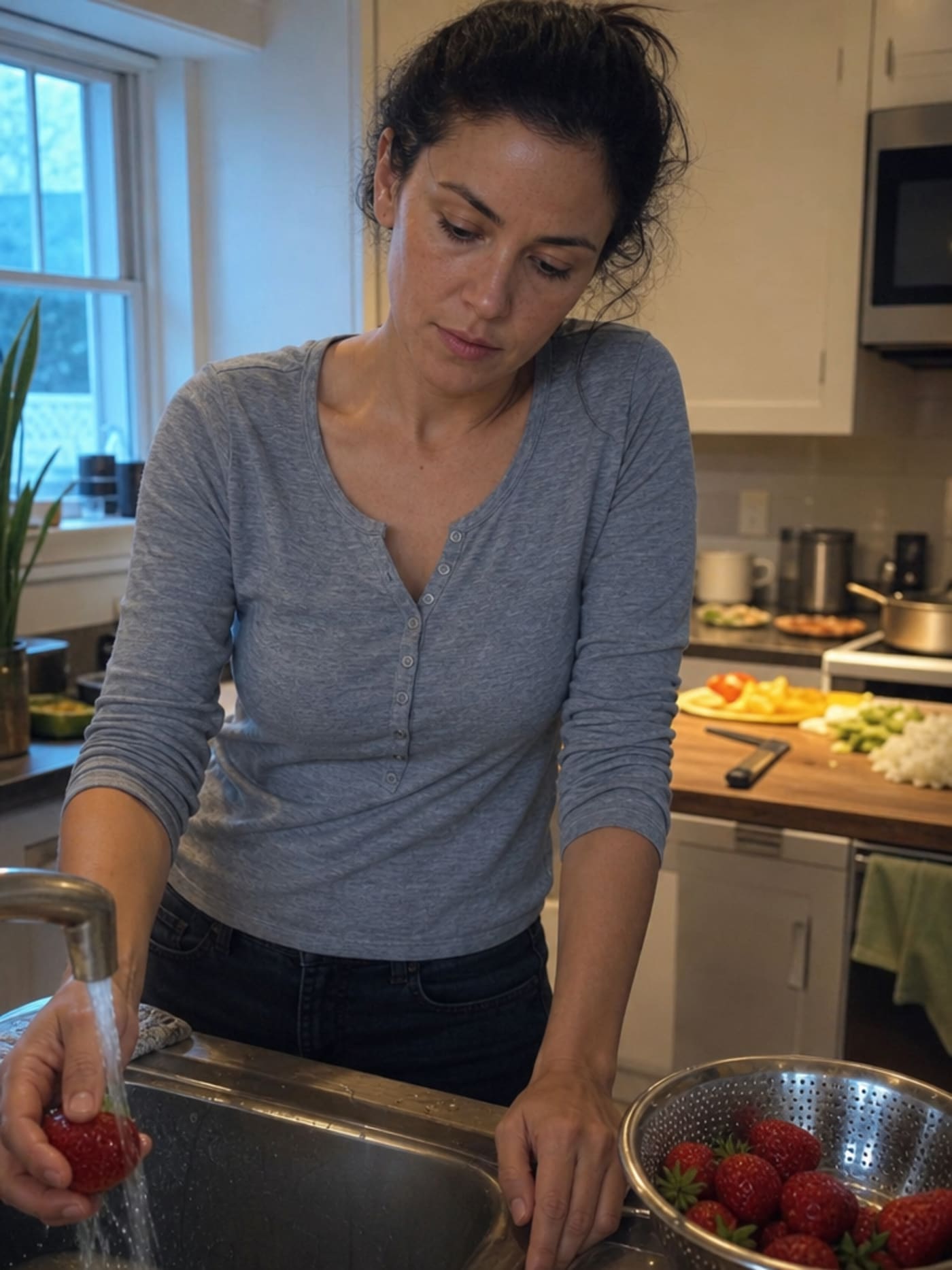
There's a moment — it happens at the sink, usually sometime between unpacking the grocery bags and getting dinner on the table — where you hold a strawberry under the faucet, count to somewhere between two and five, and then turn the water off.
And you know, even as you're doing it, that you don't entirely believe it worked.
It's not a dramatic moment. Nobody panics. You don't say anything out loud. You just carry the fruit to the cutting board and start slicing, and somewhere in the background of your mind there's a small, quiet voice asking the same question it asks every time: Is that actually clean? Not "clean enough." Actually clean — the way a bottle gets clean when you put it through the dishwasher, the way a cutting board gets clean when you scrub it properly. Really, genuinely, done.
Most of us never answer that question. We just learn to live with the shrug that follows it.
Here's the thing nobody says out loud: the shrug isn't about laziness. It isn't about not caring. It's about the fact that there has never been — for most households — a real, repeatable, hands-off routine for washing produce. There is the five-second rinse, which takes no effort and feels like nothing. There is the vinegar soak, which takes real effort and smells like a salad dressing accident. And in between those two options, there is the gap — the gap where the actual peace of mind you want is supposed to live.
For parents preparing fresh fruit for young kids, that gap is louder than it is for anyone else. Because the stakes of the shrug are not abstract. They are right there on the plate.
OZANIA was built for that gap — not as a medical device, not as a pesticide-removal guarantee, but as a physical answer to the question the five-second rinse has never been able to close. A drop-in, walk-away routine that finally makes fresh-fruit prep feel as thorough as washing a bottle. Ten minutes. Water only. A step that fits the actual pace of a weeknight kitchen.
What that actually means — and how it works — starts here.

Reason 1 — The Five-Second Rinse Is Not a Routine. It's a Shrug You've Been Calling a Routine.
There is a physical scene most parents have in common that nobody has ever given a name.
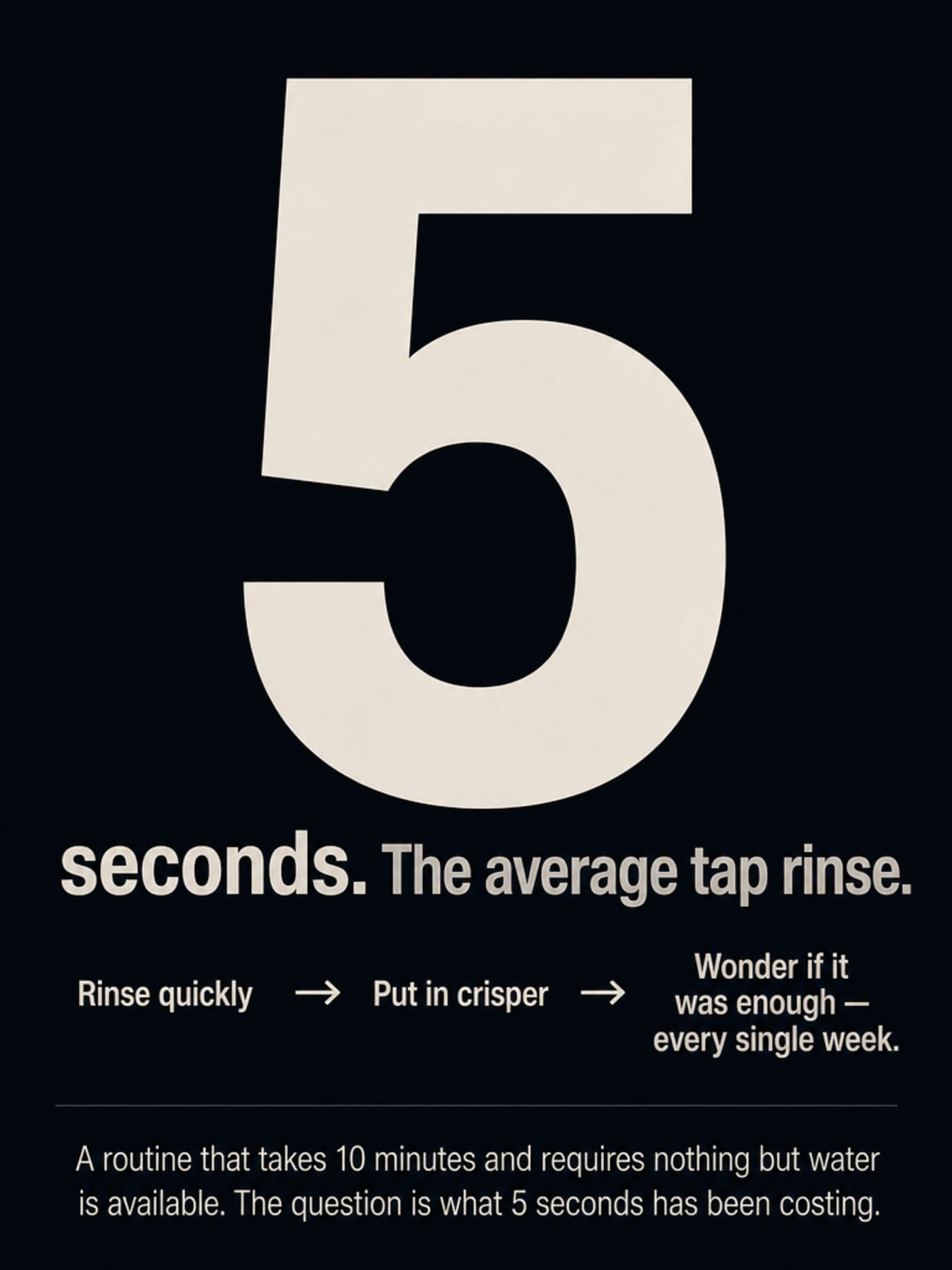
It happens at the kitchen sink, usually on a Tuesday or a Wednesday, usually sometime between unpacking the groceries and the point where someone asks what's for dinner. You open the strawberry container. You run the tap. And for somewhere between two seconds and — on a good day, when you've given yourself the mental permission to slow down — maybe eight or ten, you hold the fruit under the water. Then you turn the tap off and move on.
That's it. That's the whole routine.
And if you've ever paused in the middle of it and asked yourself "Is this actually doing anything?" — you already know the answer you gave yourself, because you had to give yourself an answer, and the answer was: probably fine.
"With things like grapes, strawberries, lettuce, and apples… there's probably still something lingering on them, no matter how long you rinse." — Nora, infoquu.com
That's not an unusual worry. It's a very usual, very quiet, very persistent worry — the kind that lives in the background of produce prep for years without ever fully surfacing, because surfacing it would require an answer, and for most households there wasn't one.
Here's what makes it specifically worse for parents. When you're preparing fruit for a toddler's plate, or slicing apples for a school lunchbox, or washing grapes to go in a bowl that a seven-year-old is about to sit down with — the shrug doesn't stay quiet. It gets louder. Because the question "is this actually clean?" is not an abstract philosophical question at that point. It is a practical, present, right-now question, and you are answering it with a gesture instead of a routine.
The frustrating part is that the shrug is not a sign of bad parenting. It is a sign of a gap in the available tools. Tap water is the universal default, and the five-second rinse is what the available tool supports. You were never doing it wrong. You were just doing the only thing that fit the pace of an actual weeknight kitchen.
Which means the fix is not willpower or attention. It's a different tool — one that fits the pace the rinse never could.
What that tool is doing to the surface of your fruit during those ten minutes, and why it closes the gap the rinse leaves open — that is what the next section covers.
Reason 2 — The Shrug Has an Anatomy. Here's What's Actually Happening in That Moment — and Why "Rinse Longer" Doesn't Fix It.
If the five-second rinse felt insufficient, the obvious fix would seem to be: rinse for longer. Run the tap for twenty seconds instead of five. Thirty, even.
The problem is that this is not really a time problem. It is a surface-contact problem and a pressure problem, and neither of those changes much between five seconds and thirty.
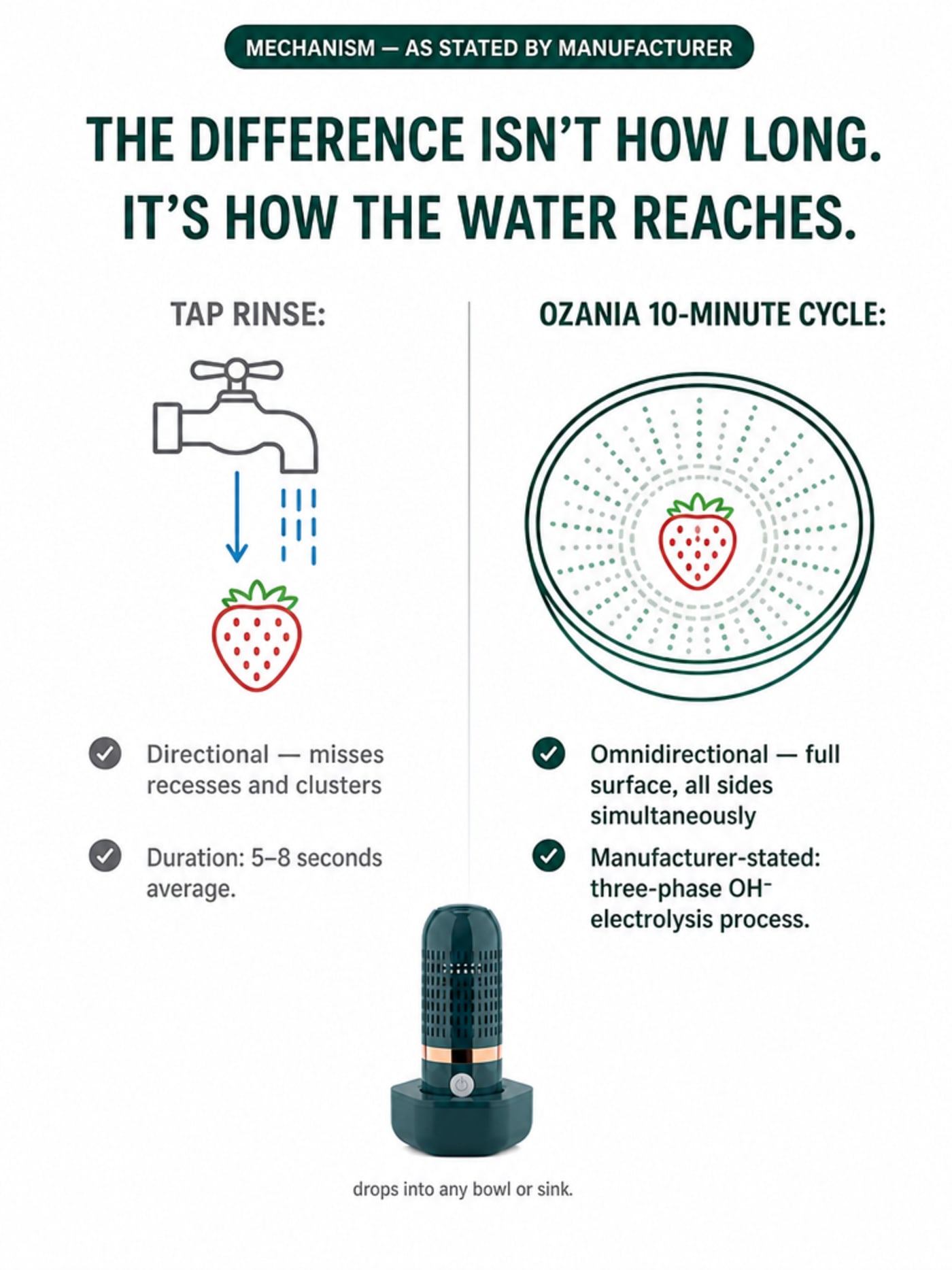
When you hold produce under a tap, what you are doing is running a column of moving water over the surface in a pattern determined entirely by how you're holding the fruit and how the water is hitting it. Some surfaces get rinsed. Recesses, stems, the areas where fruit clusters together (think: the packed-tight top of a strawberry, the clustered skin of grapes) get partial contact at best. The wash is directional — water runs the way gravity tells it to.
What one reviewer described as "actively 'deep cleaning' produce" rather than "quickly rinsing it under a faucet" is actually a structural distinction, not a subjective one. The difference is not how long the water runs. The difference is whether the cleaning action reaches the whole surface — including the crevices, the undersides, the packed clusters — in a way that a directional stream from a tap cannot physically do.
This is where OZANIA's manufacturer-stated mechanism enters. According to the manufacturer, the device uses double-layer electrolysis to generate OH⁻ (hydroxide) ions in the water surrounding the produce — a three-phase process designed to break down surface residues during the ten-minute cycle. The produce sits submerged in the ionic solution, all sides, all recesses, all clusters, simultaneously — not a directional stream but an omnidirectional soak in actively working water. The mechanism is stated by the manufacturer and described here as such; the point is not an efficacy percentage. The point is the structural difference between a moving-water stream and a ten-minute submerged agitated soak.
One more thing worth saying plainly, because you may have already seen the category's marketing, or the comments underneath it: the color change in the water during or after a cycle is partly the product of electrode chemistry — the device's electrolysis process itself contributes to what you see. Any claim that the water color represents a specific quantity of contaminants removed from your food is not a claim we are making. What the cycle delivers is the routine — the ten-minute, hands-off, full-surface ionic wash — not a water-color reveal.
The routine is the value. And the routine fits in the pace of a real dinner prep in a way that "rinse longer" never could.
What the shrug is actually costing you — not as a health claim, but as a simple daily math — is what comes next.
Reason 3 — What the Shrug Costs by Thursday
Here is a version of this that does not involve a single health claim, because it does not need to.
You buy a carton of strawberries on Saturday. They go in the crisper. By Wednesday, some of them are starting. By Thursday, you're making a judgment call on each one individually — this one, okay; that one, toss. By Friday, whatever's left goes in the bin. You paid $5.99 for the carton. You ate maybe sixty percent of it.
This is not a freshness lecture. This is just the produce math that happens in most refrigerators, and the part of it that matters here is the connection between how produce is handled during prep — whether it is rinsed once and put away, or whether it goes through a water-only agitated cycle that removes surface residues before storage — and how it behaves in the days after.
"I bought 2 green apples. They have been in my refrigerator crisper for 5 weeks. They have never changed, shrunk, shown signs of age. What does that tell you!" — Ann, commenter at infoquu.com
That's not a clinical finding. It's a real person making a real observation about the surface chemistry of commercially grown fruit — the waxes and coatings applied to slow visible aging during transportation and shelf time, the same coatings that come off in that ten-minute agitated soak. We are not claiming OZANIA extends produce life by a specific multiplier. We are noting that a surface that has been thoroughly worked on, not just rinsed, may behave differently in storage. Anecdotally. As one data point.
The more immediate cost is simpler: the ongoing weekly decision to buy the berries, rinse them for five seconds, and hope for the best — versus having a step in the routine that finally closes the question before the fruit goes in the crisper.
The five-second rinse is not just a small feeling problem. Compounded over every produce purchase, across every week of a year, it is a low-grade, recurring, completely unresolved gap in the kitchen routine — and it lives in the drawer next to all the other small things that have never quite had a solution. Until there was a physical tool that fit.
What happens when you compare that old routine to a new one — side by side, step by step — is where this lands.
Reason 4 — The Vinegar Shelf, the Baking Soda Box, and the Question They Still Haven't Answered
A lot of households already have a produce-washing ritual. It just isn't the one that fits the pace of a real kitchen.
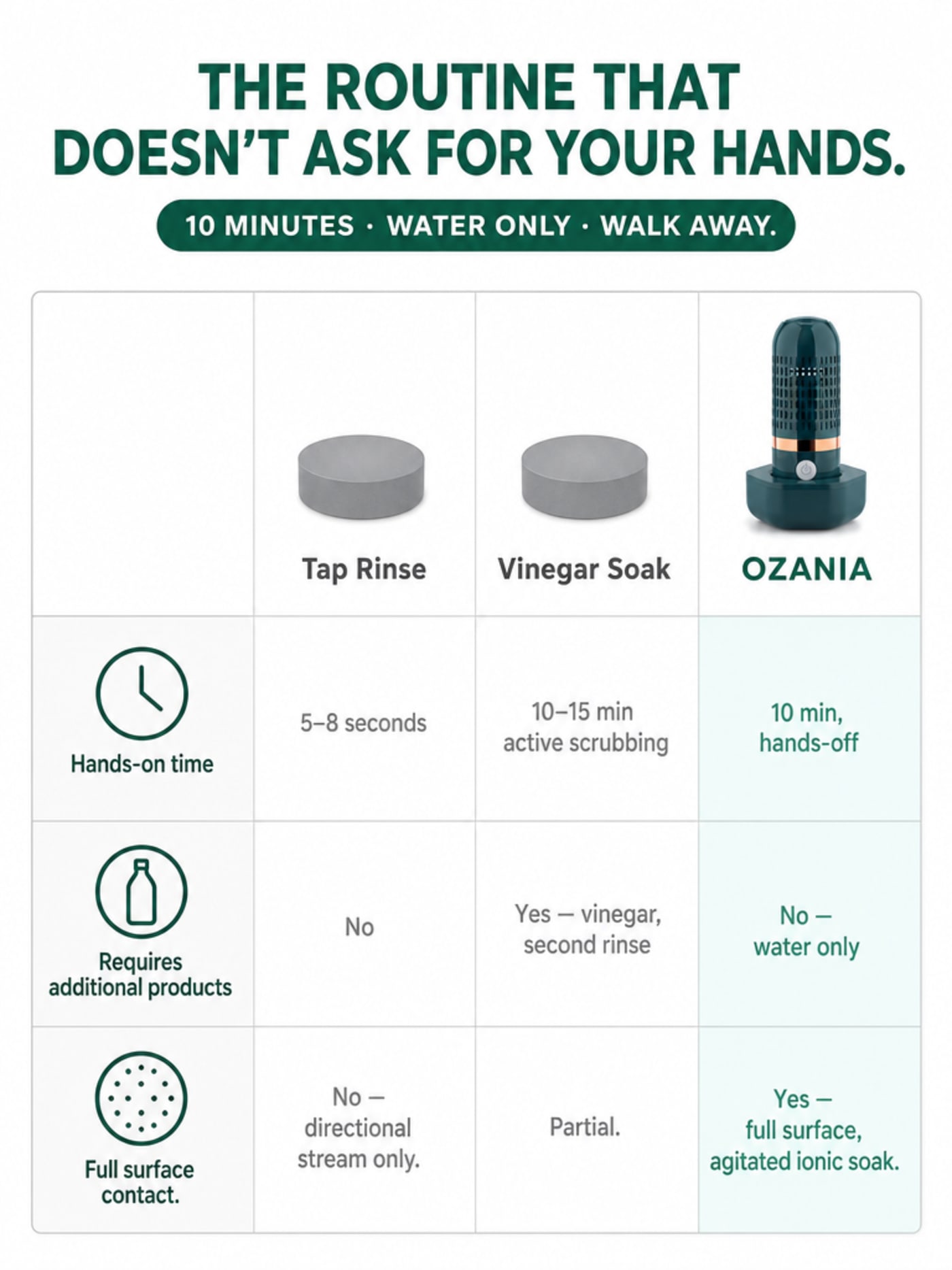
The vinegar soak is the most common version. You fill a bowl, add vinegar, submerge the fruit, wait — sometimes a few minutes, sometimes longer — then rinse everything again because the fruit now smells like dressing. Then dry. Then put away. If you are washing grapes, you are washing them more or less individually, which is how one reviewer ended up describing herself as "aggressively scrubbing every single grape individually like a stressed-out raccoon." That is not a caricature. That is what the vinegar routine actually feels like at 9pm with the dinner dishes still on the counter.
The baking soda scrub is the version that has the most academic backing — a UMass Amherst study found it effective on certain surface pesticides when applied for twelve to fifteen minutes with gentle rubbing. Twelve to fifteen minutes of rubbing. Per item. Per wash. Ask the last person you know who did this consistently on a Tuesday night.
Commercial produce sprays occupy the ironic middle: people trying to escape unknown surface coatings by spraying a different product with its own ingredients list onto their food, then rinsing it off, then wondering why it feels exactly like the rinse they were trying to improve on.
Every one of these methods is a manual operation. Every one requires your hands to be in it — measuring, pouring, scrubbing, spraying, rinsing again. Every one adds a step that competes with every other step already in the dinner-prep queue. And none of them, for most households, has stuck as a real routine — because the effort-to-outcome ratio never quite justified making them habitual.
OZANIA's structural offer is not that it removes more than vinegar (we're not making that claim and there is no independent study that would support it). Its structural offer is that it removes the labor entirely. You fill the bowl with water. You drop the device in. You add the fruit. You walk away. Ten minutes later, you come back to fruit that has been through a full-surface agitated ionic cycle — hands-off, no vinegar smell, no scrubbing, no second rinse required. The routine fits a weeknight because it does not ask for your time or your hands while it runs.
One Amazon buyer who tried a competing produce device wrote that she "went back to just using vinegar and water" — not because the device was less effective, but because it never earned enough trust to displace the familiar. The trust gap in this category is real. It is why the 30-day money-back guarantee matters — not as a fine-print footnote, but as a structural answer to the question: "but will I actually use it?" The guarantee gives you the test window the vinegar soak never offered.
Reason 5 — What the Sink Looks Like When the Question Is Finally Closed
Maya — a woman of 34, dark hair pulled back, wearing a grey henley over dark wash jeans — drops OZANIA into the glass bowl. Adds the strawberries. Turns away.
That's the whole move. The cycle runs. The blue LED goes on. The agitation begins. And she is already somewhere else in the kitchen — loading the dishwasher, talking to a kid about their day, getting the pasta going — while the produce does the part that she used to stand at the sink pretending to do with a running tap.
Ten minutes later, she comes back. The cycle is done. The fruit is ready. There is no second rinse, no smell, nothing to pour out except the water. She lifts the bowl, tips it, puts the fruit on the cutting board.
And this time — this is the part that is harder to describe until you've experienced it — she does not do the shrug. There is no small internal "good enough" to manage. No background voice asking the same question it asks every time. She sliced the strawberries, she put them on the plate, and she moved on. Not because she told herself it was fine. Because she had a routine that closed the question.
The reviewer who tried a produce purifier described the actual, honest value it delivered as "feeling better about my produce-cleaning routine overall." Not a health transformation. Not a medical result. A routine that finally felt real — the way washing a cutting board feels real, the way running a bottle through the dishwasher feels real. The kind of thoroughness that is about the ritual as much as the outcome.
That feeling is not incidental to what OZANIA does. That feeling is what OZANIA does. The device is a physical answer to a psychological gap — the gap the five-second rinse has always left open and never been able to close. "Seeing the blue light and the bubbles going is really satisfying" — that is a real buyer's words, and it is not describing a feature. It is describing what it feels like when a routine finally fits.
The ten minutes run while you are doing something else. The question gets answered. Dinner goes on the table. That is the full arc. The next step is deciding whether the shrug is still worth keeping.

→ If you've read this far, you already know what the gap costs — and you've seen a routine that closes it. Here's how to see the full details:
What Customers Are Saying
"I've tried the vinegar soak and produce sprays before, and neither one ever stuck as a real habit. With OZANIA I just drop it in and walk away — it's the first time washing fruit has actually felt like a proper step instead of an afterthought."
Rachel M., Austin TX
"Simple to set up, easy to use, and no extra products to buy. I charge it once a week and it's always ready. The blue light and the sound of it running is weirdly satisfying — I feel like I've actually done something before putting fruit on my kids' plates."
J. Kowalski, Chicago IL
"Honestly I was skeptical, but the 30-day guarantee made it easy to try. It fits right into my Sunday prep routine. The quality feels solid and it does exactly what it says — no fuss, no smell, no scrubbing."
Diana P., Portland OR
Every Morning You Rinse the Fruit and Put the Shrug Away. What You Can't Put Away Is the Question Underneath It.
It started at the sink — the five-second rinse that never quite felt like enough, the quiet hesitation before you put the strawberry on your kid's plate, the small recurring decision to call "good enough" good enough because there was nothing better available.
There is something better available now. A ten-minute, water-only, drop-in routine that runs while you do everything else, and comes back with produce that has been through a full-surface agitated ionic cycle — not a tap stream, not a vinegar soak, not a gesture. A routine.
Here is what keeping the shrug costs, from tomorrow morning onward:
- The hesitation before every plate you serve your kids — the small doubt that lives in the moment between the rinse and the knife, that never quite goes away, and never adds anything except friction to a meal you already worked to make.
- The vinegar smell, the one-grape-at-a-time scrubbing, the second rinse, the drying — the labor that was supposed to be the solution and became its own problem.
- The background voice that asks, every single produce prep, whether this time was enough — when the answer was never going to come from running the tap longer.
- The ten minutes per wash that the current routine takes from your hands — while OZANIA runs hands-off and you are somewhere else in the kitchen, doing the next thing.
- The produce sitting in the crisper that got rinsed for five seconds and may or may not be doing what a thorough wash would have allowed — a question the routine answers and the rinse never did.
You have seen the mechanism. You have seen why the tap rinse is structural — not a failure of effort, but a failure of contact. You have seen what the routine looks like when it fits. The only version of this that costs nothing is the one where you close this tab and go back to the shrug.
The routine is waiting. See how it actually works.