The One Thing to Buy Before Your Rotator Cuff Surgery — a Wrap You Can Strap On Yourself, Day One
For anyone with a shoulder surgery already on the calendar: how to walk into recovery prepared instead of scrambling to ice a shoulder you can barely reach, with an arm you can't fully use.
The moment you get a surgery date, something changes. You stop being a person with a sore shoulder and start being a person on a countdown — and countdowns make you want a list. Pre-op instructions usually cover the big things: what to eat, when to stop taking certain meds, what to bring to the hospital. What they rarely spell out is the small, practical problem that shows up the second you're home: how exactly are you supposed to ice a shoulder when one arm is out of commission?
That's the part people find out the hard way. You sit down, reach for the ice pack, and realize you need your other arm to hold it there — pressed against the surgery site, at the right angle, for twenty minutes, without moving. Ten minutes in, that "good" arm is numb and shaking. The pack has slid an inch lower than where it needs to be. You call for help, or you just give up and let it slide.
It's a strange thing to discover after the fact: the surgery was planned for weeks, but the icing — arguably the most repeated task of the first days home — wasn't. It's why, in the reviews left by people who've actually been through a shoulder repair, the same instruction keeps surfacing, almost word for word: buy the strap-on wrap before surgery, not after. Not because it's dramatic, but because by the time you need it, you won't have a free hand to go looking for it.
But this isn't only a shoulder problem, and it isn't only a pre-surgery problem — it's a category-wide gap that shows up no matter which joint you're treating, or when. Whether you're bracing for a surgery date or already deep into a recovery, almost everyone runs into the exact same wall: the ice pack in the drawer was never actually built to hold cold long enough, or hold itself in place, for the job you need it to do.

Reason 1 — The Cold That Quits Before the Pain Does

Linda didn't think much about ice packs until she needed one constantly. After her knee replacement, she assumed any pack from the pharmacy would do the job — cold is cold, right? What she found instead was a pattern repeated so often in the reviews of nearly every cheap wrap on the market that it's practically the category's signature complaint: "maybe 10 minutes, then it starts getting warmer." One reviewer put a number on it that's almost funny if it weren't so frustrating — "4 or 5 minutes of cooling max. Total waste of money."
The other side of that same coin is just as common: the pack that's too effective in the wrong way. Straight out of the freezer it's not a wrap anymore, it's a plank — "freezes very hard, not pliable," as one reviewer put it — a shape that won't bend around a knee or a shoulder, so half the cold never actually reaches the joint at all.
Here's the misunderstanding almost everyone is working from: that all gel packs are functionally the same object in different packaging, and duration is just a matter of luck. It isn't. Duration and flexibility are both direct results of what's inside the pack and how much of it there is. A thin layer of gel has almost no thermal mass — it can't hold cold because there isn't much "cold" stored in it to begin with. That's the mechanism behind the ten-minute complaint, not bad luck.
Frostane's core is a water-absorbing polymer resin — it ships dry, soaks up water in seconds, and freezes into something with real mass to hold onto, which is also what lets it stay flexible instead of turning into a board. It's held in place by a compartment/grid structure, so the cold (or the heat, if you microwave it instead) distributes evenly across the wrap rather than pooling in one spot and running out fast everywhere else. Once you see why a thin gel pack quits early, "10 minutes" stops feeling like an unlucky roll of the dice and starts feeling like exactly what you'd expect from that amount of material.
There's a second, quieter comparison running underneath all of this. On the other end of the market from the $1 gel pack sits the clinical option — a Game Ready or Cryo-Cuff-style cold therapy machine, the kind hospitals send patients home renting for around $280 a month, or buying outright for $1,000–$1,500. Effective, yes — nobody disputes that consistent, machine-driven cold works. But it's also a specific kind of overkill for someone who needs a few weeks of reliable icing, not a piece of durable medical equipment permanently parked in the living room. The honest middle ground — cold that actually lasts through a treatment, without a four-figure price tag attached to it — is the space Frostane is built to occupy.
Reason 2 — Hands-Free Relief While You Keep Living

Somewhere between "the pack is cold" and "the pack is actually helping" sits a problem nobody mentions until they're living it: you have to hold it there. For most injuries, that's an inconvenience. For a shoulder, it's a genuine mechanical problem — because the arm you'd normally use to hold a pack against your shoulder is often the same arm attached to the shoulder that's hurt, or the only working arm you have left while the other one recovers.
The reviews from people using a comparable wrap on their shoulders describe this almost identically to how Mark would describe his own evenings: "no more balancing act... no longer do I need to sit perfectly still or use my other arm to hold a loose pack in place." Another reviewer, describing the exact scenario Mark is dreading, wrote that it was "simple and easy to put on by yourself, in case you don't have anyone to help." That line matters more than it might look — it's not describing convenience, it's describing independence during a period when a lot of independence has already been taken away.
The misunderstanding worth clearing up here: "hands-free" sounds like a comfort feature, something nice-to-have. On a shoulder recovering from surgery, it's closer to a requirement — the difference between icing correctly on your own schedule and not icing at all because nobody's around to hold the pack in place. Frostane's answer isn't complicated: two adjustable straps, designed to be fastened one-handed, on either shoulder or around a knee, so the wrap holds its own position while you sit, walk to the kitchen, or just let your other arm rest for once.
That same hands-free design pays off differently for Linda. She isn't managing a compromised arm — she's managing a life that doesn't pause for a twenty-minute ice session. Reviewers describing the same design on a knee mention icing "while I walk the dog" or moving through light tasks around the house with the wrap staying exactly where they put it. Once a wrap can survive actual movement instead of only working while you sit perfectly still, icing stops being an appointment you have to schedule and becomes something that just happens alongside the rest of your day.
If you're curious about exactly how a wrap manages to hold both real cold and stay strapped on with one working hand, it's worth a quick look at how the whole thing is actually built — the core material, the strap design, and what comes in the box.
Reason 3 — One Wrap for the Whole Comeback

For Linda, the hardest part of recovery wasn't the pain itself — it was the logistics of managing it. "My swelling was SO BAD and lasted for SO LONG," one recovering knee patient wrote in a forum for joint-replacement patients, "I lived in that thing and I don't know what I would have done without it." Another patient described the workaround she eventually settled into: six gel packs in rotation, "2 in use, 2 already frozen, 2 re-freezing" — a system that works, technically, but turns every day of recovery into a small logistics project. Her sister's summary of the whole ordeal was blunter: "it ran me ragged."
The quiet assumption behind that six-pack shuffle is that reliable cold during recovery has to be either inconvenient (rotate packs constantly) or expensive (rent or buy a machine). Neither is actually true — it's just what the available options force you into. A machine gives you consistent cold but costs four figures and needs constant water refills; a cheap gel pack costs nothing but quits in minutes, so you compensate by buying six of them and running a rotation like a part-time job.
Frostane's dual hot-and-cold function is built specifically for the shape of a real recovery, not a single ice session: freeze it for the early days when swelling is the priority, then microwave it (about a minute per side) for the weeks after, when stiffness takes over from swelling. One wrap, the same price range, covering both phases most people actually go through — instead of a machine bill on one end or a freezer full of rotating packs on the other.
It's worth being precise here about what this is and isn't: Frostane offers comforting hot and cold therapy that can ease swelling-related discomfort and soothe soreness during recovery days — always used alongside your surgeon's or physical therapist's specific icing instructions, not in place of them. It doesn't treat, cure, or speed the healing of anything, and no honest product in this category claims otherwise. What it does is remove the logistics problem, so the actual recovery gets a little more room to happen on its own timeline.
Reason 4 — The One Thing to Buy Before Your Surgery
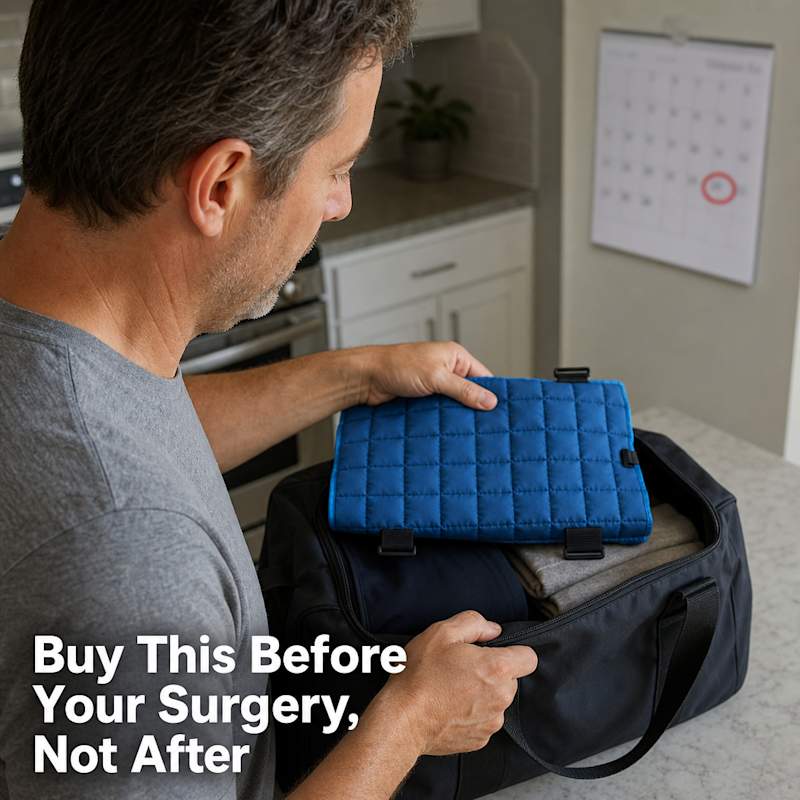
There's a specific kind of shopping people do in the weeks before a scheduled surgery — not browsing, exactly, but preparing. A short list of things they're told, or have figured out, they'll need on day one. For shoulder surgery in particular, that list keeps circling back to one item that isn't always on the official discharge instructions: something to ice the shoulder with, that doesn't require a working second arm to use.
This is where the pattern in the reviews becomes almost instructional. "Buy this BEFORE surgery," one reviewer wrote, in capital letters, adding that they "would not consider undergoing shoulder surgery without having this prior to surgery." Others describe it in more practical terms — "I purchased this to use after rotator cuff surgery, it fits well and is quality made," or simply, "ice therapy is essential for my recovery." A few describe buying it for someone else entirely: a spouse before a shoulder replacement, a sister, a son who pitches and strains his shoulder after games. The pattern across all of it is the same — people preparing ahead of a known date, not scrambling after the fact.
The misunderstanding this corrects is a subtle one: most pre-surgery checklists focus on what happens in the hospital, not what happens the moment you're back on your own couch, alone, with one arm that doesn't work yet. Frostane's design — two straps built for one-handed fastening, a wrap shaped to sit against a shoulder without needing a second hand to hold it there — answers the part of recovery that starts the second the hospital instructions end.
To be direct about the limits of that claim: Frostane provides comforting cold therapy at the surgery site and gentle heat for stiffness in the weeks that follow, used alongside — never instead of — whatever your surgeon or physical therapist has actually prescribed. It doesn't reduce complications, prevent clots, or make anyone heal faster; no wrap does, and no honest one will tell you otherwise. What it does is remove one very specific, very real obstacle from the first difficult days: not having a free hand to hold the thing that's supposed to be helping you.
What Customers Are Saying
"I bought this two weeks before my rotator cuff surgery and I'm glad I did — day one home, I could actually strap it on myself."
Robert T., Columbus
"No more asking my husband to hold an ice pack in place. It stays put while I just sit and rest."
Denise M., Austin
"Simple to put on with one hand, which is exactly what I needed after surgery. Feels well made too."
Carla P., Denver
Before You Check Anything Else Off Your Pre-Surgery List
- Cheap ice packs go warm in minutes — Frostane's water-absorbing polymer core is built to hold usable cold long enough to finish a treatment.
- Frozen-solid packs won't bend around a joint — Frostane freezes flexible, not into a plank.
- Holding a pack in place costs you a working arm — two adjustable straps fasten one-handed and hold the wrap still while you move.
- A cold-therapy machine can run $280/month to rent or $1,000+ to own — Frostane covers the same real need at a fraction of the cost.
- One wrap handles both phases of recovery — freeze it for swelling, microwave it (~1 min per side) for stiffness later.
Frostane ships dry and soaks up water in seconds — you'll see the difference the first time you use it. It comes with two adjustable straps and an instruction manual, backed by a 90-day money-back guarantee that comfortably outlasts a typical recovery window, with free shipping and delivery in 3–4 days. If you have a surgery date circled on the calendar, this is the kind of thing worth having ready before, not after.