The Knee Recovery Wrap You'll Basically Live In — Without Renting a $1,000 Ice Machine
For anyone facing a knee surgery, a fresh injury, or a recovery that's already dragging on longer than they expected — relief you control yourself, at home, without a rental invoice attached to it.
Diane didn't expect the hardest part of her knee replacement to be the freezer.
Three weeks in, the surgery itself was behind her. What wasn't behind her was the swelling — the kind that doesn't spike and fade in a day but settles in and stays, low and constant, for weeks. Her husband had taken to keeping a rotation going: one gel pack on her knee, one already thawing on the counter, two more hardening in the freezer for their turn. "It ran me ragged," she said — and she wasn't the one recovering.
Before surgery, someone at the clinic had mentioned a cold-therapy machine — the kind hospitals use, the kind you can rent for the weeks you need it most. She looked it up. $280 a month. Or close to $1,000 to buy one outright. For a recovery that was supposed to last six to eight weeks, that math didn't work, and she said so. So she did what most people do: she went home with a stack of pharmacy gel packs and a plan to make it work.
It didn't, not really. The packs that had been cold enough in the store went lukewarm in ten or fifteen minutes on her knee. The ones that stayed in the freezer too long came out rigid — a flat, unbending slab that wouldn't wrap around a joint, no matter how she angled it. She was choosing, every few hours, between a pack that had already quit working and a pack too hard to use at all. That's not a small annoyance when you're three weeks into a recovery and every hour of swelling is an hour you feel in your range of motion the next week.
Here's the part almost nobody explains before you're the one living it: this isn't really a "which ice pack" problem. It's a gap in the whole category — between the $1 pack that can't hold cold and the $1,000 machine that holds it but costs a small fortune and a lot of hassle to run. Almost everyone recovering at home ends up stuck somewhere in that gap, improvising with a rotation of packs because nothing in between exists. That gap is exactly where the rest of this is going.

The cold that's supposed to help you is usually gone before it does
If you've been icing anything — a knee, a shoulder, a back — for more than a week, you already know the real complaint isn't about pain. It's about time. The pack goes on cold enough to matter, and then somewhere around the ten-minute mark, it just... stops. It's still sitting there, still technically "an ice pack," but it's not doing the job anymore. You either keep going with something that's barely working, or you get up, unwrap it, and go trade it for another one from the freezer — assuming you have another one ready.
The other option people quietly discover is worse in a different way. The clinical-grade cold therapy machines — the ones hospitals send patients home with a rental agreement for — genuinely do hold their temperature. They also cost $280 a month to rent, or somewhere north of $1,000 to buy outright, and they come with their own hassle: a reservoir you refill, a pump that runs, tubing to manage. People try them, and a fair number quietly go back to gel packs within a week or two — not because the machine didn't work, but because keeping it running became its own chore. One recovering knee patient described it exactly this way: she and her family "went through them faster than my freezer could freeze them" — and that was with the machine running.
So the honest state of the category is this: a $1 pack that quits in minutes, or a $1,000 machine that works but runs you ragged and costs a fortune. Almost nobody talks about that gap directly, which is why so many people end up rotating five or six cheap packs through their freezer just to fake the effect of one pack that actually holds.
What most people misunderstand here is that the failure isn't really about "cold" at all — it's about volume. A thin layer of gel simply doesn't have the mass to absorb heat from your skin for very long; it warms up fast because there's not much cold in it to begin with. That's also why the same thin packs freeze into an unbendable board — there's just enough material to go rigid, not enough to stay pliable. Frostane's core is a water-absorbing polymer that ships dry and soaks up water in seconds — which means you control how much cold mass goes into it, and the compartment/grid structure inside is built specifically so that mass stays evenly distributed and flexible instead of freezing into one solid brick. It bends around a knee, a shoulder, a hip, straight out of the freezer, because the grid keeps it in flexible sections rather than one rigid slab.
That's the mechanism bridge that matters: once you understand why thin packs quit fast and freeze hard — not enough material, no structure to keep it pliable — a wrap built with more absorbent mass and an internal compartment structure stops sounding like a marketing claim and starts sounding like the obvious fix for a problem you can now actually name.
We're not going to hand you an inflated "stays cold for 45 minutes" number we haven't measured ourselves — that exact kind of promise is the single most distrusted line in this entire category, and for good reason. What we can tell you honestly is what Frostane is built to do: hold a therapeutic cold longer than a thin commodity gel pack, and stay soft enough to wrap the joint the whole time it's working — not a rigid board for the first ten minutes and dead weight after that.
Nobody tells you how much of "icing" is actually just holding something in place
Ask anyone who's iced a joint for more than a few days what the actual chore is, and it's rarely the cold itself. It's the holding. Sitting perfectly still, propping a pack against a knee with a pillow, or — worse — using your one uninjured arm to hold a pack against an injured shoulder because there's genuinely no other way to keep it there.
That second version is its own particular misery. One shoulder-recovery patient described it plainly: before switching to a hands-free wrap, she had to "sit perfectly still or use my other arm to hold a loose pack in place" — meaning the arm she actually needed for everything else in her day was tied up holding an ice pack instead. Another wrote about the alternative once she had a proper hands-free design: "no more balancing act." That phrase says everything — icing, done the old way, is a balancing act you have to actively perform, not something that happens in the background while you live your life.
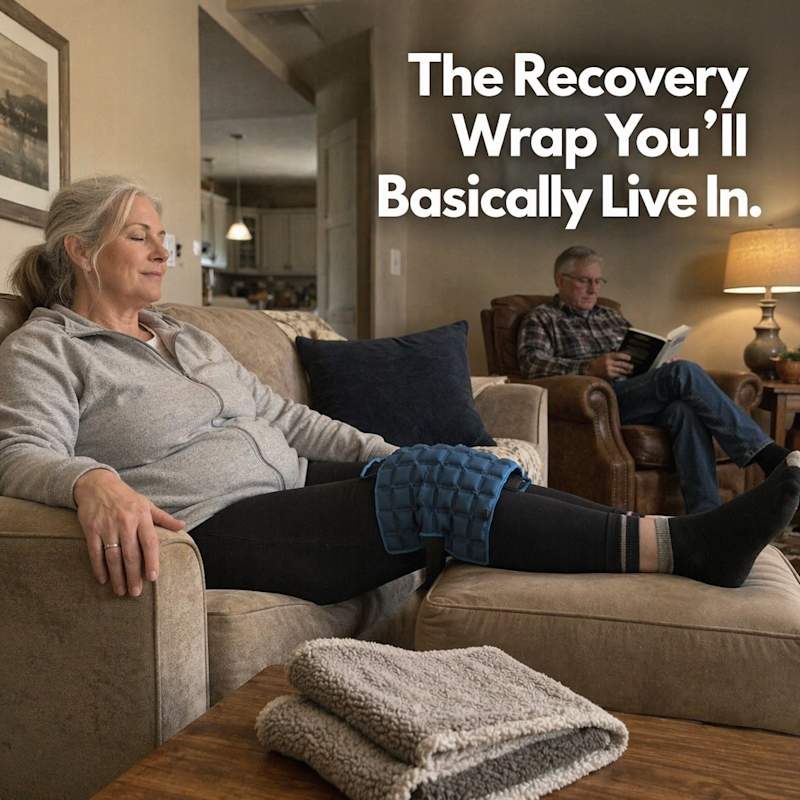
Diane felt a milder version of the same thing. Before she found a wrap with real straps, icing her knee meant being parked on the couch, leg elevated, unable to do much else for twenty minutes at a stretch. Once she had something that actually stayed on, she started freezing it before taking the dog for a walk, sliding it on, and going — "it took the edge off my bad knee" without costing her the walk.
Here's what people misjudge going in: they assume "hands-free" just means "has a strap," and plenty of cheap packs technically do. But a strap that isn't matched to the pack's flexibility just slides — the pack stiffens, shifts, and works its way loose the moment you move, which is exactly the "I did notice you need to be resting otherwise it would slip off" complaint that shows up again and again in reviews of loose, unstrapped packs. Frostane pairs the flexible grid-built pack with two independently adjustable straps designed to hold it against the body through actual movement — walking, light tasks, sitting — not just while you're frozen still on a couch.
For anyone recovering with one arm compromised — a shoulder surgery patient, specifically — that same strap design solves a second, sharper problem: fastening the thing at all without a second pair of hands. "Simple and easy to put on by yourself, in case you don't have anyone to help," is exactly how one reviewer of a comparable wrap put it. That's not a minor convenience when the alternative is calling someone into the room every single time you need to ice.

Recovering at home shouldn't mean choosing between hassle and a bill you can't justify
Recovery from a knee surgery or a serious knee injury isn't a single bad week — it's a stretch of weeks where swelling has to be actively managed, day after day, on a schedule that doesn't care whether you're tired or your caregiver is out of gel packs. This is the part of the map that produces the most motivated, most willing-to-spend buyer, because the stakes feel real and immediate: manage the swelling well, or spend the next month feeling it in your range of motion.
The instinct a lot of people have — understandably, because it's what the clinic mentions — is to look at renting a proper cold-therapy machine. It's not a bad instinct; those machines genuinely hold their temperature better than a thin gel pack. But the economics are brutal for a home recovery: $280 a month to rent, or somewhere in the $1,000–$1,500 range to own one outright, plus the ongoing hassle of refilling a reservoir and managing tubing — all for a recovery window that, for most people, is measured in weeks, not months. One patient's family put it bluntly: rotating packs through the freezer manually "ran me ragged," and that's the workaround people fall back to specifically because the machine felt like overkill for the money.
What this reason bridges is a false choice most people don't realize they're being offered: "spend four figures on a machine" or "suffer through a rotation of cheap packs that barely work." Nobody's telling you there's a middle option — one wrap, built to hold cold longer and stay flexible, that you own outright for a fraction of a rental month, and that works for the entire recovery window without a subscription or a reservoir to manage.
It's also dual-purpose in a way a rented ice machine isn't. Early in recovery, when swelling is the problem, you want cold — that's what the frozen wrap gives you. Weeks later, when the swelling has settled but stiffness has taken its place, the same wrap microwaves for about a minute per side and becomes a heat pack. One wrap covers both halves of a real recovery timeline instead of requiring two separate purchases (and always follow your surgeon's or physical therapist's specific icing and heat instructions for your recovery — Frostane is built to be a comforting tool alongside that guidance, not a replacement for it).
For the two-pack rotation Diane and her husband improvised out of necessity, the direct answer is the 2-unit bundle — one wrap in the freezer, one in use, exactly the workaround people already do manually, minus five extra gel packs cluttering the freezer.

The best time to solve this problem is before you actually need it
There's a version of this story that starts earlier — before the surgery, before the recovery, while there's still a date circled on a calendar and a checklist of things to buy.
This is Marcus's situation. Rotator cuff repair in three weeks. He's never had a shoulder — or an arm — out of commission before, and the thing that's actually keeping him up at night isn't the surgery itself, it's the very practical question of day one home: how does someone with one arm in a sling ice the other shoulder by themselves? He's not wrong to be worried about it. It's a documented, repeated pattern in real reviews from people who've been through exactly this: "Buy this BEFORE surgery," one wrote, adding that they "would not consider undergoing shoulder surgery without having this prior to surgery." Another bought theirs specifically "to use after my recent shoulder surgery" and called it "just what was needed to ice down the surgery site." A third called the whole approach "essential for my recovery."
What almost nobody explains to a pre-op patient is that the hardest hour of a shoulder recovery isn't the surgery — it's the first attempt at self-care afterward, alone, with one arm that doesn't work yet. That's the moment a loose gel pack fails hardest: you can't hold it in place with your operated arm, and your good arm goes numb trying to hold it there instead. Frostane's answer to that specific moment is structural, not incidental — two independently adjustable straps designed to be fastened one-handed, so the wrap can be strapped onto the operated shoulder using only the arm that still works. "Simple and easy to put on by yourself, in case you don't have anyone to help," as one comparable-wrap reviewer described it — which is the exact scenario a pre-op patient is trying to plan around weeks in advance.
This is also, frankly, the least price-sensitive moment in the entire buying journey — not because people with a surgery date are careless with money, but because a fixed deadline and a real stake collapse the usual hesitation. You're not comparison-shopping five ice packs three days before surgery; you're making sure you have the one thing that solves the specific problem you can already see coming. The 90-day money-back guarantee matters most right here, too — it comfortably spans a typical post-op recovery window, so if it isn't the right fit once you're actually using it one-handed at home, that's not a risk you're carrying alone.
Follow your surgeon's or physical therapist's instructions for icing at the surgery site — Frostane is built to sit alongside that guidance, hands-free and one-handed, not to substitute for it.

What Customers Are Saying
"The straps actually stay put when I walk around — that alone made icing feel less like a chore during recovery."
Linda R., Ohio
"Simple to use and it held up well through my whole recovery. Glad I didn't spend on a rental machine."
Frank T., verified customer
"Nice that I can use it hot or cold — practical for the different weeks after surgery."
Susan M., Arizona
The gap between a $1 pack and a $1,000 machine, finally closed
- Ships dry, soaks up water in seconds — you control the cold mass, not a thin pre-filled layer
- Grid/compartment core stays flexible straight out of the freezer — no rigid brick that won't wrap around a joint
- Two adjustable straps built for hands-free wear, including one-handed fastening for a compromised arm or shoulder
- Dual-purpose: freeze for cold therapy, microwave about a minute per side for heat later in recovery
- Backed by a 90-day money-back guarantee — long enough to see your own recovery through it
None of this replaces what your surgeon or physical therapist has already told you to do. It's built to sit alongside that guidance — the tool you reach for between appointments, on your own schedule, without a rental invoice or a rotation of five gel packs clogging your freezer.