Strap It On With One Hand — Relief That Stays Put, Even When Your Other Arm Is Out
For anyone icing a shoulder that won't let them use both arms — post-surgery, post-workout, or just plain sore — a wrap you can put on yourself, and forget you're wearing.
Tom didn't think about his "good" arm until he needed it for everything.
For the first two weeks after his rotator cuff repair, every ice session turned into the same small ordeal: prop the pack against his bad shoulder, hold it there with his good hand, try not to move, try not to think about how numb that good hand was getting. Fifteen minutes in, his arm would go tingly, the pack would slide an inch, and he'd have to start the whole balancing act over again — sitting perfectly still, holding a pack in place, for something that was supposed to make him feel less stuck, not more.
He's not alone in this. It's one of the most repeated complaints from people icing a shoulder on their own: "no more balancing act," one reviewer wrote about switching to a strap-on wrap. "I no longer need to sit perfectly still or use my other arm to hold a loose pack in place." Another, describing the same kind of wrap: "simple and easy to put on by yourself, in case you don't have anyone to help." That's the whole complaint in two sentences — and the whole relief, too.
The frustrating part is that this isn't really about the shoulder at all. It's about the pack. A loose gel pack was never designed to be worn — it was designed to be held. So the moment you need both hands back — to eat, to text, to just sit without thinking about your arm — the pack becomes the problem, not the solution.
But there's a deeper problem underneath even that — one that has nothing to do with hands-free straps at all, and almost nobody talks about it directly.

The Cold's Gone Before the Pain Is
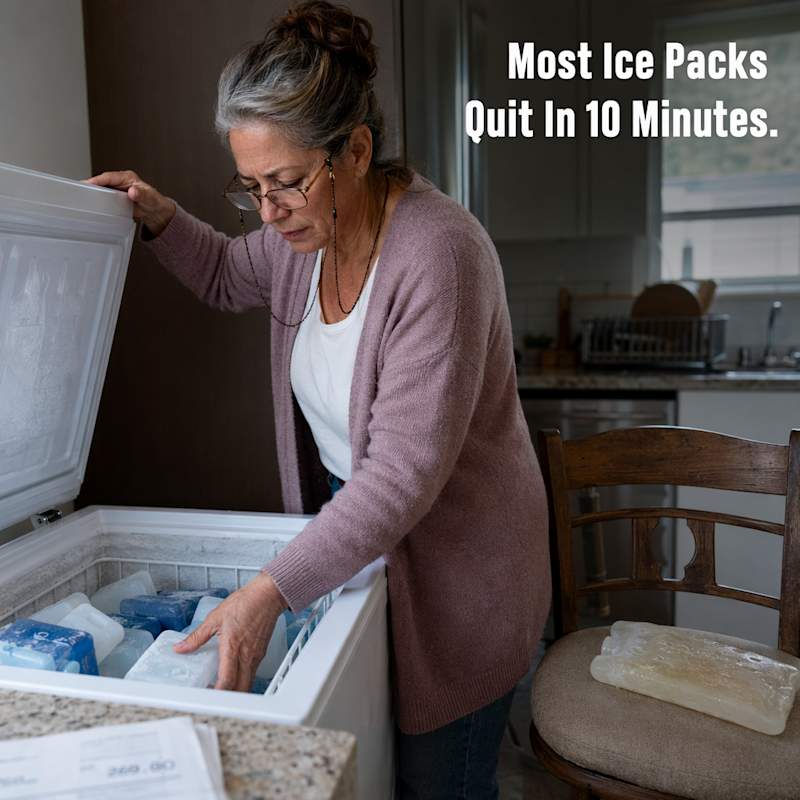
Here's the problem almost nobody names correctly: it isn't that ice doesn't help. It's that most ice packs quit long before your knee — or your shoulder, or your back — is actually finished needing them.
Maria knows this rhythm by heart. Ice the knee, feel the relief kick in, and by the time she's settled into the couch, the pack has already gone lukewarm and started sliding sideways. Her fix, for a long time, was brute force: six gel packs bought at once, two in the freezer, two on her knee, two thawing on the counter, rotating them like laundry. "We went through them faster than my freezer could freeze them," as one recovering knee patient put it. "It ran me ragged."
The other option — the real clinical cold therapy machines hospitals send patients home with — solves the duration problem, but creates a bigger one. Rental units like the ones used after knee surgery run around $280 a month, with a buy-it-yourself price tag closer to $1,000–$1,500. So the honest choice most people are handed is: a $1 pack that quits in minutes, or a four-figure machine that never should have felt like the only upgrade available.
This is the misunderstanding worth correcting: cold therapy doesn't fail because ice "doesn't work" — it fails because the gel-to-insulation ratio in a cheap pack is too thin to hold temperature. Frostane's core is a water-absorbing polymer resin — not a thin gel sachet — built into a compartment/grid structure designed to hold and distribute cold evenly rather than dumping it all in the first ten minutes. It ships completely dry, soaks up water in seconds, then freezes flexible instead of into an unwrappable board.
Once you see why thin gel fails, it stops feeling like bad luck and starts feeling like a design flaw you can simply route around — which is exactly why a $49.99 wrap that holds its temperature is a rational middle ground, not a compromise, between a pack that quits and a machine that costs as much as a used car.
Hands-Free Relief While You Keep Living
This is Tom's reason, and it's the one that turns "relief" from a chore into something you barely notice you're doing.
The hidden assumption behind most ice packs is that you'll be sitting still, holding it, for the whole session. That assumption breaks down fast in real life — when you're recovering from shoulder surgery and your other arm is your only functioning arm, "just hold it there" is not a small ask. It's the thing that turns a 20-minute ice session into an ordeal that costs you the use of both arms at once.
Frostane's two adjustable elastic straps are the bridge here: instead of a pack you hold, it's a wrap you wear. The straps are designed to fasten with one hand, on either shoulder, either knee, so a person recovering from a one-arm injury isn't dependent on someone else's hands to get relief. Reviewers on comparable strap-on wraps describe it this way: "This reusable wearable icer gives me back my mobility." Another: "The hands-free strap design... you can secure it around your shoulder so it stays in place while sitting, walking around the house, or doing light tasks."
What changes once you understand this isn't "a stronger strap" — it's a different design goal entirely. Cheap packs are built to be cold. Frostane is built to be cold while attached to a moving, living person. That's why it stays put doing dishes, walking the dog, or sitting at a desk, instead of only working if you don't move a muscle.
If you're curious exactly how the strap system and the grid core work together — and what's actually in the box — it's worth walking through before you decide which size to grab.

One Wrap for the Whole Comeback
Maria's second chapter starts here — not the daily ache, but the specific, time-bound stretch after a knee surgery when swelling, stiffness, and freezer math all collide at once.
Recovery weeks are when the six-pack-rotation workaround gets most desperate, and when the $1,000 machine temptation is strongest. "My swelling was SO BAD and lasted for SO LONG," one knee-replacement patient wrote about her recovery. "I lived in that thing and I don't know what I would have done without it." That's not hyperbole for most post-op patients — it's a description of how often the pack actually gets used, all day, for weeks.
The real misunderstanding in this window is that people think their only two choices are "renting the clinical machine" or "grinding through with disposable packs." What's missing is a middle category: a wrap durable enough to be the only pack in rotation, used daily for weeks without falling apart or losing its cold. Frostane's grid/compartment build is specifically about surviving that kind of repeat use — freeze, use, refreeze, repeat. And because it does both cold (for the acute swelling days) and heat, in about a minute per side in the microwave (for the stiffness that follows), it covers the whole arc of a recovery instead of just the first week.
Two things make this safe to trust rather than a leap of faith: the 90-day money-back guarantee, which is roughly the length of a full knee-recovery window, and the fact that this is framed as comforting relief you use alongside your surgeon's or PT's instructions — never a replacement for prescribed care. It's not meant to be the whole plan. It's meant to be the one part of the plan you don't have to think about.

The One Thing to Buy Before Your Surgery
Diane's reason is the one almost nobody plans for until it's too late — and the customer feedback on this is loud and specific enough that it's basically a warning label from people who've already been through it.
"Buy this BEFORE surgery," one shoulder-surgery patient wrote. "I would not consider undergoing shoulder surgery without having this prior to surgery." Another: "Ice therapy... is essential for my recovery. I had rotator cuff repair." The pattern is consistent — shoulder surgery patients are explicitly told to prepare in advance, but nobody explains that the ice pack they already own probably won't work once one arm is out of commission.
The misunderstanding here is timing, not product knowledge. Most people shop for post-op supplies reactively, after the fact, when they're already struggling. But shoulder surgery has a fixed, known date. That's a genuine advantage most recovery situations don't offer: you can solve the "how will I ice this myself" problem before it's a problem, while you still have two working arms to figure it out.
Frostane's answer here is the same mechanism as Reason 2 — one-handed strap application — but the framing shifts from convenience to necessity: on day one home from surgery, with the operated arm essentially useless, a wrap that requires two functioning hands to fasten simply doesn't work, and one that doesn't isn't a nice-to-have. It's worth noting, too, that a real slice of these purchases aren't even for the buyer themselves — "Wife really loves it after her shoulder replacement," "Gift for a sister" — partners and adult children are quietly doing this prep work for someone else, which is its own kind of care.
As with recovery generally: this is comforting cold therapy at the surgery site and heat for the stiffness weeks later, used alongside — never instead of — whatever your surgeon prescribes.

What Customers Are Saying
"I could finally put it on myself without asking anyone for help. That alone made my recovery so much easier to deal with."
Rachel T., Denver
"Simple to strap on and it actually stays put while I move around the house. No more sitting still holding a pack."
J.M., Austin
"Wish I'd bought this before my surgery instead of after. Would have saved me a rough first week."
Carol P., Tampa
Why Readers Keep Coming Back to This One
- Cold that holds long enough to finish a treatment — not gone in 10 minutes
- Freezes flexible, not into a plastic brick you can't wrap around a joint
- Two adjustable straps designed to fasten one-handed, on either shoulder or knee
- Doubles as heat therapy for the stiffness that follows swelling
- Backed by a 90-day money-back guarantee — long enough to cover a real recovery window
Whether it's a shoulder that's down to one working arm, a knee recovering from surgery, or just the plain frustration of a pack that quits too soon — the fix isn't a $1,000 machine or a drawer full of sad gel packs. It's one wrap that actually holds up its end of the deal.