Too Big, They Fall Out. Too Small, They Hurt. The Earplugs That Finally Just... Fit.
For everyone who's opened a drawer full of half-used foam and a returned "premium" box — three sizes, one soft seal, and an end to the nightly gamble.
Renee's nightstand drawer tells the whole story. A crushed strip of foam plugs, most used once. A little tin of wax putty that never worked. And, tucked behind them, a return-shipping label she never got around to using for a $38 pair of "cute" reusable earplugs that gave her a pressure headache inside ten minutes.
That's four different products, four different failures, and one identical problem underneath all of them: they were never built for her ear. The foam was too big and slipped out somewhere around 2am. The putty just sat there, doing nothing. The premium pair was marketed as "one size fits most" — which, it turns out, is marketing for "one size fits nobody in particular."
She's not alone in this. Across the reviews and forums, the same two complaints show up over and over, almost like a script: either too big and they fall out in the middle of the night, or so uncomfortable they cause pressure pain and scabbing. One reviewer put it more bluntly — within ten minutes of putting a pair in, she had a "massive pressure headache" and was miserable the rest of the day. Another said the plugs would fall out of her ears at night without her even realizing, because they were too uncomfortable to keep in while asleep.
It's a strange kind of category failure: an entire industry selling products meant to be worn for eight straight hours, sized like a baseball cap. But the fall-out and the earache were never really the disease — they were the symptom of something the whole category quietly ignores: almost nobody actually gets a plug shaped for their ear, let alone shaped for a full night's sleep next to someone who won't stop snoring.

Reason 1 — The noise was never really the point. The seal was.

For most people who end up shopping for earplugs at midnight, the story starts the same way: a partner who snores, and a bedroom that stops being restful the moment the lights go off. "He goes to bed early, snores... regular plugs don't work... and I'm awake writing this. Tired, pissed and out of ideas," is how one exhausted partner described it in a sleep forum — and it's hard to find a more accurate six words for the feeling than "tired, pissed, and out of ideas."
The instinct, when foam and wax fail, is to assume the sound is the problem — that the snoring is simply too loud to be blocked by anything short of a wall. And sometimes that's partly true: one commenter measured his wife's snoring at over 90dB and reported that even custom-molded rubber plugs from an audiologist — a $200+ solution — still didn't block over 60% of the noise.
But here's what almost nobody tells you: a huge portion of "I can still hear him" isn't a volume problem. It's a seal problem. A plug that doesn't sit flush in the canal — because it's too big, too small, or shaped for a different job — leaks sound around its edges no matter how dense the material is. That's the misunderstanding the whole category runs on: people keep buying louder-sounding solutions (thicker foam, deeper putty, pricier molds) when the actual fix is a better-fitting one.
This is where Dormio's whole design logic starts: not "block harder," but "seal better." The half-in-ear silicone body is shaped to sit low and flush against the ear, and it ships with interchangeable S/M/L tips specifically because ear canals aren't standardized — the same reason a $200 custom mold can still underperform if the fit isn't dialed in for that night's sleeping position. Muffling the snore isn't about brute density; it's about a seal that doesn't move once you're asleep.
Micro-proof: this is precisely the gap in the failed-solutions pattern across the research — foam described as "bulky, keeps falling out," putty that "doesn't do any good," even premium reusables sent back because they weren't good enough to drown out a partner's snoring. The common denominator every time isn't loudness. It's fit.
Reason 2 — The sizing roulette everyone quietly accepts
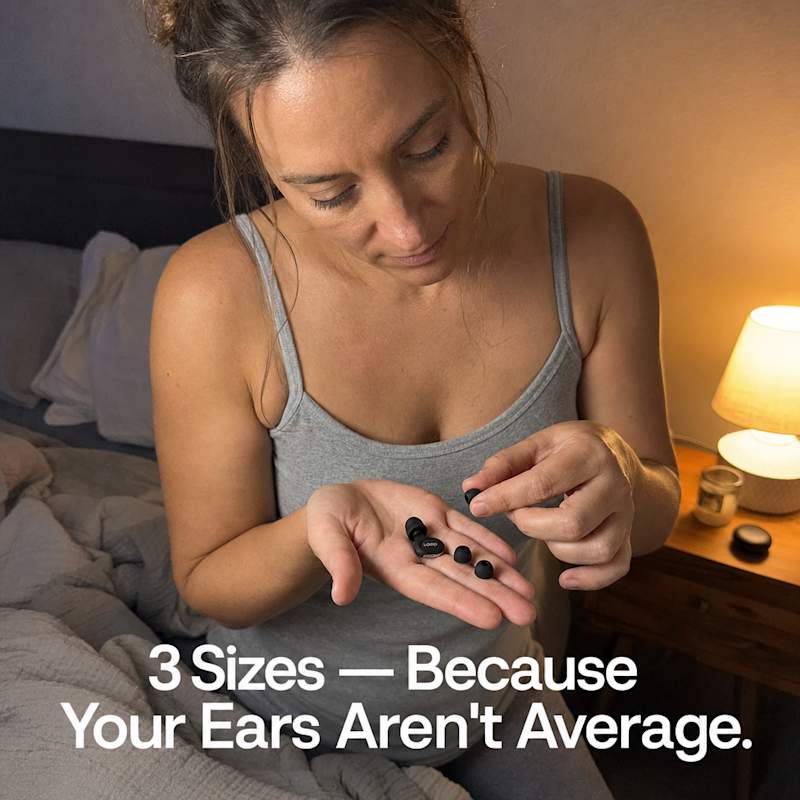
This is the reason Renee's drawer looks the way it does, and it's the most universal complaint in the entire category: earplugs sold as "one size" being worn by people whose ear canals are, obviously, not one size. The failure shows up in exactly two directions, and almost every disappointed buyer has lived through both. Too big, and the plug won't seat properly — it works its way loose overnight and falls out. Too small, and it doesn't seal at all, or worse, it presses somewhere it shouldn't and causes real pain. One reviewer described it as plugs "too big and fall out in the middle of the night, or so uncomfortable they cause pressure pain and scabbing." A side sleeper reported plugs falling out — or being pulled out in her sleep without realizing — because of the discomfort.
The quiet misunderstanding here is that people think they've tried "earplugs" and earplugs, generically, don't work for them. What they've actually tried is one specific size, made by a company that picked a single mold and hoped it would average out across millions of different ears. It almost never does. This is also the friction point where price becomes a live objection — people who've already spent money once, or twice, understandably start to think: "these are probably expensive for what they are." And when a $38–$64 pair still doesn't fit, that skepticism is earned, not irrational.
Dormio's answer to this isn't a marketing claim — it's a literal box contents difference. Every unit ships with S/M/L interchangeable tips, precisely because the fix for "one size fits nobody" is never a better single size — it's options. You're not guessing once and hoping; you're trying the size that matches your own canal, the same logic an audiologist would use, minus the $200 fitting appointment. The silicone itself is soft, non-toxic, and hypoallergenic, and the whole shape sits low enough in the ear that side sleepers aren't pressing a hard ring into the pillow all night — the exact mechanism behind the "pressure pain and scabbing" complaint above.
A brief editorial note here, for anyone wondering exactly how the fit system and the full bundle work — beyond the three tip sizes, every Dormio order includes a portable carry case and lanyard, and because the plugs are silicone rather than foam, they rinse clean under a tap and go right back in the case, which is the difference between "buy foam every week" and "buy once, wash, repeat for years."
And the economics genuinely favor that math: at $49.99 per unit, Dormio sits above drugstore foam but meaningfully below the $200+ cost of a custom mold that — per the research above — still didn't solve the problem. Reusable-for-years against a $5 box you refill weekly, or a $200 mold that underperforms, is a very different comparison than reusable-vs-drugstore-foam alone.
Reason 3 — Blocking everything is not actually the win condition

There's a fear that almost never gets said out loud before someone buys their first "real" pair of earplugs, and it's this: if these actually work, will I sleep through my alarm? Or worse — will I not hear my kid. One person described it plainly: "the only thing I'm still paranoid about is not being able to hear my alarm." Another said she'd find herself anxiously worrying she wouldn't hear her alarm go off for work — which, for someone like Renee with a 7am shift, isn't a minor detail. It's the actual reason she hesitates before buying anything described as "blocks everything."
The misread here is treating "more blocking" as an unambiguous upgrade. It isn't. A plug engineered to seal for sleep — muffling the low, steady drone of snoring and street noise — behaves differently from a plug (or a wad of wax) that just jams the canal shut indiscriminately. The goal was never total silence; total silence is actually the thing people are afraid of. The real goal is a night where the specific noise that's keeping you up goes quiet, while a sharper, higher, more urgent sound — an alarm, a knock, a kid crying down the hall — still gets through.
Dormio is built and sized around that distinction: a half-in-ear seal that muffles the droning, continuous noise that ruins sleep, without being marketed or engineered as an audio vacuum. It's an honest trade, and it's the one the category almost never says out loud, because "blocks less than the competitor" sounds like a weakness instead of what it actually is here — a safety feature.
To be direct about the limit of this claim: this isn't a guarantee tied to a specific decibel spec, and it shouldn't be sold as one — it's a design intention, matched by the same low-profile, seal-focused shape described in Reason 1. What is verifiable is the shape and material choice behind it: soft, half-in-ear silicone, not a hard full-block industrial plug repurposed from a job site.
Reason 4 — The thing nobody warns you about before you buy your first pair

Here's a complaint that shows up constantly in earplug discussions and almost never in earplug marketing: putting plugs in and suddenly hearing your own voice boom inside your skull, or noticing your heartbeat, thudding, right in your ear. "My own voice sounds boomy, and I can often hear my heartbeat during meditation," is how one person described it — and it's disorienting enough that some people take the plugs straight back out, assuming something's wrong with them, or with the product.
Nothing is wrong. This is called occlusion — it happens, to some degree, with any plug that seals the ear canal, because the sound of your own body (voice, pulse, chewing) has nowhere to escape and reflects back at you. It's genuinely useful to know this before your first night, not after, because otherwise it reads as a defect rather than a known, explainable phenomenon.
What's worth understanding, though, is that occlusion intensity isn't fixed — it's worse with a hard, deep-seated plug that presses further into the canal, and lighter with a soft, shallow, half-in-ear seal. This is the honest, modest version of the claim: Dormio's low-profile silicone shape is designed to sit lighter in the canal than a deep-insertion plug, which can reduce how pronounced that "head in a barrel" sensation feels — not eliminate it, because no in-ear plug fully does, but noticeably soften it in a way that matches the comfort-first shape described throughout this article.
This is also, quietly, the same design choice doing double duty across every reason above: a shallower, softer, better-fitted seal is what stops the fall-out (Reason 2), what makes the muffle-not-silence balance work (Reason 3), and what makes occlusion less jarring here than with a deeper industrial plug. It's one design decision, not four separate features bolted together.
What Customers Are Saying
"I've bought three different kinds of earplugs before these. This is the first pair that actually stayed in all night without hurting."
Renee T., Columbus OH
"The size options made the difference — I finally found one that just disappears once it's in. No more pressure headaches."
Marisol G., Tampa FL
"Practical, comfortable, and I can still hear my alarm in the morning. Worth it after years of foam that never worked."
J.K., Denver CO
The drawer full of failed fixes doesn't have to be your ending
- Most "I can still hear him" complaints are a seal problem, not a volume problem — S/M/L tips fix what a single "one size" can't.
- Soft, half-in-ear silicone sits low and flush, so it doesn't press into the ear on your side and doesn't work loose overnight.
- Muffles the steady drone of snoring and street noise, without engineering out the sharper sounds that matter — your alarm, a knock, a kid down the hall.
- Lighter, shallower seal means less of the "own voice booming" occlusion effect than a deep, hard-insertion plug.
- Reusable and washable — one set, rinsed and reused, instead of a weekly foam re-buy or a $200 mold that still underperformed.
- Backed by a 90-day money-back guarantee and free 2–3 day shipping — there's no real risk in finding out if the right size finally seals it.
You don't need to spend another night deciding which trade-off you're willing to live with. Try the sizes that actually match your ear, sleep on it — literally — and send them back within 90 days if it doesn't change your nights. Most people don't.