The Important Days You Missed Don't Have to Be the Blueprint for Every Important Day That's Coming
For women who know exactly which trip, gathering, or celebration their period turned into something to survive — and who have another one on the calendar right now.
You probably remember the specific day. Not a category of day — the actual one. The concert you had been looking forward to for six months. The Thanksgiving visit where you spent half of Wednesday in your sister's guest room while everyone else was in the kitchen. The New Year's Eve you planned so carefully and then watched arrive from the wrong room.
There is a particular kind of frustration that comes from that kind of memory. It is not the same as the frustration of cramps in the abstract. It is the frustration of having done everything right — booked the flight, cleared the schedule, looked forward to the thing — and then having the day go sideways in a way that felt completely outside your control. You were not careless. You were not unprepared in any way you knew how to be. You just did not have a comfort plan for that specific situation, and by the time you needed one, it was too late to make one.
What makes it stay with you is not the pain itself. Pain passes. What stays is the specific scene: the version of that day you did not get to have. The hike you did not go on. The table you left early. The ball drop you watched from the bathroom floor while your family was in the other room. Those are not abstract losses. They are scenes with addresses and timestamps, and they do not go away cleanly.
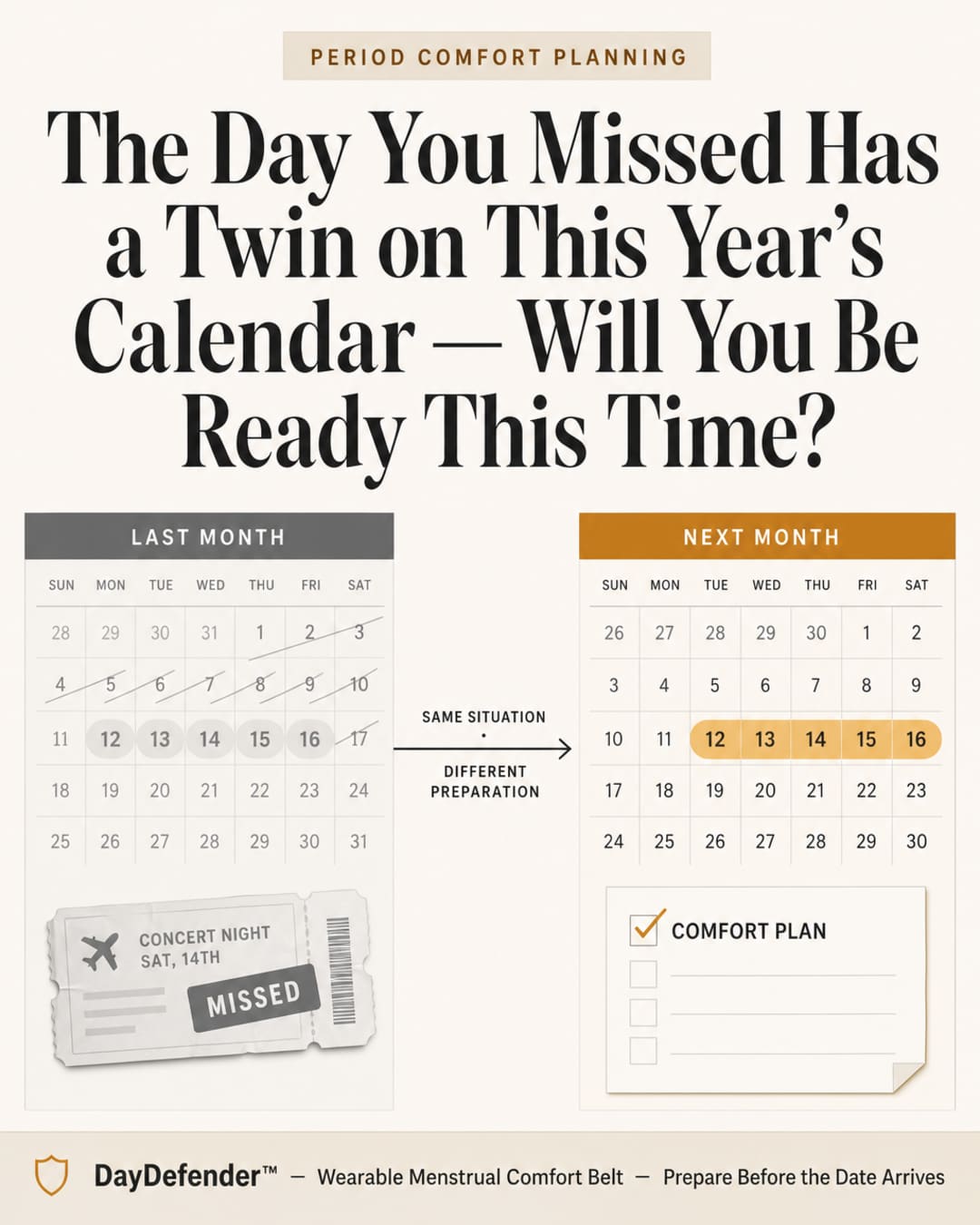
Here is the part worth paying attention to: you probably have another one coming. A specific date, a specific event, a specific reason you are already thinking about it — and your period may land in the same window. The question is not whether that situation will exist again. The question is whether you will have a different plan for it this time.
What changes between that memory and that upcoming date is not luck or timing — it is the decision, made in advance, to prepare differently, and understanding exactly what that preparation could include.
That Day Already Has a Name. That's What Makes This Different.
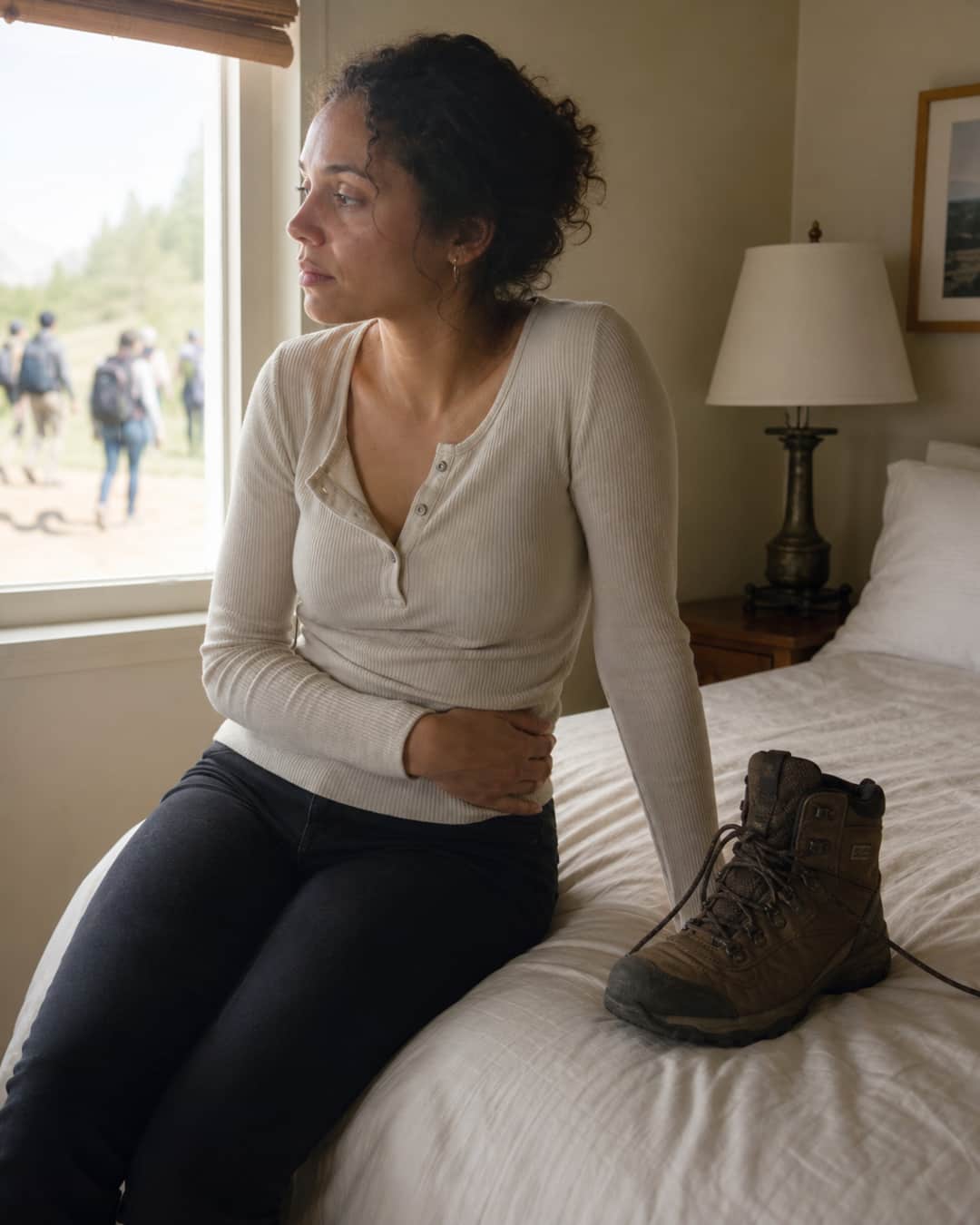
Most conversations about period discomfort talk about symptoms. Cramps. Fatigue. The general difficulty of the experience. And those things are real. But if you are reading this, there is a reasonable chance the conversation that keeps replaying in your head is not about symptoms in general — it is about one specific day. The trip where you sat out the afternoon your friends went hiking. The holiday visit where you spent three hours in a back bedroom while everyone else was at the table. The birthday that you technically attended but did not really get to have.
That specificity is not a small thing. It is actually the most important thing in the room.
When something costs you a singular experience — not a Tuesday, not a regular evening, but a trip you saved for, a celebration you planned, a reunion you drove nine hours to reach — the memory holds differently than general discomfort does. You do not forget it the way you forget a hard Wednesday. You carry it forward as a reference point. That is what can happen. That is what has already happened to me. And the approach of another event with a similar calendar overlap starts to bring that reference point back.
Maya has described it as a kind of advance grief. She knows the December trip is coming. She knows her cycle may land in the same window. And she starts running the same mental scenario she ran last year: What do I do if it happens again? Do I have anything with me? Do I have a plan? The anxiety is not irrational — it is based on a real prior experience, and it starts weeks before she ever leaves home.
What is worth naming is that the memory is doing the work here that it should be doing: it is telling her something is worth preparing for before the departure date, not the morning everything gets hard.
What "Preparing Differently" Actually Means (It Is Not What Most People Try First)
When a previous difficult period disrupts something that mattered, the first response is usually one of two things: the next time a similar event approaches, you either try to think positively about it (maybe it won't be that bad this time), or you grab whatever you have on hand on the morning it starts and improvise.
Neither of those is actually a preparation plan. The first is wishful, and the second is reactive — you are already in the middle of the situation before you have made any decisions about how you want to handle it.
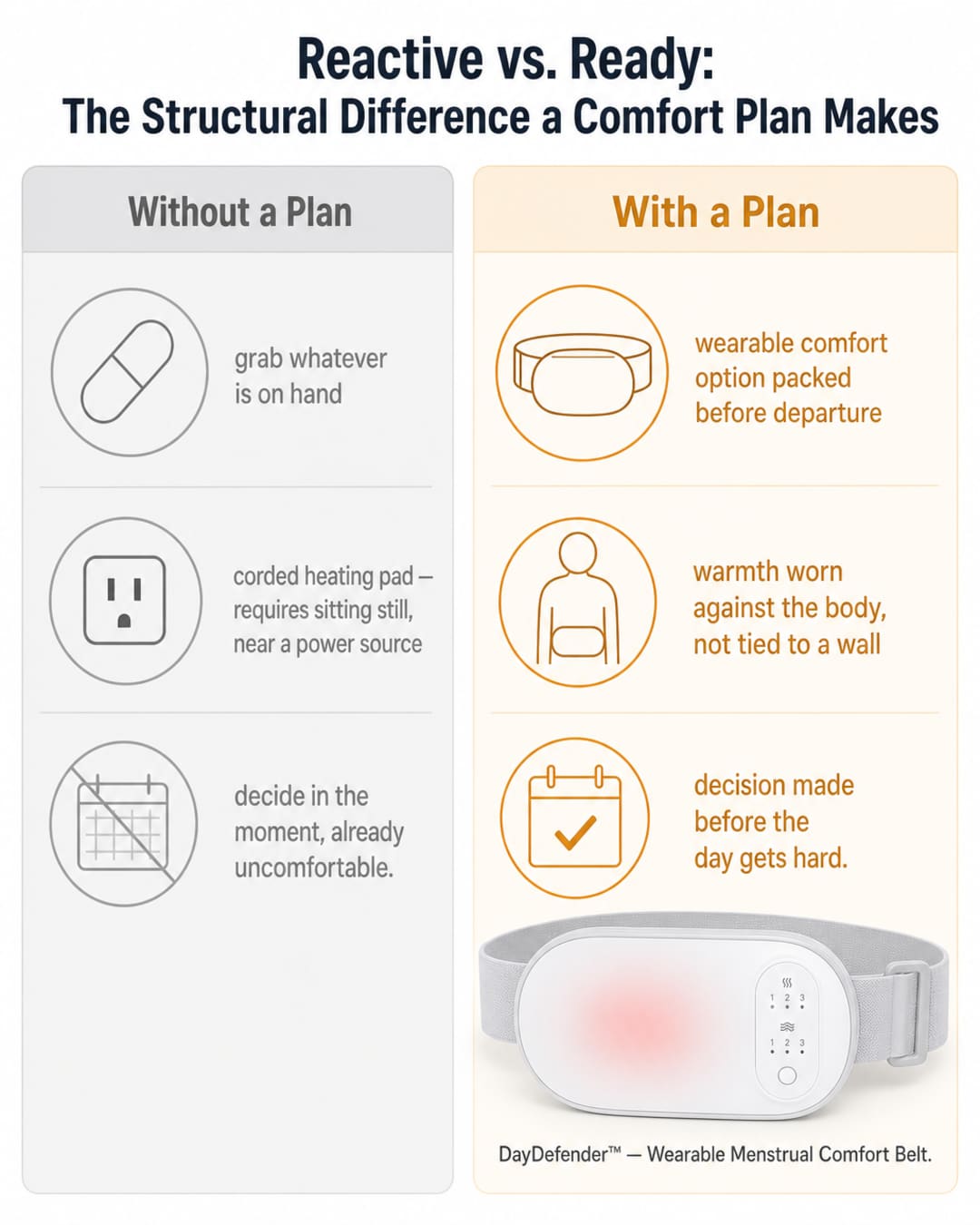
The problem with improvisation on the day is not that there are no options available in the moment. It is that you are making decisions about your comfort when you are already uncomfortable, often away from home, with a reduced margin to figure things out. You are in an airport, or at someone else's house, or halfway through a shift. What you did not bring with you on day one is not going to be there.
Heat is one of the most consistently used tools for menstrual cramp management, and most people already know this — the issue is that the conventional form of it, a corded electric heating pad, requires you to be sitting still next to a wall outlet. That works at home, on your own couch, with nothing you need to be doing. It does not work on a long drive. It does not work in a hotel room where you want to move between spaces. It does not work in the middle of a holiday gathering where the last thing you want is to announce that you need to go lie down.
DayDefender is a wearable menstrual comfort belt. It is designed to be worn against the body — which means warmth is available in the place you actually want it while you are doing the things you came to do, rather than requiring you to stop doing those things first. The specific heat and vibration settings are documented in the supplier's product information and user manual, which you should review before purchase. What the form factor changes is structural: instead of comfort being something you go somewhere to access, it travels with you.
Preparing differently means making a decision before you leave. It means the device is in your bag before the trip starts — not because you have guaranteed yourself a pain-free day, but because you have not left yourself without options if the day gets hard.
The Real Ledger: What It Has Already Cost You
Diane has stopped counting the specific events. She has a rough mental list — the New Year's Eve, a spring birthday that was difficult, two years ago at Christmas when she got through dinner but spent the rest of the evening in her mother-in-law's upstairs bathroom. She does not think of these as disasters. She thinks of them as the price of having a body that sometimes makes certain days harder than other people's days.
But that framing deserves some pressure.
These are not ordinary days that happened to be a little hard. These are the days people plan specifically because they are meaningful — the celebrations, the gatherings, the trips that appear once a year or once in several years. The statistical weight of your cycle landing on a random Tuesday is very different from it landing on the specific thirty-six-hour window of your anniversary trip or the only day in a year your extended family is in one place.
When you add up what has been affected — not abstractly, but concretely — the number has a real shape. It is the experiences that were harder to enjoy. The conversations you were half-present for. The photographs you looked uncomfortable in. The moments you excused yourself from. The plans you made and then had to partially abandon. None of those are recoverable. You cannot go back and be present for a version of those days that already happened.
That arithmetic is not meant to be grim. It is meant to be honest. Because the same arithmetic applies to the upcoming date: if you arrive at it without a plan and the situation is difficult, that day also joins the ledger. And the days on that ledger are not replaceable days.
The cost of not preparing is not just discomfort in the moment. It is the specific, named experiences that become harder than they should have been — and that you remember.

"I Already Have a Heating Pad" — and Four Other Things Worth Thinking Through
The objection that comes up most honestly at this point is a fair one: I already do things for my period. I have ibuprofen. I have a heating pad at home. I have figured out some version of a system. Why does this need to be different?
The answer depends entirely on where the pain shows up.
If the only days your period creates significant discomfort are days you are at home, near your couch, with no particular reason to move around — the existing system may be exactly enough. The corded heating pad does its job in that context. The pills work the same regardless of location.
But if the days it matters most are the ones where you are not at home — where you are on a plane, in someone else's house, in a restaurant, on a trail, in a hotel room between activities — then the gap in that system is structural. It is not a gap in your effort or your willingness to manage the situation. It is a gap in what the available tools are physically capable of doing when you are somewhere other than your couch.
Sasha made that comparison on the morning of her qualifying exam. She had ibuprofen. She sat in a bathroom stall and took it and waited. The ibuprofen eventually helped, but she spent the first forty minutes of a two-hour examination that mattered significantly to her waiting for it to work, in a cold bathroom, alone. What she did not have was something she could wear — something that meant the moment she sat down in that exam room, warmth was already present at the location of the discomfort, not something she was hoping would arrive in the next thirty to forty-five minutes.
The comparison is not about whether DayDefender is superior to medication, or superior to a heating pad. It is about what each tool is designed to do, and where it is capable of doing that. Pills travel. A corded heating pad does not. A wearable belt is designed specifically for the situations where heat is wanted somewhere the cord cannot reach.
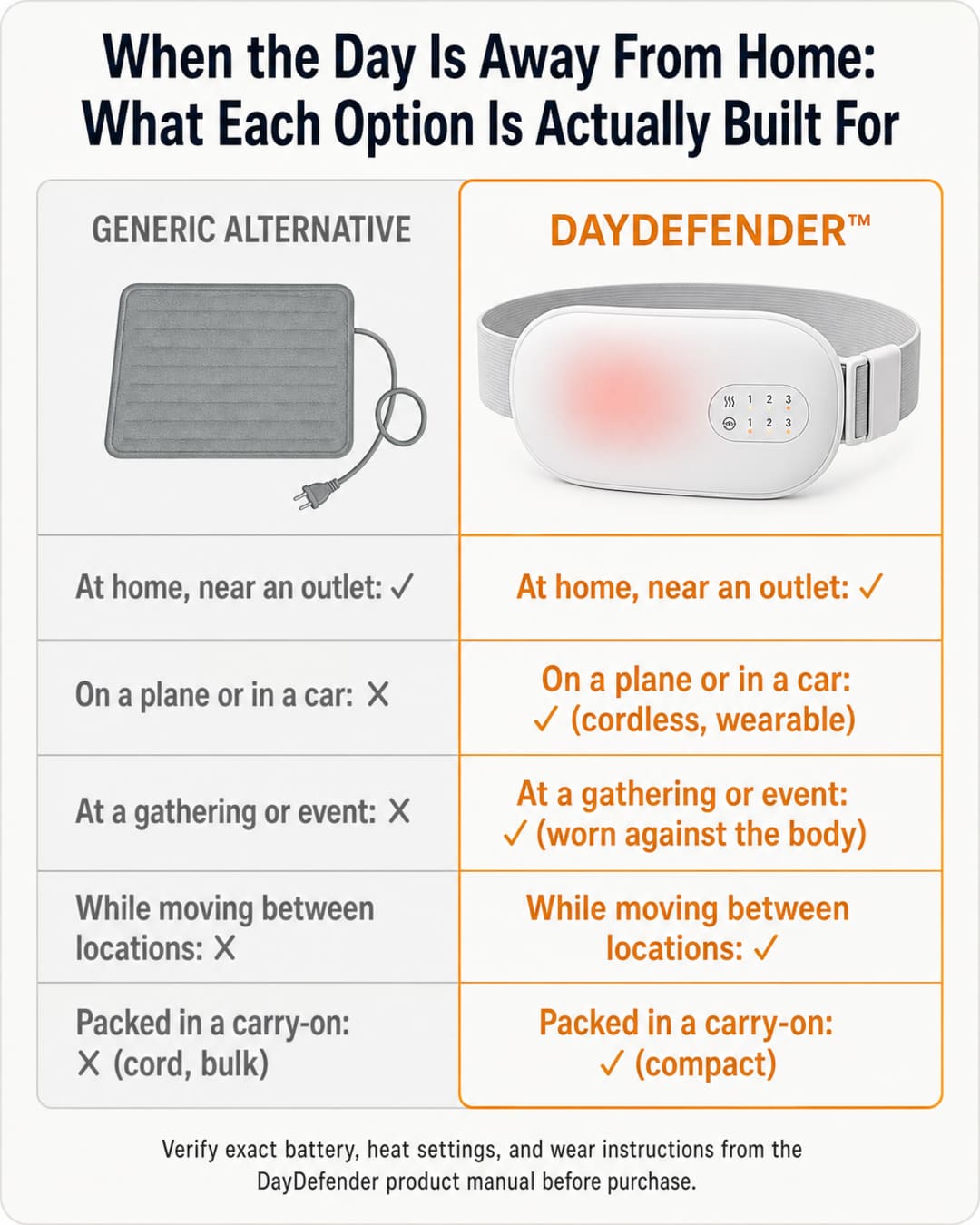
If you want the full details on how DayDefender works — the exact settings, wear instructions, battery, and what the product manual covers — those are on the next page. What follows here is the part that is harder to put in a spec sheet.
What the Trip Actually Looks Like When You Go Prepared
Maya went on the December trip. Her period arrived on day two, the same as it did the year before. This time she had the belt packed. She put it on before they left the rental house for the hike. It was under her base layer. Nobody mentioned it, because there was nothing to mention. She was on the trail.
She describes it not as a miraculous experience — not pain-free, not transformed — but as a different quality of present. The discomfort was there. She was also there. She was not sitting in the house watching shapes move through the window. She was the shape moving through the window.
The transformation that this angle is actually about is not the elimination of pain. It is the shift from arriving at an important day unprepared and managing a crisis in real time to arriving at an important day with a plan already in place and the available tools already with you. The difference is experienced in the ratio of the day you get to have versus the day you spend managing.
Nobody is promising you a pain-free holiday. The device does not guarantee an experience. But a wearable comfort option, packed before you leave, gives you something you cannot manufacture on the morning everything is already hard: the option to stay in the moment rather than remove yourself from it.
The next important date on your calendar — the travel, the gathering, the celebration, the obligation that has a date and a weight to it — has not happened yet. That day is still available to you in full. What you do between now and then is the only part you can actually influence.

What Customers Are Saying
"I packed it for a long Thanksgiving weekend at my in-laws and it was genuinely useful to have. Easy to wear under clothing, easy to travel with. Really glad I had it with me."
Rachel M., Denver, CO
"I had been skeptical, but the fact that it's cordless made a real difference for me. I used it during a long drive and it was exactly what I needed — practical and well made."
Jess T., Austin, TX
"I wish I had thought to pack something like this on trips sooner. Having a wearable option already in my bag instead of improvising in the moment was a different experience entirely."
A.K., Portland, OR
Every Important Date That Already Happened Without a Plan Has a Sequel on Your Calendar
You know the trips. You know the gatherings. You know the specific scenes where your period arrived before your preparation did, and you managed the day instead of having it.
Here is what is also true: you can read this and decide it does not apply, and the upcoming date — Thanksgiving, the Christmas visit, the New Year's reservation, the December defense, the holiday shift — will arrive exactly as it has before, with whatever you happen to have on hand.
Or you can look at the calendar now, notice that a specific meaningful date is approaching, and make a different decision than the ones that produced the memories you are still carrying.
The specific shift that makes a difference:
- You stop making period-comfort decisions on the morning everything is already hard.
- You have a wearable option in your bag before you leave — not improvised, not borrowed, already there.
- The warmth you want during a difficult moment is available at the location of the discomfort while you are still in the room, on the trail, at the table.
- The important date on your calendar becomes one you were present for, not one you managed.
- The ledger of days you could not fully have stops growing.
The version of your next important day where you are at the table, on the trail, in the room — that version requires one decision made before the departure date, not during it. You saw what the mechanism is. You saw what the comparison looks like. You have a specific date in mind already, or you would not have read this far.
The day you are going to is still available. The preparation window is now.
Next page: verified product specifications, use instructions, shipping, return terms, and the full offer details.