You've Been Looking Forward to This. Don't Spend the Day Managing It.
There is a particular kind of quiet dread that shows up about ten days before something you have been genuinely excited about. You have the tickets, or the reservation, or the flight confirmation. You know the date by heart. And somewhere in the back of your mind, you are doing the math.
It is not catastrophizing. It is just experience. You have been through enough cycles to know that a period showing up on the wrong weekend does not mean the plan is ruined — but it does mean the plan gets harder. You spend the day half-present, half-managing. You go to the bathroom more than you want to. You smile through something that deserves your full attention. You tell yourself you are fine, and sometimes you are, and sometimes you are not, and either way you did not want your body's schedule to be part of the conversation at all.
That is the actual problem. Not pain in the abstract. The specific, personal cost of a day you had been looking forward to becoming a day you got through.
What changes the calculation is not luck and it is not white-knuckling it — it is deciding, before the day arrives, that you want to give yourself a real comfort option rather than waiting until you are already in the middle of it.
That decision — the preparation, not the hope — is exactly what the next few sections are about.

Reason 1 — The Moment You Worked Hardest to Get, and Your Period Almost Took It

You remember the exact kind of moment. The kind you planned for, paid for, looked forward to across an entire quarter of ordinary Tuesdays. And then your body had a different schedule.
It might have been a concert where you spent the second half leaning against a wall instead of in the crowd. A holiday dinner where you excused yourself more than once and came back quieter than when you left. A weekend away that became about finding heating pads in an unfamiliar town instead of the thing you had actually come to do. You did not cancel. You showed up. But showing up and being present are not the same thing, and you know the difference in your body.
This is what gets lost when the conversation stays at the level of "managing cramps." The cramp is the mechanism; the real cost is measured in something harder to name — the concert you were physically at but not fully inside, the dinner where the people at the table got a smaller version of you than you wanted to give them.
What makes it sharper is that these events are not random Wednesdays. They are the dates you circled. The ones with tickets and reservations and a hotel you booked months ago. Your period does not know that, obviously. But you do.
The reason so many women describe the same pattern — a good experience that was half-diminished by cramps — is not bad luck. It is a preparation gap. The event got a plan. The period did not.
And that gap is worth examining closely, because what fills it is less dramatic than you might expect.
Reason 2 — Your Body Doesn't Warn You on Convenient Days
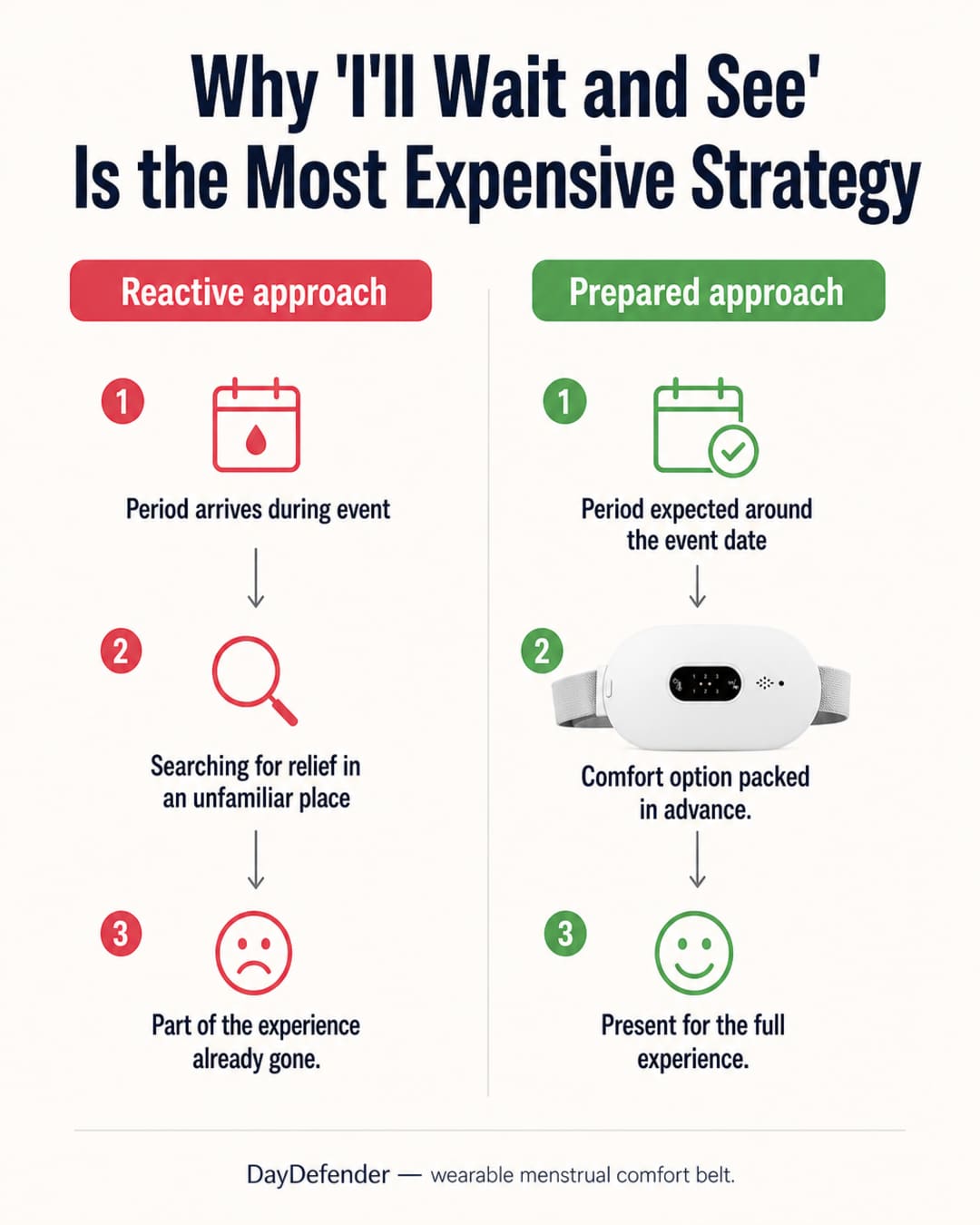
Here is the part that makes preparation feel unreliable even when you want to do it: cycles shift. Even if you track carefully, you have probably experienced the two-day early arrival that reorganized a plan you thought was safe. The period that was "due after the weekend" and showed up Friday morning.
This is not a failure of tracking. Cycles respond to travel, stress, disrupted sleep, and time-zone changes — the exact conditions that stack up around the kinds of events worth attending. A research-backed observation that travel and disrupted routines can affect cycle timing is not a scare tactic; it is the reason "I'll wait and see" is a less useful strategy than "I'll prepare before I leave."
The practical implication is not complicated. A comfort option that lives in your bag or your hotel room does not require your period to arrive on schedule to be worth having brought. It only needs to be there if it shows up.
What DayDefender offers in this context is exactly that: a wearable menstrual comfort belt that you prepare with before the trip, not during it. It is not a guarantee of anything. It is the equivalent of packing the thing you hope you don't need — because on the day you do need it and you didn't pack it, no pharmacy in the airport terminal is going to feel like a sufficient substitute for having thought ahead.
The mechanism here matters: a wearable format means it is with you in the seat, in the venue, at the table — not left behind at the hotel because a heating pad requires a wall outlet and a horizontal surface.
Which raises the obvious next question: what, exactly, is the cost of not preparing, when the event has a specific date?
Reason 3 — What a Difficult Day During a Trip You Booked Months Ago Actually Costs
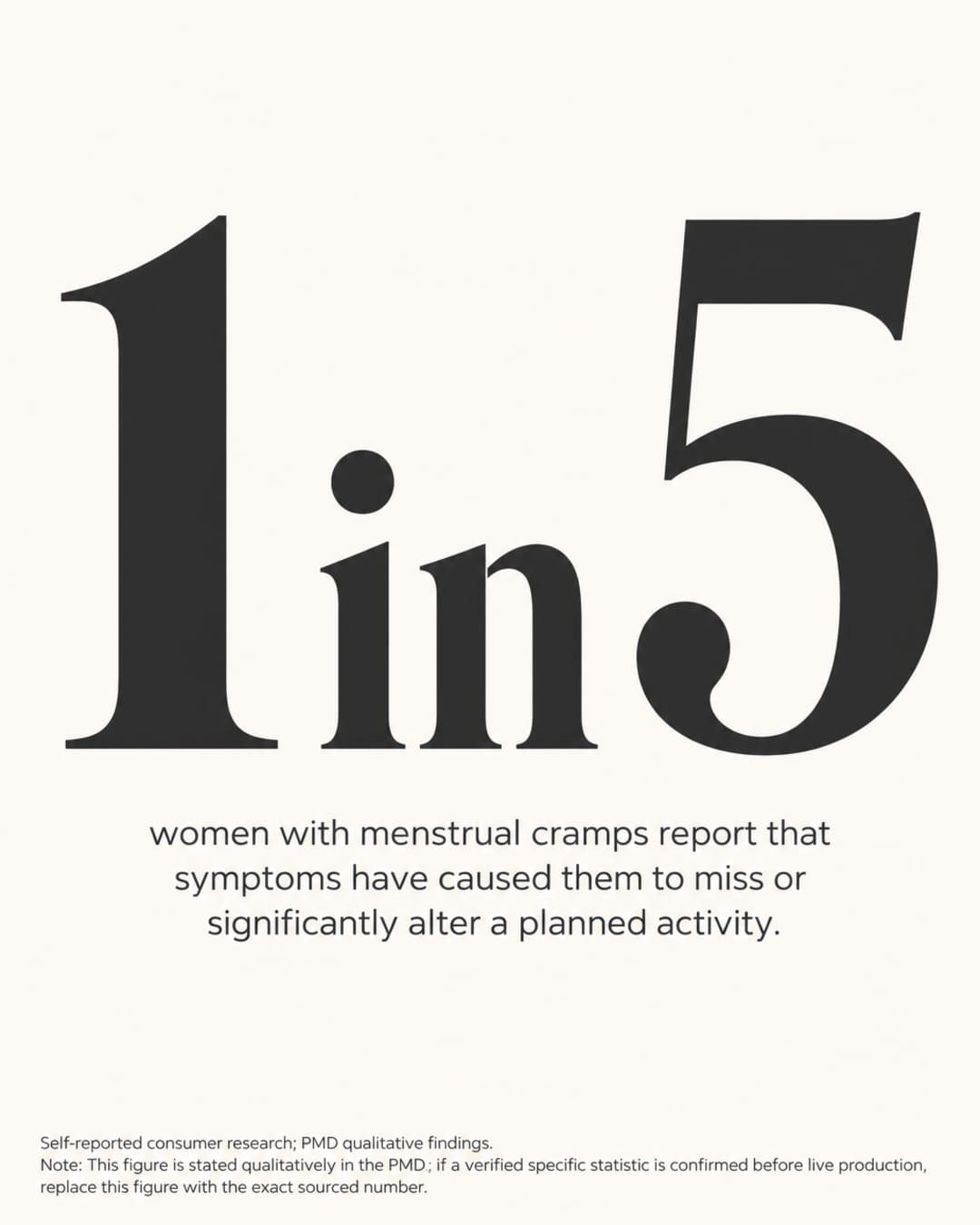
The financial cost of a trip is the most visible number, but it is not the only one.
Consider what goes into the kind of event that tends to overlap with a period at the worst moment. Flights or a long drive. Accommodation. Tickets or reservations that are non-refundable or difficult to move. Time off from work that you do not have an infinite supply of. And underneath all of that: the anticipation you spent across the weeks before it, the texts with the friend you are going with, the specific outfit you picked.
None of that is wasted by a difficult period — you are still there, you still paid for it. But the experience is taxed. You get a reduced version of a day you paid full price for, including the non-financial price of looking forward to it.
This is not a dramatic framing. It is just the honest arithmetic of what it costs when a comfort option that would have fit in a carry-on was not there.
The counter-argument that usually comes up is: "I already have methods that work for me." If that is genuinely true — if what you currently do handles it fully and leaves you present for the whole day — then this product is not for you. But if you have sat through an event wishing you had more options, or found that what works at home does not translate well to a venue, a car, or a crowded dinner table, then the question is not whether a better-prepared version of you is possible. It is whether you will do something about it before the next date on the calendar.
Once you understand that cost clearly, the comparison between options becomes a different conversation entirely.
Reason 4 — The Old Category Answer Is Designed for Your Couch, Not Your Plans
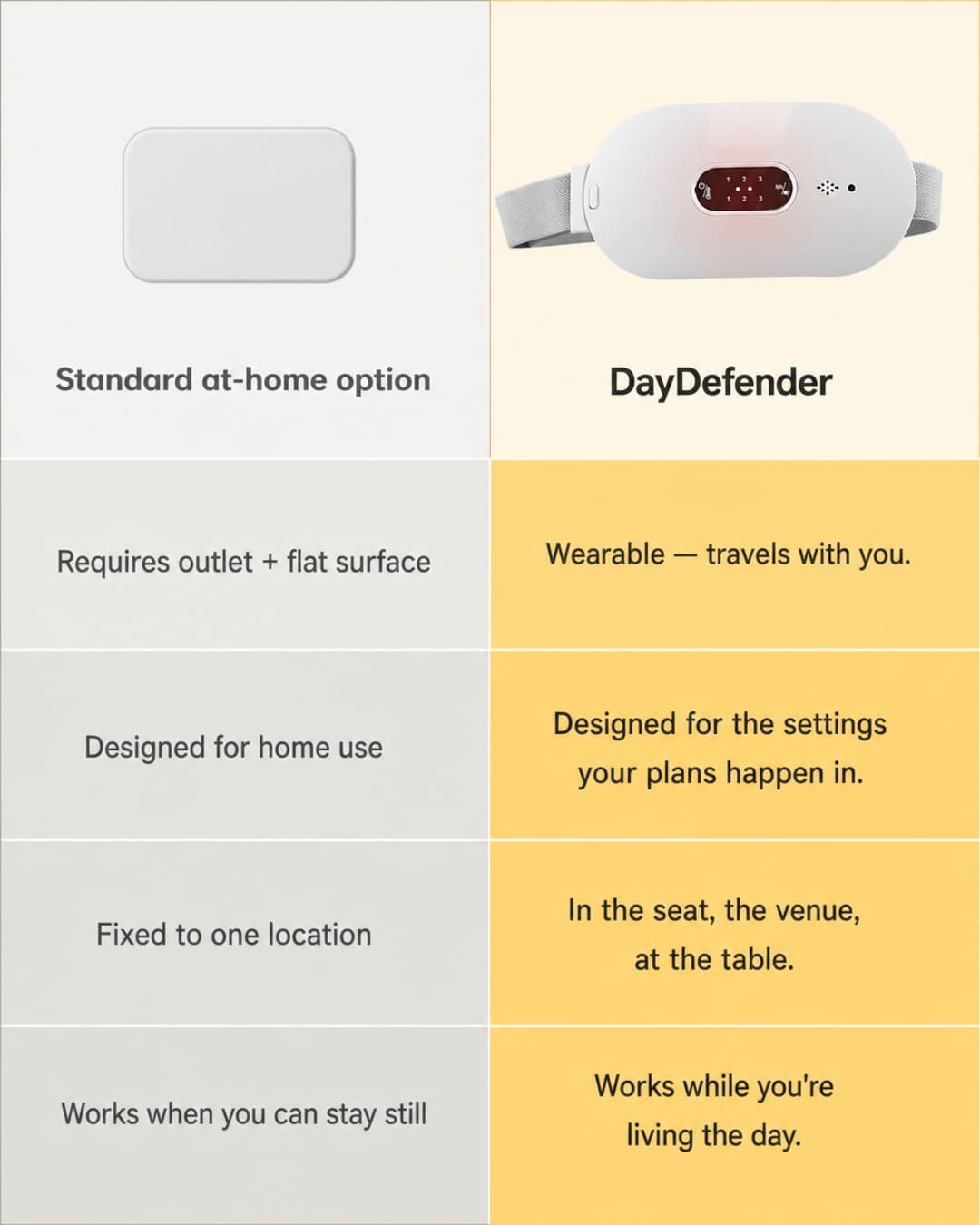
The existing solutions for menstrual comfort do not have a gap in their marketing — they have a gap in their design.
A traditional plug-in heating pad works. It works very well, on the couch, with an outlet two feet away, in a home where you can control how long you stay horizontal. That is not the same environment as a six-hour drive, a venue with a thousand people in it, or a holiday dinner where you want to be at the table rather than excusing yourself to lie down.
Over-the-counter medication has its place. Many women use it and find it helpful. It also has timing constraints, stomach sensitivities for some people, and a limited duration — and on a long event day, the window can be unpredictable.
DayDefender is not in competition with either of those. It is a different form factor for a different setting: wearable, portable, designed to be used in the places where your important days actually happen rather than in the place where you recover from them. The product combines comfort-technology features in a belt you wear at your waist, under or over clothing depending on the situation, so the comfort option travels with you.
The comparison is not "which is better." It is "which is suited to the situation you are actually in." A concert seat is not your couch. A road trip is not your living room. A holiday dinner is not your bedroom. The option that fits the setting is the one worth having thought about before you packed.
Reason 5 — What the Day Looks Like When You Were Ready for It
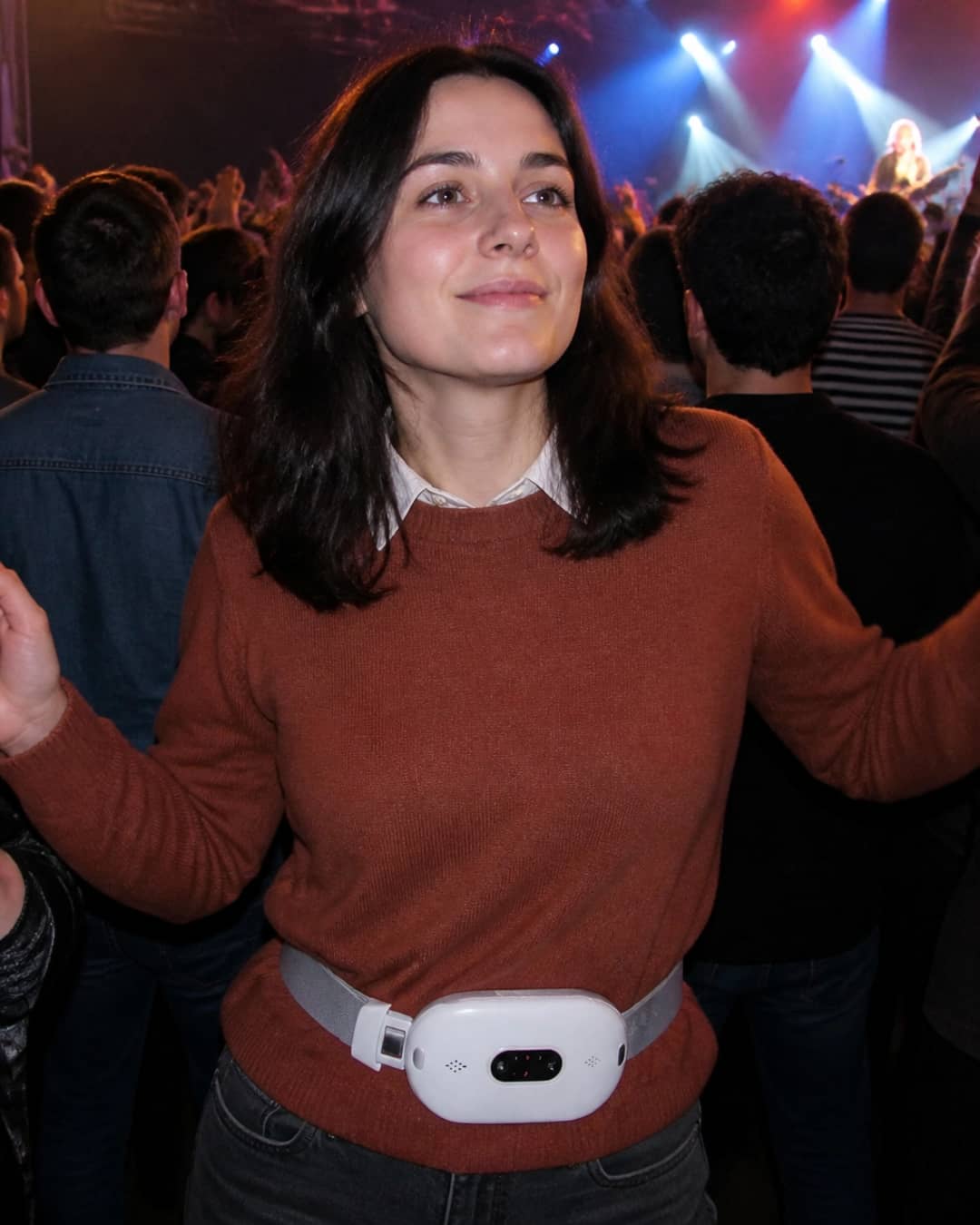
There is a version of the day you planned that you have probably already pictured. Not a perfect day — just a day where the experience is the main thing rather than what you are managing around the experience.
You are in the crowd, actually in it, and the song comes on and you do not have to make a decision about whether to stay or go. You are at the table and the conversation moves and you move with it. You are in the passenger seat on the road trip and the playlist is right and the miles pass the way you wanted them to. None of it is remarkable — it is just the day working the way a day is supposed to work.
That is what preparation creates access to. Not a guarantee. Not a promise that nothing will be difficult. A comfort option you actually have with you, one you thought about before you needed it, so that when your period arrives you are not starting from zero in a hotel bathroom with nothing useful in your bag.
The women who describe this shift do not describe it as dramatic. They describe it as the difference between being at an event and being in one. Between getting through a day and having the day.
DayDefender is a wearable menstrual comfort belt. Before the next date you have been looking forward to, review how it works and the instructions, and decide whether it belongs in your preparation. That is the whole ask — one decision, before the day, so that on the day your only job is to be there.
What Customers Are Saying
"I packed it for a concert trip and was really glad I had it with me. Easy to use and practical — exactly what I needed to feel prepared rather than anxious about the weekend."
Rachel T., Austin TX
"I've tried a lot of things over the years. What I liked about this one is that it actually goes with me — it doesn't need an outlet or a flat surface. My Thanksgiving trip was the first one in a while where I felt like myself the whole time."
M. D., Portland OR
"Well made, comfortable to wear, and it fits under clothes without making a big deal of itself. I appreciated having a comfort option available without having to plan my whole day around it."
Priya K., Chicago IL
The Next Important Date Is Already on Your Calendar — and You Still Have Time to Prepare for It
Think back to the last time a difficult period landed during something you had been looking forward to. Not the cramps in isolation — the specific experience those cramps were inside. The event you paid for, planned for, took time off for, bought the outfit for. The version of that day you got was smaller than the one you were supposed to have.
That is the cost that does not appear on a receipt. But it is real, and you have felt it, and another date is coming.
Here is what you now know:
- The overlap between important events and period timing is not bad luck — it is predictable enough to prepare for.
- Reactive strategies work better in familiar settings; they fail most visibly in the exact environments where your important days happen.
- A wearable comfort option you bring with you is a categorically different tool than what works at home — because it goes where the day goes.
- Preparation before the event costs less, in every sense, than improvising during it.
- A single decision now — before the date — is the entire difference between two versions of the same day.
You have seen what happens when the day arrives and the option is not there. You have also pictured what the day looks like when it is. The mechanism is not mysterious: a wearable menstrual comfort belt, prepared for and packed before the event, available when your period arrives rather than scrambled for after.
The next date on your calendar does not move. Your period does not coordinate. But your preparation can.
See how DayDefender works — and decide whether it belongs in your plan before the next event.