Your Trip Is Booked. Your Period Might Be, Too.
For anyone who has ever checked the calendar twice — once for the flight, once for their cycle — this is the comfort plan worth making before you pack.
There's a specific kind of dread that arrives a few weeks before a trip you've been genuinely looking forward to. You're not dreading the trip. You're dreading the math. You open the calendar app, count the days, and the number lands somewhere between "probably fine" and "exactly that week."
Most people don't talk about this out loud. They just carry it. The quiet background calculation that runs through every conversation about the holiday plans: where the nearest pharmacy will be, whether the rental car has a comfortable seat, whether the family gathering has somewhere to slip away for twenty minutes without explaining why. The trip is real and good and worth going on. The mental overhead is also real.
The frustrating part isn't the possibility of discomfort — it's the feeling of not having a plan. Of waiting until the day is already hard to figure it out. Cramps on a regular Tuesday are one thing. Cramps on the morning of a four-hour drive, or on the first full day of a visit you've been planning since September, are something else. The situation is the same; what changes is what's at stake.
That gap — between "the date is on the calendar" and "I have actually thought about my comfort options" — is exactly what this is about. Not a promise that every day will be easy. A real option to think through before you leave.
The Anxiety Starts Before the Cramps Do
Nobody warns you about this part. The cramps, if they come, arrive on the day. The worry arrives weeks earlier, the moment you notice the dates are close.
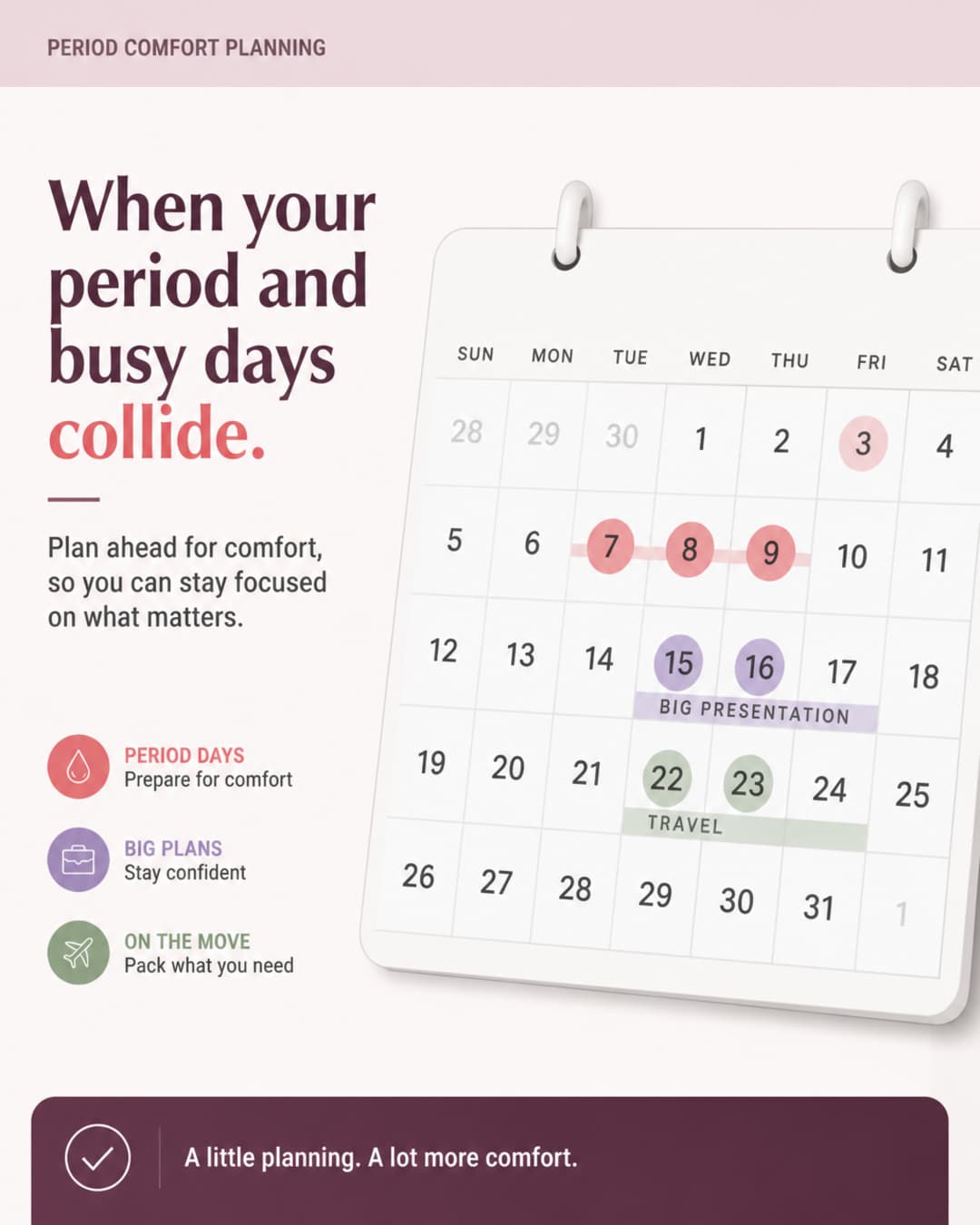
Maya knows the feeling. Trip booked for the Wednesday before Thanksgiving. Period estimated — based on nothing more reliable than a rough count backward — for sometime Thursday or Friday. Not confirmed. Not certain. Just close enough that it sits in the back of her mind every time someone at work asks if she's excited for the holiday.
She is excited. That's the whole problem. When the event doesn't matter much, the uncertainty is easier to brush off. When you have been looking forward to something — a trip, a gathering, a celebration you planned and saved for and told people about — the anticipatory weight is proportionally heavier. The mental load isn't irrational. It's a direct function of how much the event means.
What's worth naming here is that the anxiety itself has a cost. Not a dramatic one. Just the quiet, low-grade cost of carrying something unresolved. The "I should probably think about this at some point" that you keep deferring because the date still feels far enough away. And then it doesn't.
The impulse most people follow is to wait. Wait until the period actually arrives, then figure it out. There is a logic to that — no point solving a problem that might not materialize. But the waiting strategy has a structural flaw, and understanding it changes how you think about the calendar.

What "I'll Figure It Out When I Get There" Actually Costs You
Here is the misunderstanding worth unpacking. Most people treat period-comfort management as a reactive problem — something you address when symptoms arrive. Reach for what you have on hand. Stop at a pharmacy. Find somewhere to lie down. The assumption underneath this is that the day of is soon enough.
That assumption works reasonably well at home. At home, you know where everything is. You can control your environment, adjust your schedule, cancel or reschedule. The tools you rely on are plugged into the wall, available whenever you need them.
Travel is a different operating environment. Dana figured this out the hard way. New Year's Eve, her first time hosting, friends coming over at seven. Her period arrived that morning. Everything she had was at home. Everything she had at home required being stationary, or plugged in, or somewhere she could lie flat for thirty minutes without anyone noticing. None of those things were available after 5pm on December 31st in her own kitchen with a party starting in two hours.
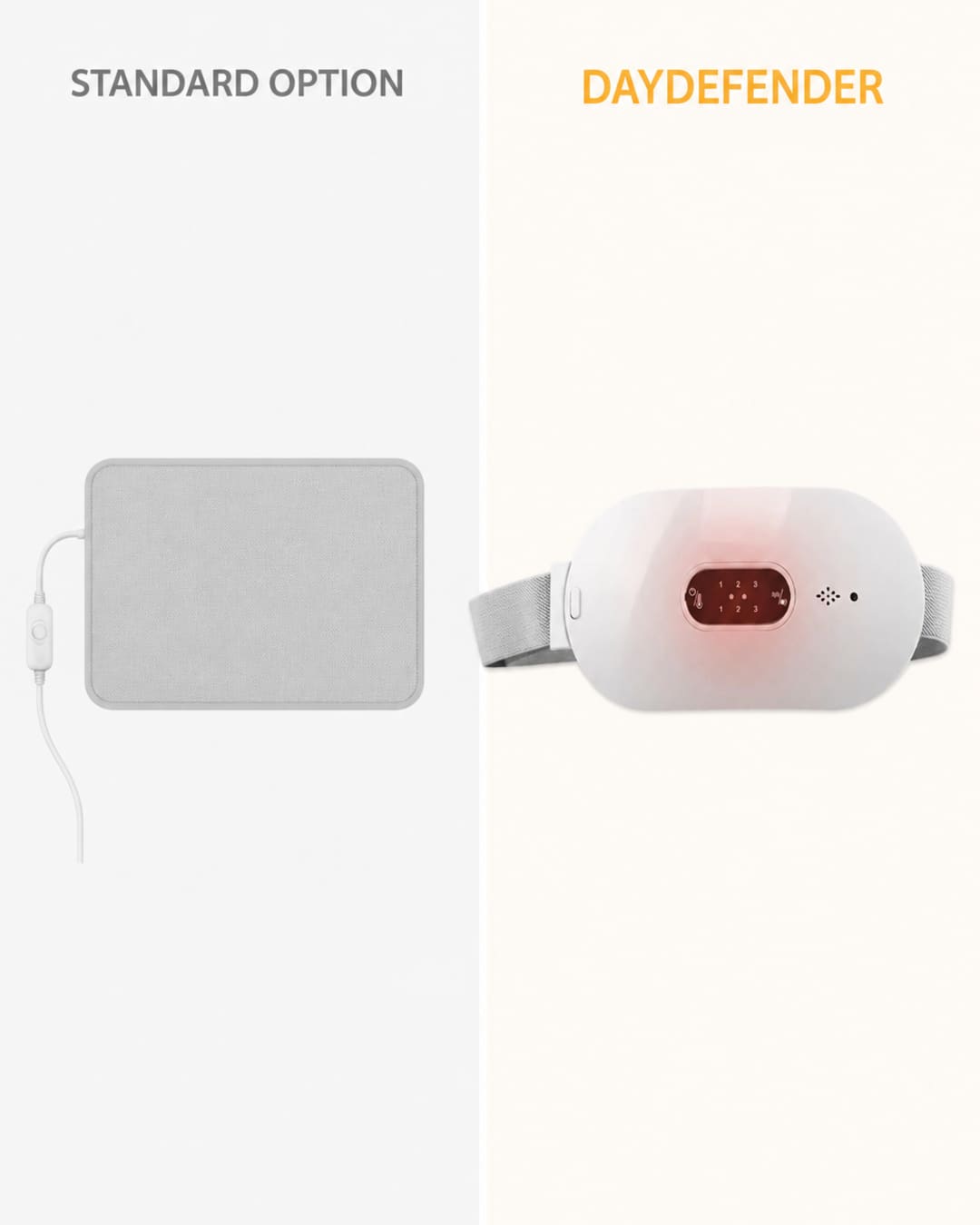
The gap isn't between having a solution and not having one. It's between having a solution designed for home and having one that actually works in the situation you're in. A corded heating pad does not pack. It doesn't work on a plane, in a passenger seat, at a family dinner table, or in a hotel room where you've agreed to be somewhere at nine in the morning. The mechanism of relief is sound — heat applied to the lower abdomen has a long history of being part of a menstrual comfort routine. The form factor is the problem.
DayDefender™ is a wearable menstrual comfort belt. It's designed to be part of a preparation routine that travels with you, rather than a solution you leave at home by accident. The idea is not that it replaces everything you already do — it's that it exists when the things you usually rely on don't.

The Day You Spent the Most On Is the One You Were Least Prepared For
Let's make the cost concrete, because it usually isn't when the trip is still weeks away.
A Thanksgiving flight — booked months in advance, factoring in the price surge — runs several hundred dollars round trip for most US travelers. The hotel, or the gas and tolls for a road trip, on top of that. The time off work arranged and approved. The coordination with family or friends who are also traveling. The specific occasion — a holiday, a birthday, a concert with tickets that sold out fast — where the date is not optional and the experience cannot be rescheduled.
Now consider what a difficult period actually costs against that backdrop. Not necessarily a ruined trip — most people push through — but a compromised one. The hours spent managing discomfort instead of being present. The experience watched from a degree of remove. The recurring thought, underneath everything else, of how much easier this would all be on the couch at home.
Priya has done this calculation more than once. The Christmas visit costs what it costs — money, time, the emotional investment of a trip she makes once a year. She cannot know for certain when her period will arrive. What she can know is whether she has thought about her comfort options before she boards the flight. One of those things is outside her control. The other isn't.
The point is not that preparation guarantees a better trip. It's that arriving at an expensive, meaningful, hard-to-reschedule event having done nothing about a known, recurring possibility is a choice with a cost. Not a dramatic cost. Just the quiet, preventable cost of waiting until the options are limited.

Why the Thing You Already Own Wasn't Designed for This
The most common objection at this point is reasonable: "I already have a heating pad. Why would I need something else?"
The honest answer is that a corded heating pad is genuinely useful in its intended context. It does the thing it was designed to do, in the place it was designed to do it — stationary, plugged in, at home. The issue isn't efficacy in that setting. The issue is portability.
When you're traveling, or spending a full day outside your home environment, the category of "comfort options I own" and the category of "comfort options actually available to me in this situation" are different lists. The gap between them is a portability gap, not an efficacy gap.
A wearable belt is designed specifically for the second list. Not better in absolute terms — different in a meaningful practical way. It goes where you go. It works in the situations where the other option doesn't. It belongs in a bag, on a flight, in a passenger seat, at a gathering. Whether it belongs in yours depends on whether that gap applies to your life — but for the event-conscious planner who has an important date approaching and can't predict exactly when her period will arrive, the portability question is the relevant one.
What Preparation Actually Looks Like on the Day
This is the part that's hard to visualize until you've done it: what does it feel like to have thought ahead?
It doesn't mean the day is guaranteed to be easy. It doesn't mean the period doesn't arrive. What it means is that when you leave for the trip — when you load the car, or get to the airport, or walk out the door toward the thing you've been planning — you're not carrying the weight of having done nothing.
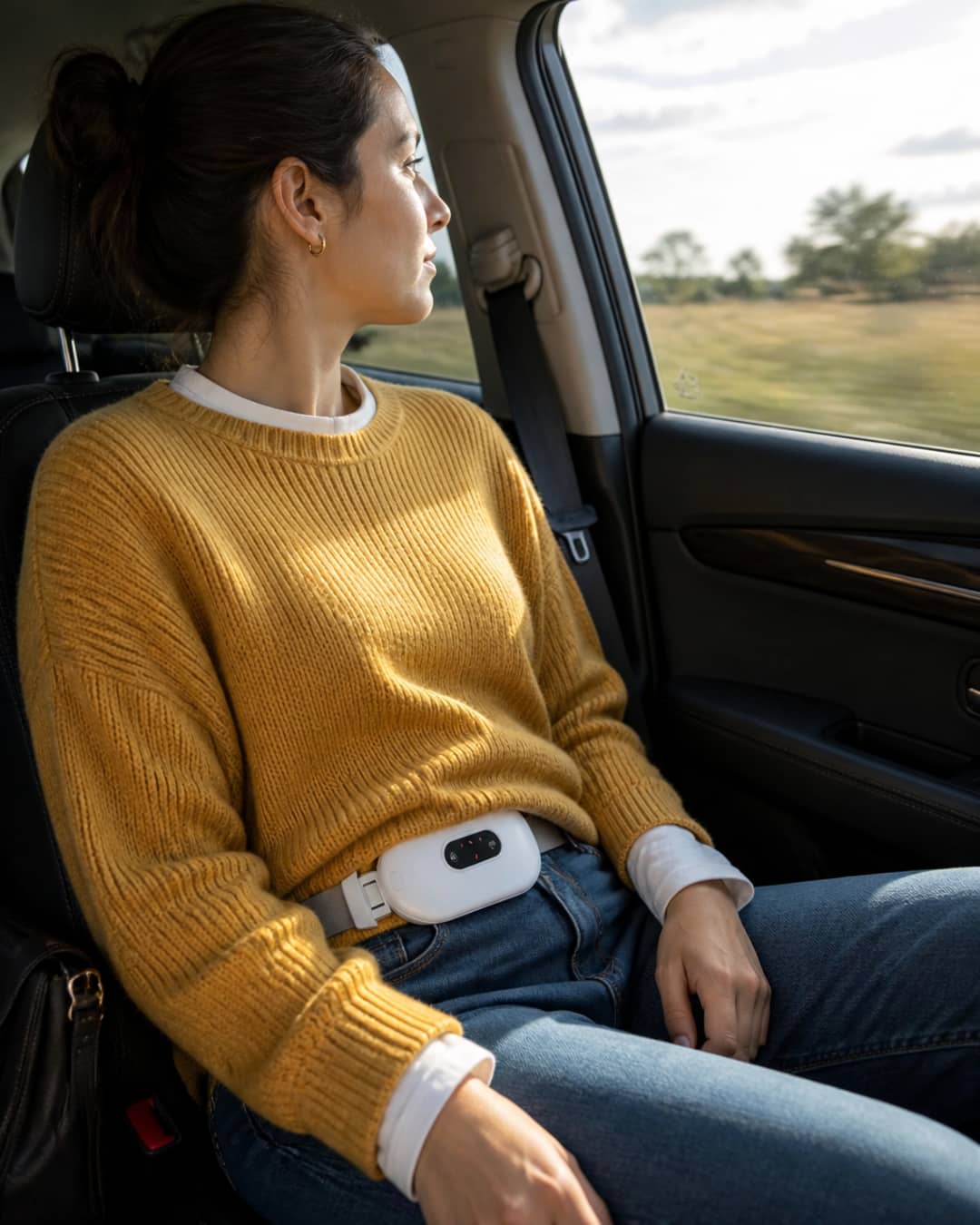
Maya's Thanksgiving trip happened. Her period arrived Thursday morning, one day into the visit. She had packed the belt. She wore it under her sweater during the afternoon, while her family was in the kitchen. She was present for most of it in a way that, the year before, she hadn't been.
Not a perfect day. A prepared one. There's a real difference, and the difference starts before departure.
The purchase trigger for this kind of product is almost always a calendar moment — a specific date approaching, a period window that overlaps with something that matters. That moment is the time to think about it, not the morning of. The window between "I notice the dates are close" and "I'm already on the road" is exactly the window that this kind of preparation is designed for.
If you have a trip, a gathering, a party, a visit, or a fixed commitment on the calendar — and your period may be expected around that time — this is the moment to look at your options.
What Customers Are Saying
4.8 out of 5 · 247 customer reviews
"I have a long flight every December to see my family and the timing always made me anxious. Having a comfort option I could actually pack and use while traveling made the whole preparation feel much more manageable."
Rachel T., Denver CO
"Practical and easy to use. I appreciated that it does what it says without requiring me to be near an outlet. Fits into my bag without any hassle."
M.K., Chicago IL
"I wish I had thought about this sooner. The idea of actually preparing before the event rather than scrambling on the day felt like common sense once I thought it through. Well made and worth it."
Janelle P., Austin TX
The Trip Is Coming. The Window to Prepare Is Now.
Here is the real cost of not clicking: you already know the dates are close. You've done the math at least once. The event is on the calendar, it matters to you, and your period may arrive right in the middle of it.
The question is not whether to solve it on the day — most people find something. The question is whether you want to arrive at a trip you've invested in, a gathering you've been looking forward to, a fixed date that cannot move, having thought about your comfort options — or not.
What changes when you prepare:
- The mental load drops. The quiet background calculation — "what will I do if it arrives during the trip" — has an answer before you leave.
- The gap between home and away closes. A comfort option designed to travel is available in the situations where the one plugged into your wall isn't.
- The event stays the event. You've already invested the time, money, and emotional energy. Preparation is how you protect that investment.
- You're not solving it on the worst possible morning. Departure day, travel day, the morning of the big dinner — these are not the times to figure out logistics.
- One decision, made now, is one thing you're not carrying. That has a value that's hard to quantify and easy to recognize.
If you arrive at the product page and DayDefender isn't the right fit for your situation, you'll know quickly. But if you have a real date on the calendar and a period window that overlaps with it, the time to look at your options is before you pack — not after you're already on the road.