Don't Wait Until You Get Home to Do Something About Your Neck
This is for anyone whose neck and shoulders quietly tighten across the workday — and who keeps putting off doing anything about it until the day is already over.
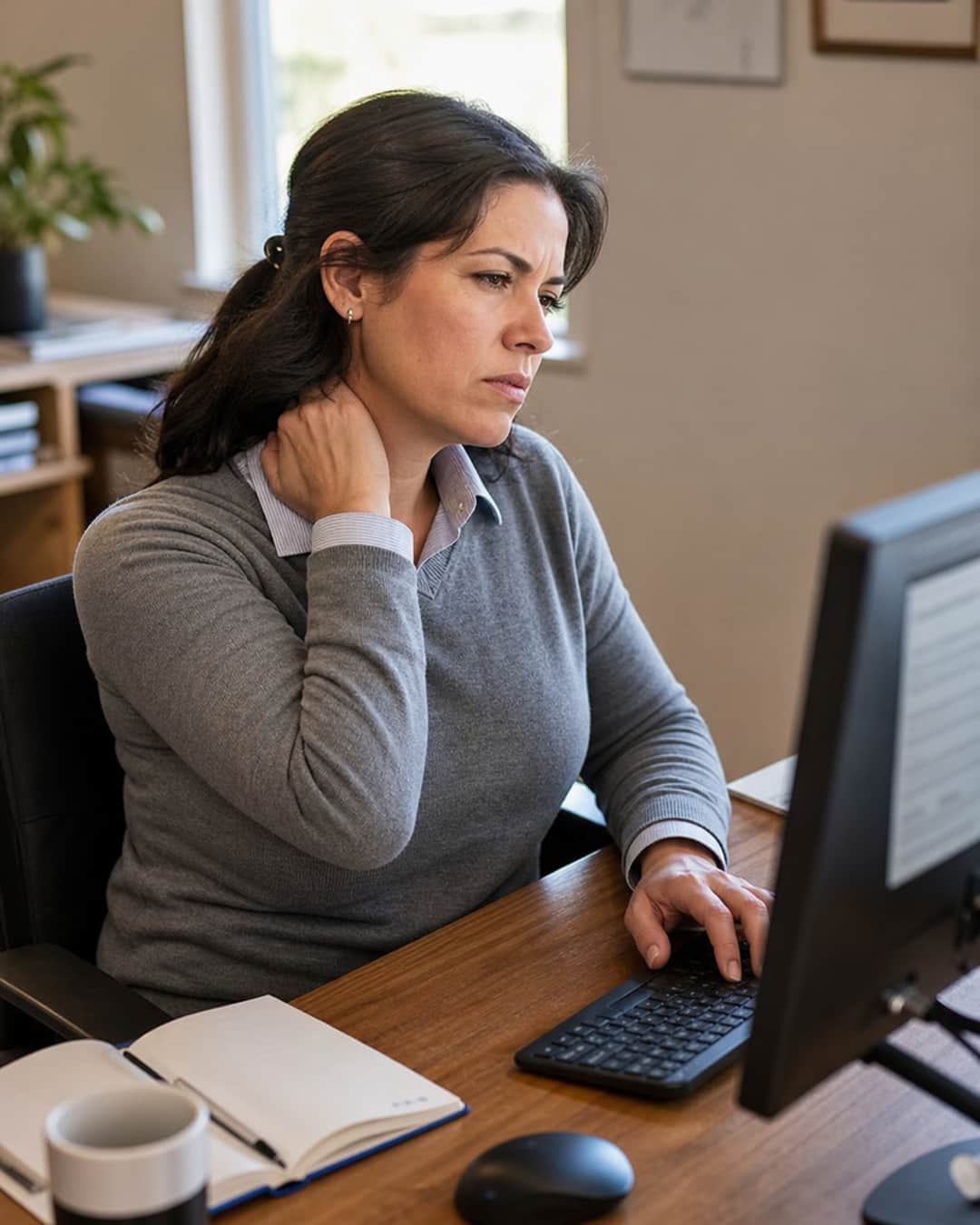
There's a particular kind of discomfort that doesn't announce itself dramatically. It builds. Somewhere around the second or third hour at the keyboard, you notice your shoulders have crept upward. Your neck feels denser than it did at nine in the morning. You roll your head, hear the familiar crackle, press two fingers into the spot where your neck meets your shoulder — and then go back to your screen. Because there's more to do. Because the thing you use for this is at home. Because you'll deal with it tonight.
Tonight arrives. You're tired in a different way now — the accumulated tiredness of a full day, not just the tight neck from the afternoon. You heat up a pad, or you try to reach the spot with your fingers, or you do a few neck rolls before bed and call it done. And then the next morning, inside the first two hours at your desk, the same thing starts again.
That cycle — tension building during the day, relief attempted at the end of it, reset and repeat — is what most desk workers have normalized. Not because it's the only way. Mostly because nobody asked whether the routine could move earlier.
The question worth sitting with is a simple one: what if your neck-comfort routine didn't have to wait until you got home?
Reason 1 — The Worst Part Isn't the Tightness. It's When It Happens.
There's a difference between neck tension that arrives after a long day and neck tension that arrives in the middle of one.
When it builds during the afternoon — during your most demanding hours, during calls, during the stretch of the day when you most need to concentrate — it doesn't just hurt. It interrupts. It splits your attention between the task in front of you and the sensation behind your ear, at the base of your skull, at the point where the neck meets the trap. You press the spot with your thumb. You roll your shoulder. You shift in your chair. None of it does much, and it costs you a beat of focus every time.
The problem isn't that people don't try to manage this. They do — in the evening. After work. When they've already absorbed a full afternoon of that fractured attention. By that point the comfort routine they run is genuinely late. The tension has had five or six hours to settle in, to be compensated for by adjusted posture, tensed-up secondary muscles, a jaw held a little too tight. The evening routine is addressing something that spent the whole afternoon becoming more stubborn.
This is the part that rarely gets named directly: the timing mismatch. You have the need at two in the afternoon. You have the routine at nine at night. That gap — measured in hours of low-grade discomfort that disrupts focus, alters posture, and makes the second half of the workday harder than it needs to be — is the actual problem.
Most tools aren't designed to close it. They're designed for use at home, in a chair, with your day already finished. That's not a criticism — it's just a design assumption that doesn't match where the discomfort actually lives.
"By the time I get home, I'm too tired to even bother. I just want to sleep. And then it starts again tomorrow." — a recognizable experience in desk-worker feedback
The next part is about what the device does and why the combination it uses is relevant to this specific situation — not as a treatment claim, but as a look at how three things work together in one wearable.
Reason 2 — Heat, Massage, and Electrical Stimulation — Here Is What the Combination Actually Does
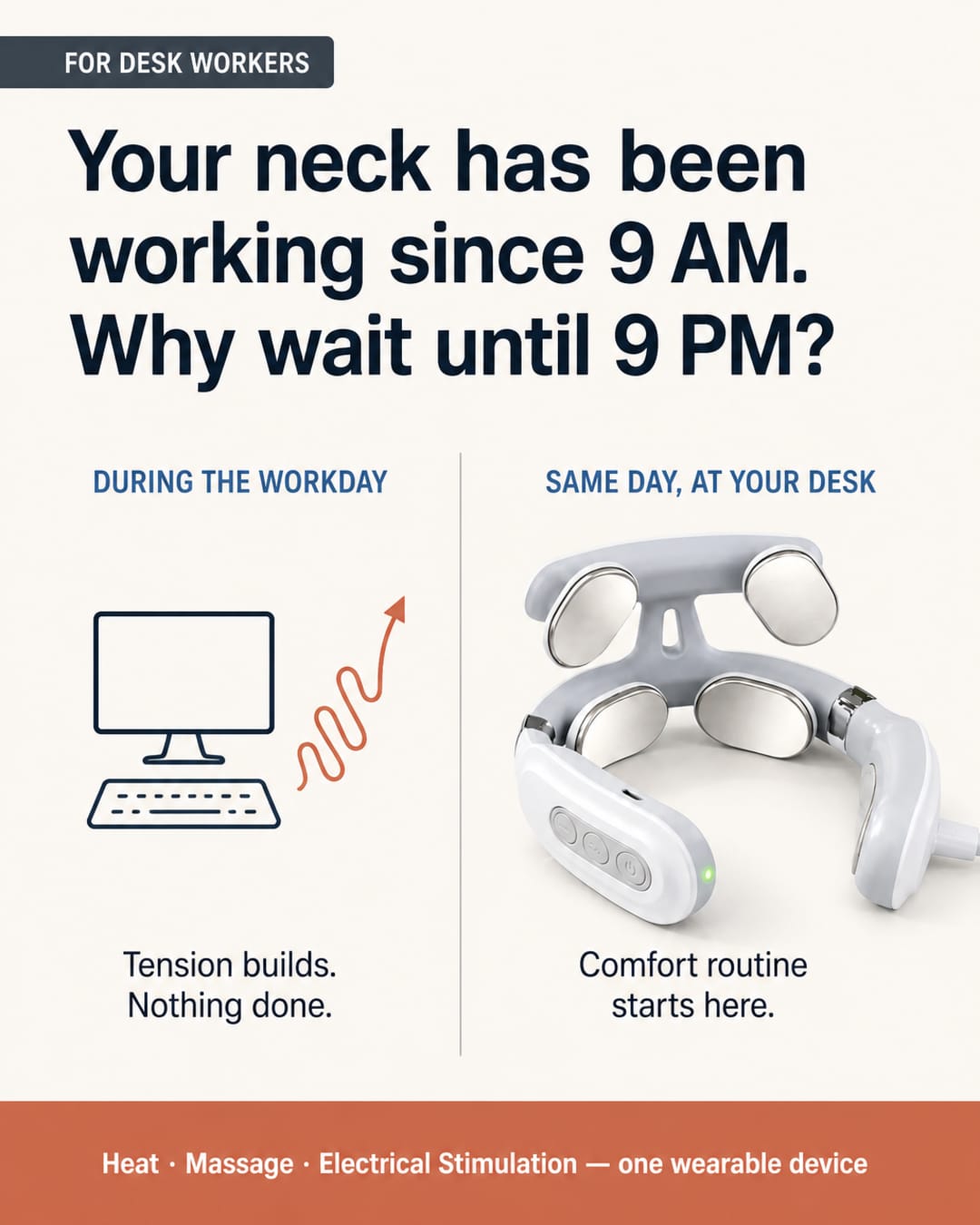
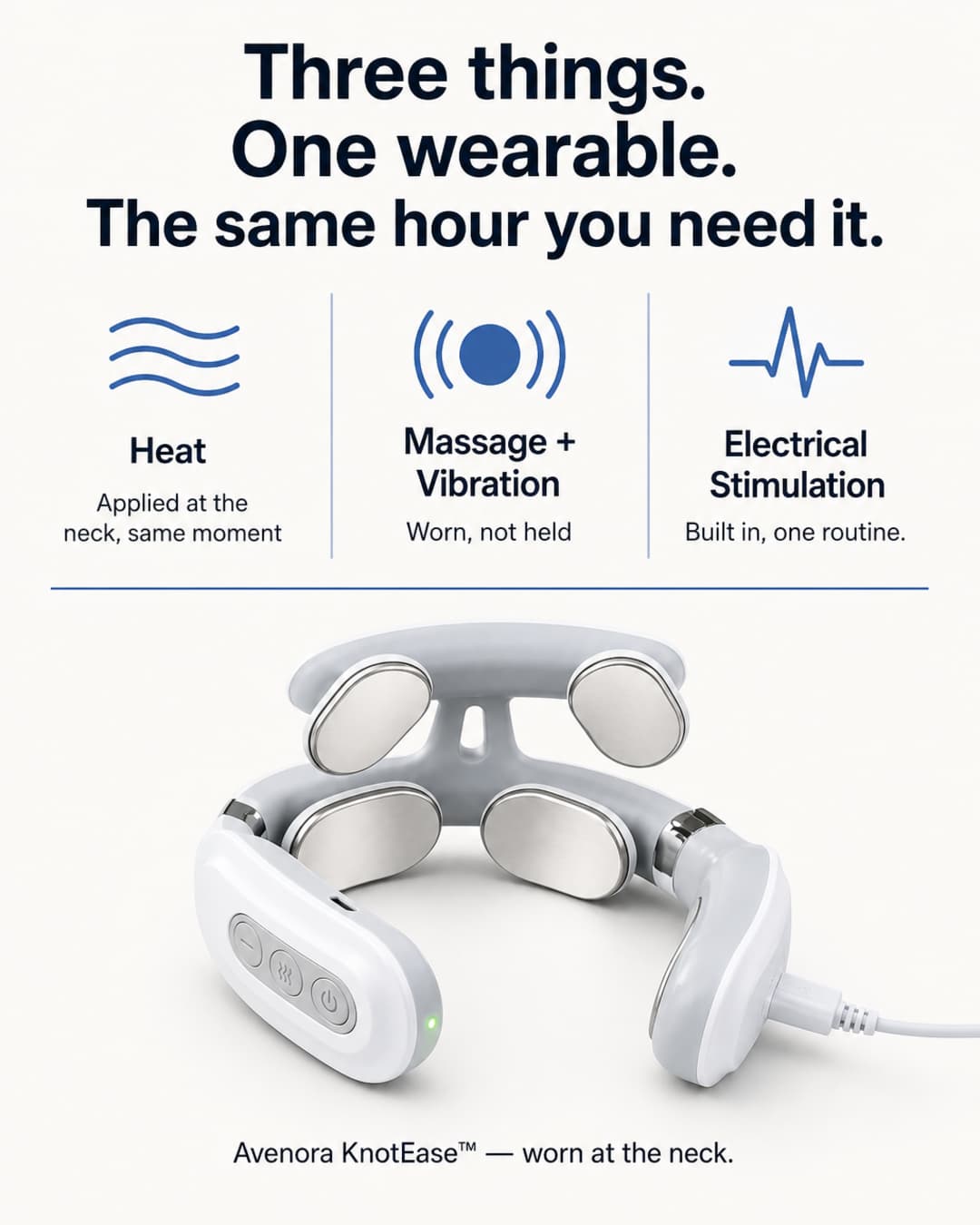
It's worth being direct about what KnotEase is: a wearable neck device that combines heat, massage and vibration, and electrical stimulation in a single unit designed to be worn around the neck.
Each of those three things has its own function in a comfort routine, and seeing them together in one wearable is the relevant starting point for understanding why this is a different kind of option.
Heat — the application of warmth to a specific area — is a common component of neck-and-shoulder comfort routines for a reason. A heated pad does one thing. KnotEase integrates heat with the other two functions in the same unit, applied to the same area simultaneously, so you're not sequencing them across three separate sessions.
Massage and vibration — rhythmic mechanical input to the neck area — is the tactile dimension. The device is worn at the neck, which means the contact points are at the back and sides of the neck, the area where a wearable collar-shaped device naturally sits. This is distinct from a handheld massager that requires you to position it and hold it in place; you wear this one and continue with what you're doing.
Electrical stimulation (EMS) — the delivery of a low-level electrical signal through contact points — is the third component. Before publishing any specific claim about what EMS does or doesn't do, consult the device's verified instructions and regulatory documentation. What can be said accurately is that it is one of the three functions built into the unit.
What makes this relevant to the office-day situation specifically is the form factor. You are not lying down. You are not holding anything. The device fits around your neck and you can remain seated at your desk while it runs, which is the entire point of positioning it as something you don't have to wait until evening to use — provided the device's instructions permit use while seated and working, which should be confirmed before advertising.
The combination isn't the same as three separate tools used at three separate times. It is one routine, at the time the discomfort is actually present.
Reason 3 — Count the Afternoons, Not Just the Ache
There is a way to think about this that has nothing to do with discomfort as a medical matter.
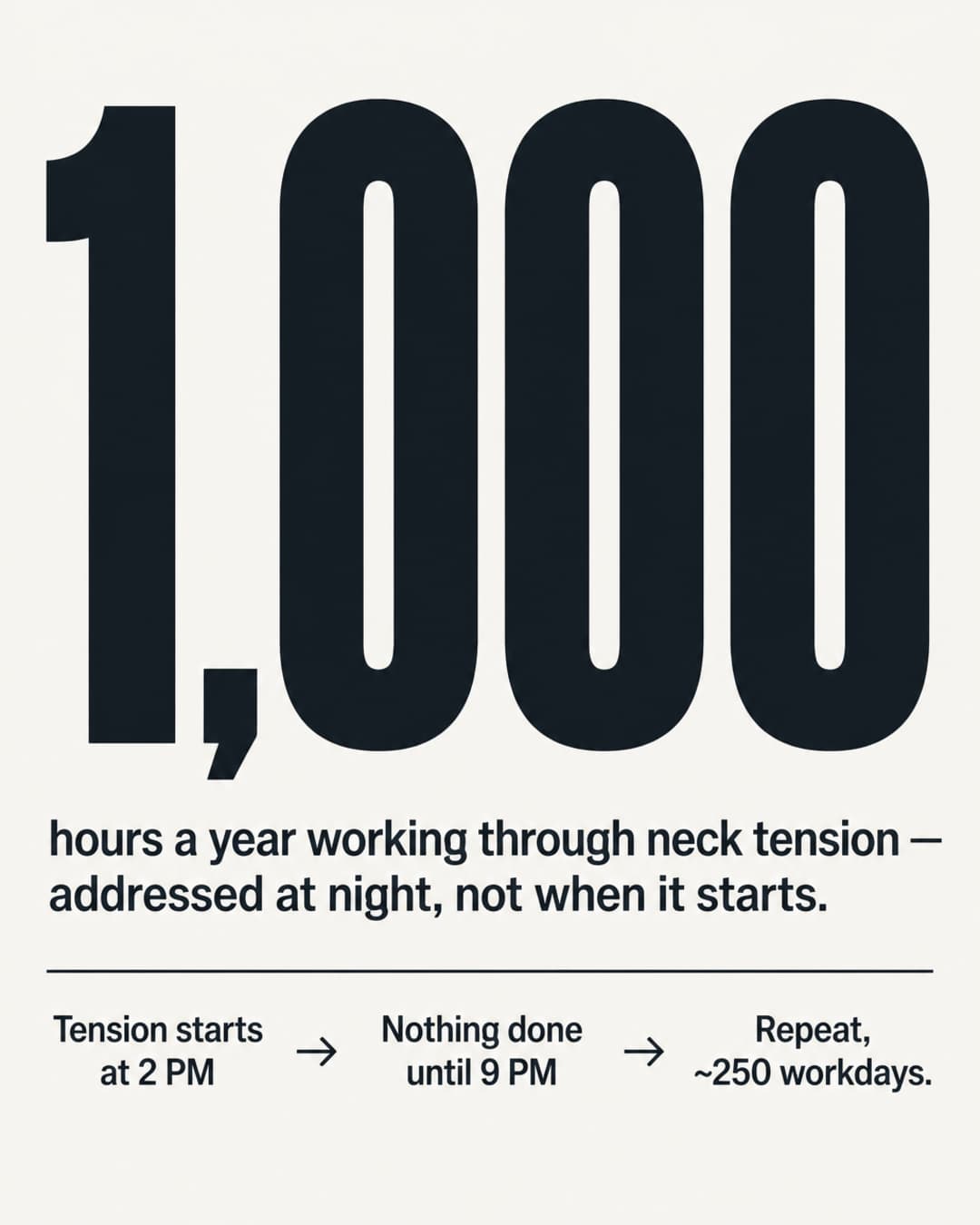
Think about the number of workday afternoons in a year — roughly 250, accounting for weekends. If neck and trapezius tension starts building reliably at, say, two in the afternoon, and isn't addressed until the evening at the earliest, that's an average of five or six hours per day in which a person is working with reduced comfort and split focus.
Over a year, at a conservative estimate of four disrupted hours per day: roughly 1,000 hours.
That is not a medical claim. It is a straightforward arithmetic observation about what the timing gap costs — not in medical terms but in the quality of the hours spent at the desk. Hours in which a person is pressing their own neck instead of concentrating, adjusting their posture instead of finishing a paragraph, waiting until it's bad enough to do something instead of addressing it when it starts.
Nobody writes that number down. It accumulates invisibly, absorbed into the background noise of a working week, normalized because it's been happening long enough that it no longer registers as a problem to be solved — just a condition to be endured until the day ends.
The routine you run at nine at night doesn't recover those afternoon hours. It addresses what's left of the discomfort at the end of them.
The thing worth asking is not whether evening routines help. They may. The thing worth asking is why the routine starts so late.
Reason 4 — Every Other Option Has the Same Assumption Baked In
There are several approaches a person in this situation might use, and they tend to share one structural assumption: they are designed for use after the workday.
A heating pad plugs in, usually to a wall. You use it sitting in a chair at home or lying down. It is not something most people bring to the office, and it requires both hands to be free of anything else.
A handheld massager requires one arm to be raised and positioned behind the neck or across the shoulder. During a workday, at a desk, mid-task, that is either not possible or sufficiently disruptive that you wait until later.
Stretching helps some people. It is free. But it requires stopping the task, standing up, moving through a sequence, and it doesn't replace heat or sustained mechanical input to the area.
Professional massage is a different category. It's effective for many people. It also requires scheduling, travel, time outside the workday, and a cost per session that most people don't incur daily.
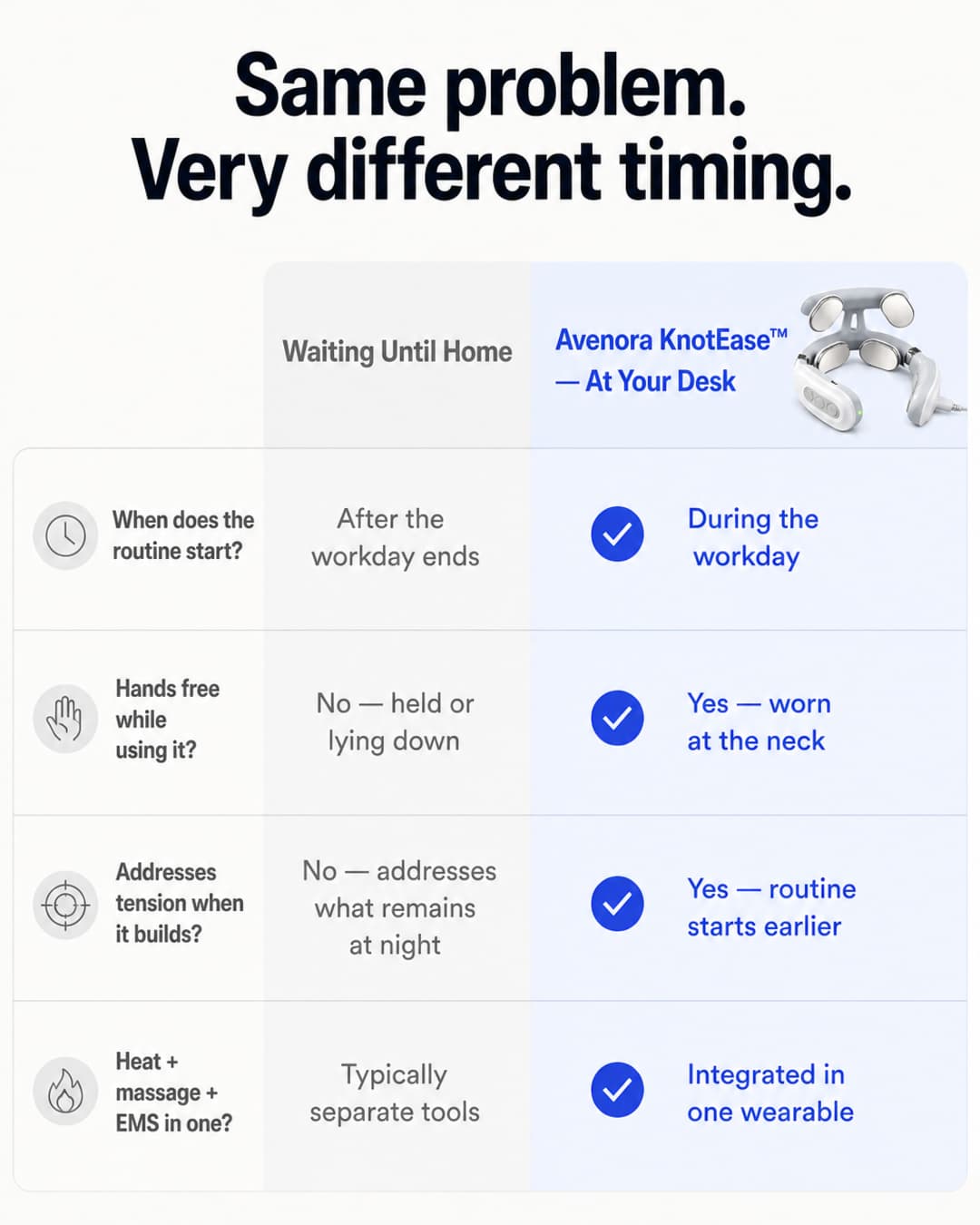
The structural difference KnotEase offers is not that it does more things than any one of those. It's that it is designed to be worn. It sits at your neck. Your hands are free. You can remain at your desk. The routine can start during the workday, not after it — which is the only form of this comparison that actually addresses the timing problem described in every section above.
This comparison is made on a structural basis, not on an efficacy-superiority basis. Every claim above should be verified against the actual device's instructions and permitted use before advertising.
Reason 5 — The Afternoon Doesn't Have to Be the Hard Part of the Day
There is a version of the workday that desk workers rarely think of as an option, because they've stopped expecting it. It's not the version where everything feels effortless. It's the version where a tight neck at two in the afternoon gets addressed at two in the afternoon.
Not at night. Not after the tension has had five more hours to be compensated for. Not after the day has already been harder than it needed to be.
KnotEase is a wearable. It sits at your neck. You put it on. You return to what you were doing. The heat, the vibration, the electrical stimulation — all three running while you stay at the desk. If the device's instructions permit use while seated and working (confirm this with the documentation before advertising), the routine doesn't interrupt the day. It runs alongside it.
This is not a guarantee of instant relief. The device is positioned as a convenient addition to a personal comfort routine, within its verified intended use — not as a medical treatment and not with any promised outcome attached. What it offers is a different structure: the comfort routine starts when the discomfort starts, rather than hours after.
For someone who has been absorbing the same pattern for months or years — tight neck by mid-afternoon, wait it out, deal with it tonight, reset tomorrow — that shift in timing is the actual change on offer.
That's the thing the evening routine was never going to provide, no matter how well it worked. It was always starting too late.

What Customers Are Saying
"I used to just push through the afternoon tightness and deal with it at night. Having something I can actually put on at my desk is a practical change to my routine — easy to use and stays in place while I work."
Rachel M. · Austin, TX
★★★★★
"Well made and does what it says. I like that I don't have to stop what I'm doing to use it — it fits around my neck and I keep working. The heat component is noticeable and comfortable."
D. Okafor · Chicago, IL
★★★★★
"I was skeptical, but the concept makes sense once you actually try it during the day instead of waiting until the evening. Practical and not complicated to figure out."
James T. · Seattle, WA
★★★★☆
Your Neck Has Been Waiting Since Two O'clock
The tension that builds by mid-afternoon doesn't stay at mid-afternoon. It's still there at four. It's still there when you pack up. It's still there when you finally sit down at home to do something about it — except now you're doing it seven hours late, with less energy than you had when the discomfort first started, and it's already tomorrow morning before the cycle begins again.
You've seen what the timing gap costs. You've seen what the combination is. You've seen what it looks like to close that gap — not by adding another evening routine, but by moving the routine earlier.
What changes when the routine starts during the workday instead of after it:
- The hours between two and five at your desk are not spent managing tightness at the expense of focus
- The evening routine, if you still want it, starts from a different baseline
- The pattern of "absorb it all day, address it tonight" gets an alternative
- The device does the work while your hands remain on the keyboard
- You stop treating afternoon discomfort as something you have to earn the right to address later
The reader who got this far already knows that the evening routine isn't the problem — it's just arriving too late. The question isn't whether to change every habit. It's whether to add one earlier option to the day, at the time it actually matters.
The full details — exactly how it works, how it fits, what the instructions permit, and what the actual offer looks like — are on the next page. This is the moment to look.