That Knot Between Your Shoulder Blades Keeps Coming Back Because You Keep Chasing It
For anyone who has spent months pressing directly on the same stubborn spot — and watching it return by morning.
There is a specific kind of frustration that does not get talked about enough. It is not the pain itself, though that is real. It is the ritual around the pain — the one that starts the moment you feel that familiar tightness set in between your shoulder blades, somewhere in the middle of your back, just out of reach.
You know the drill. You get up from the desk. You find the ball. You lean into the wall, or you lie on the floor, and you roll until you hit the spot. There it is — that specific, slightly nauseating ache that tells you you have found it. You stay there. You breathe. For a minute, maybe two, it softens. You stand up, roll your shoulders back, think: okay, that helped.
By the next morning, it is back. Same spot. Same depth. Same stubbornness.
If you have been doing some version of that routine for months — or years — you are not alone, and you are not doing it wrong. The problem is not the effort. The problem might be the direction.
Most people, when they feel a knot between the shoulder blades, aim everything they have directly at that spot. It feels logical. It feels like the right target. But what if the more useful starting point was not the spot you can feel — but the area you have been overlooking?
What follows is why a different kind of approach — one that starts at the neck, not the knot — has become worth paying attention to.
The Ball Finds the Spot. The Spot Never Actually Leaves.
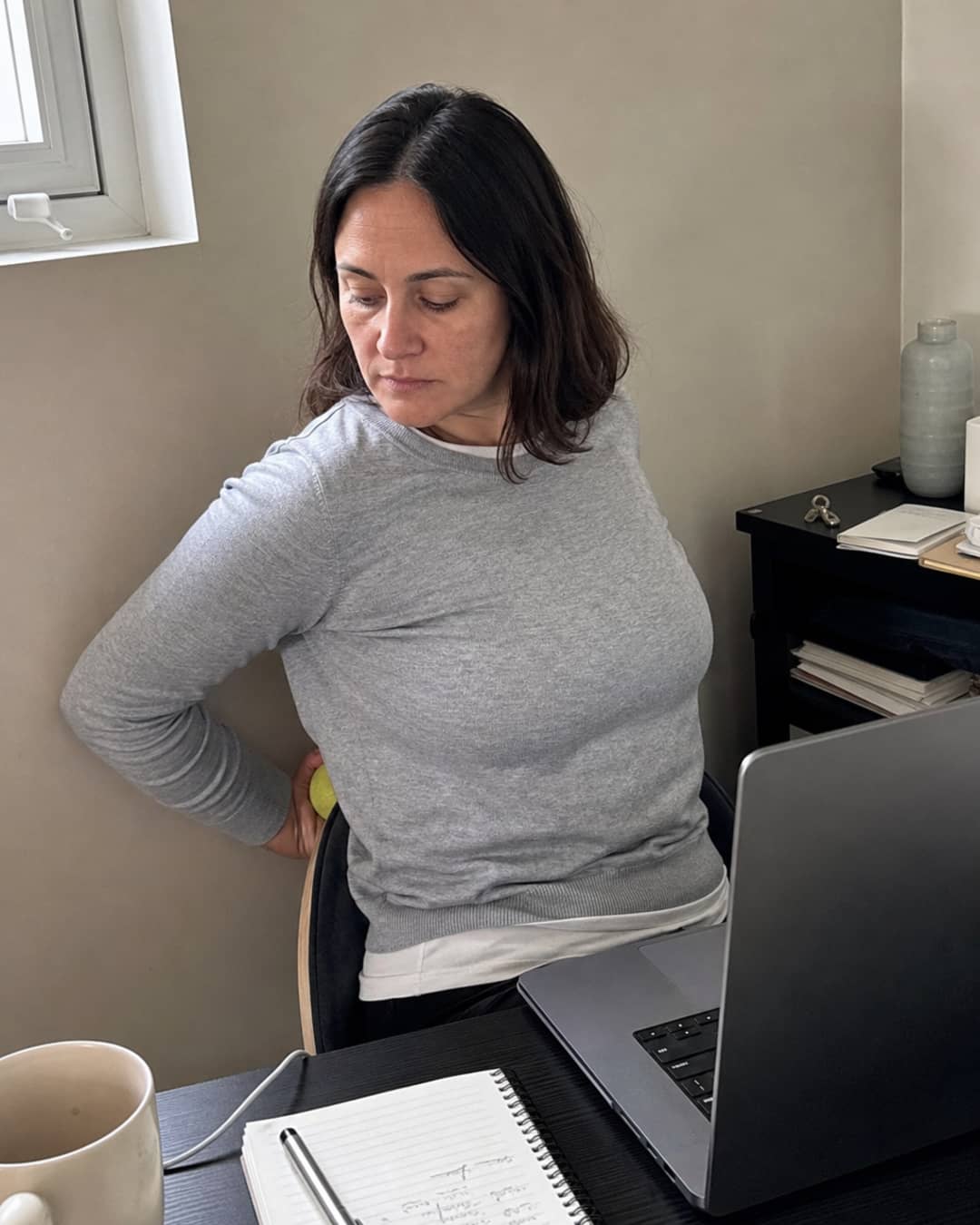
Maya — a woman of 34, shoulder-length dark hair, wearing a light grey fitted crewneck over a white undershirt — knows the exact square inch. She could point to it with her eyes closed. Two inches to the left of her spine, just below where her shoulder blade ends. She has been pointing to it, one way or another, for most of the past eighteen months.
The lacrosse ball is the latest attempt. Before that, a massage stick. Before that, a tennis ball in a sock that she used to roll against the wall in the spare bedroom while her laptop sat open on the floor. Each tool found the spot. Each gave her a few minutes of something that felt like relief. None of them made the spot stop coming back.
This is the quiet failure that most people never name out loud: the approach is working in the moment but not over time. The sensation of finding the knot — that deep, dull pressure that says yes, right there — feels like progress. It registers as doing something. So you keep doing it.
But notice what happens the next day. Or the day after. The spot reasserts itself, sometimes before lunch. The ritual begins again. After enough repetitions, the cycle starts to feel less like self-care and more like maintenance on a problem that is not actually resolving.
What most people who chase the interscapular knot have never been asked is a simpler question: what if the place you keep pressing is not the only place worth paying attention to?
The answer to that question starts somewhere most people have not tried looking.
And where exactly that place is — and why it changes the direction of the whole routine — is what the next section is about.
The Neck and the Upper Back Are Not Two Separate Problems
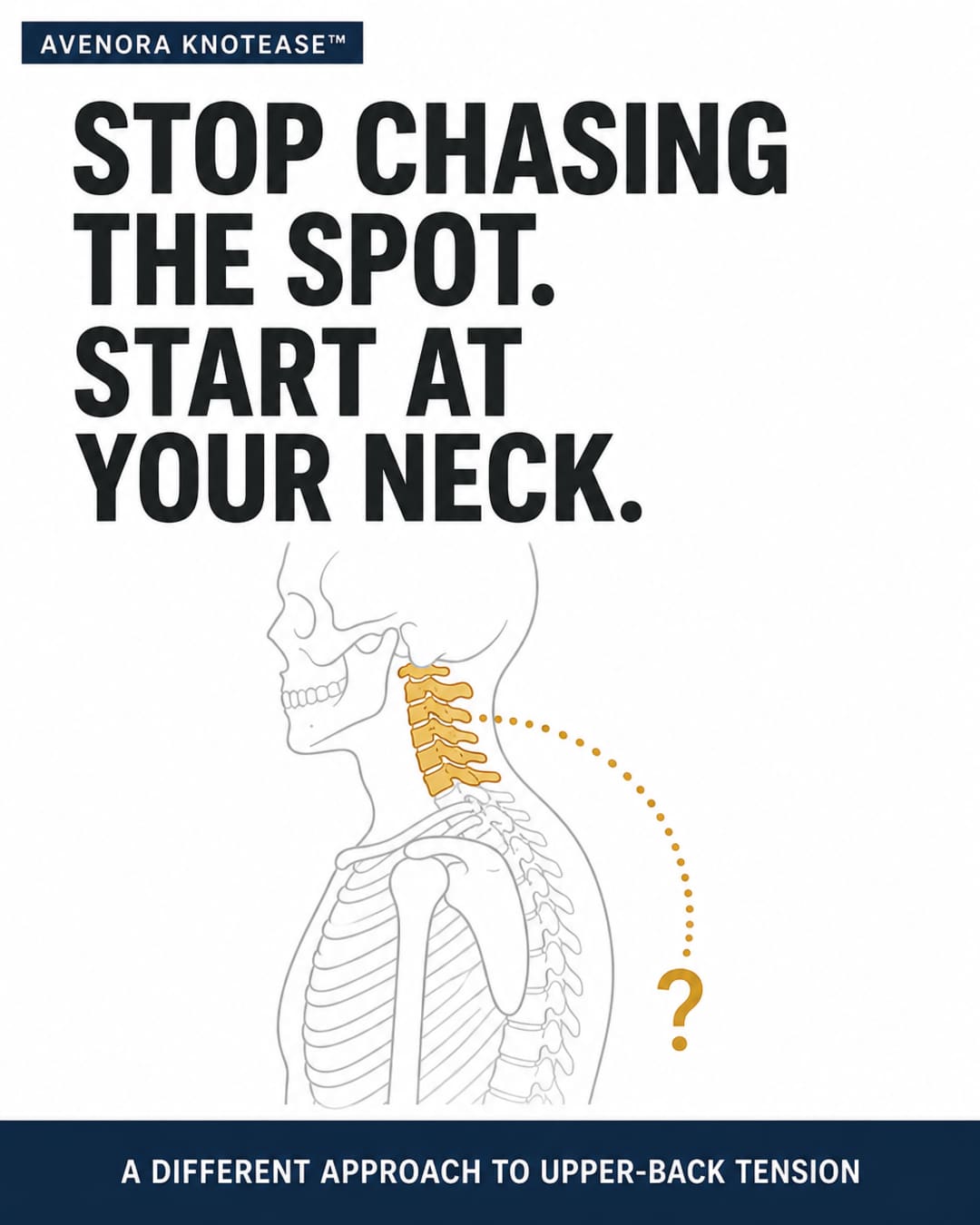
Here is the thing most people with a persistent interscapular knot have never been told: the neck and the upper back are not isolated regions with nothing to say to each other. The muscles that hold your head up, manage your posture, and respond to hours of screen time do not stop at the base of your skull. They extend downward. The cervical region is, in a very real structural sense, upstream of a great deal of what you feel in your upper back.
This is not a claim that every knot between the shoulder blades originates in the neck, or that treating the neck automatically dissolves tension elsewhere. It doesn't work that cleanly, and anyone telling you otherwise is oversimplifying. But it does mean that a comfort routine aimed exclusively at the lower spot — the one between the shoulder blades — is working on only one part of a larger connected area.
The Avenora KnotEase™ is a wearable device that combines heat, massage and vibration, and electrical stimulation, worn around the neck. It is not a device that physically reaches the interscapular region. It does not claim to. What it offers instead is a different kind of starting point: a neck-centered comfort routine, applied to the region that most people with upper-back tension have never specifically addressed in their self-care practice.
The question it asks is a different one from the one most tools ask. Instead of "can we press harder on the spot that hurts?" it asks: "what happens when you start with the neck?"
For a lot of people, that shift in direction is the part that feels new.
But understanding why it works — or rather, how it works — means looking at what the device actually does, and why the combination matters.
Add Up What the Chase Has Actually Cost You
Derek — a man of 47, close-cropped grey-salt hair, wearing a navy zip-up fleece over a collared shirt — does not think of himself as someone who spends a lot of money trying to fix his back. But when he actually ran the mental list, he counted: a foam roller, two different massage balls, a massage stick, a percussive massager he bought during a sale that was too heavy to use comfortably, three visits to a massage therapist over the course of a year, and a heating pad that lives on the corner of his desk. None of it was unreasonable. Each purchase made sense at the time.
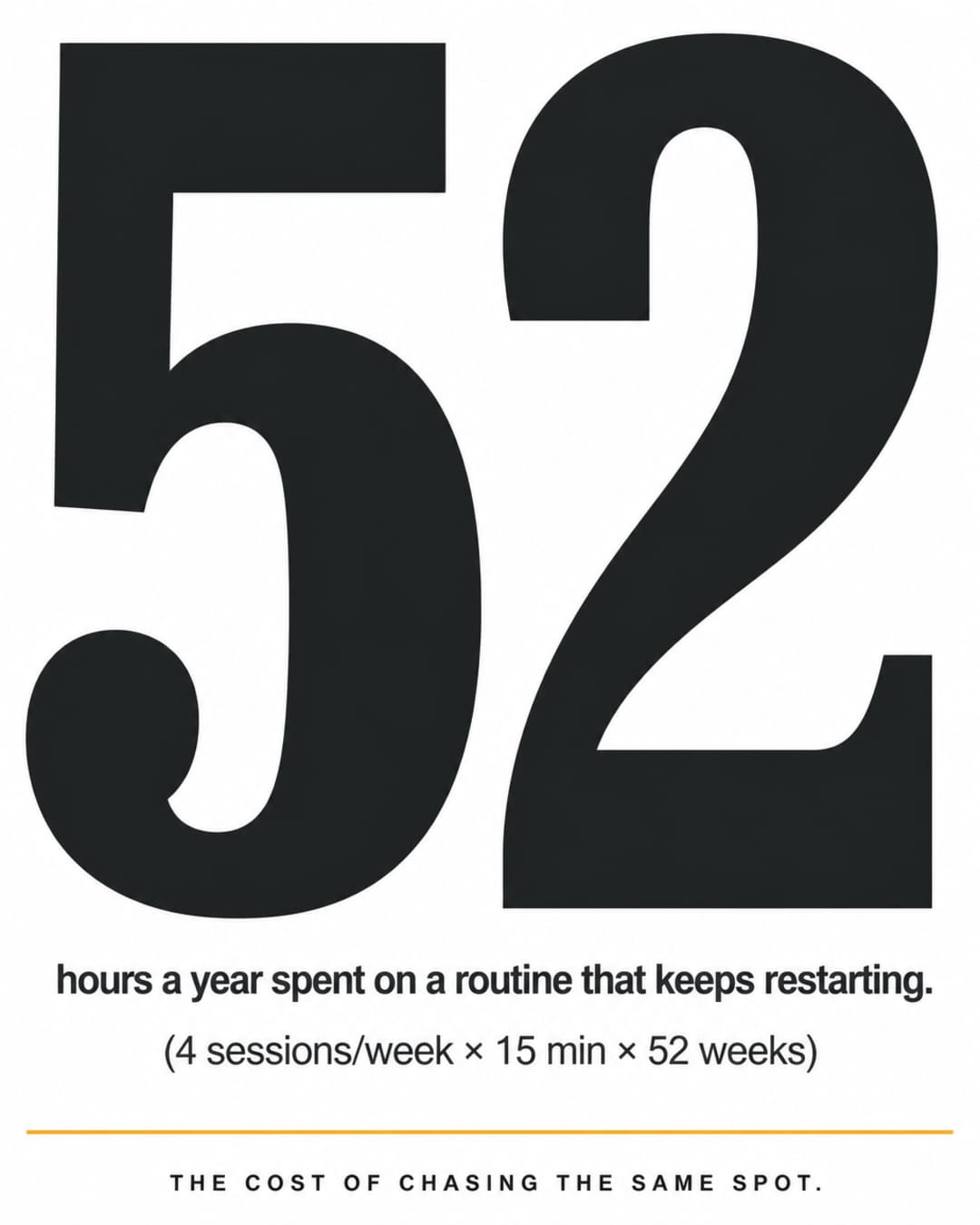
The thing Derek had not tracked was time. The average roll-and-press session takes somewhere between five and fifteen minutes. If you do that four or five times a week — which is conservative for someone with a persistent knot — you are spending somewhere between twenty and sixty minutes a week on a routine that, by definition, is not resolving the underlying situation. It is managing it. Over a year, that is a meaningful number of hours spent on a habit that keeps restarting.
The cost of a recurring unsolved problem is not just what you spend on tools. It is the time inside the repetition. It is the mental overhead of a discomfort that lives in the background of your day. It is the moment, for Derek, when he gets into his car after work and reaches for the foam roller in the trunk — not because it solved anything last time, but because he doesn't know what else to do.
That cumulative weight is exactly what a different starting point is designed to interrupt.
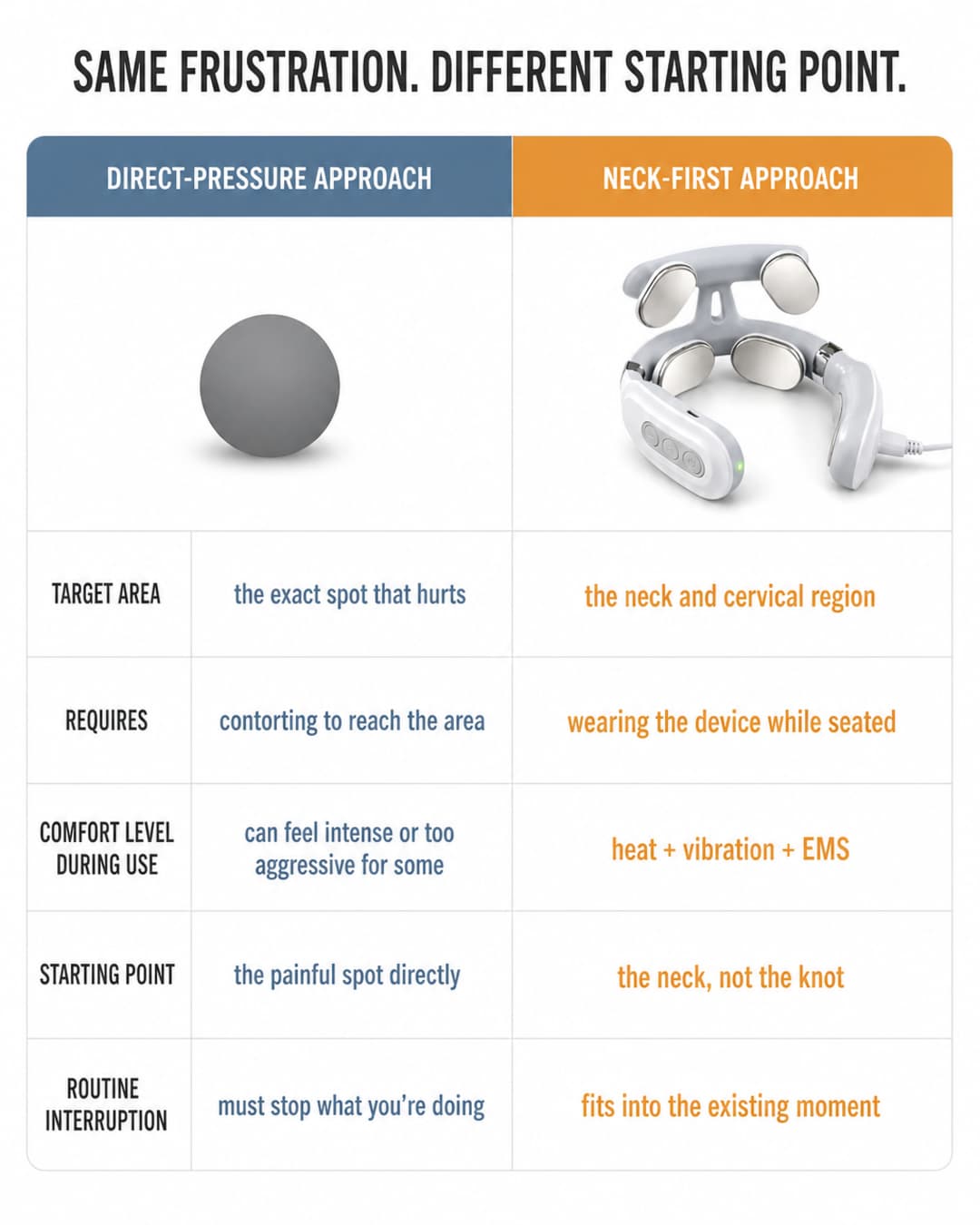
What "Chasing the Spot" Looks Like Next to Something Else
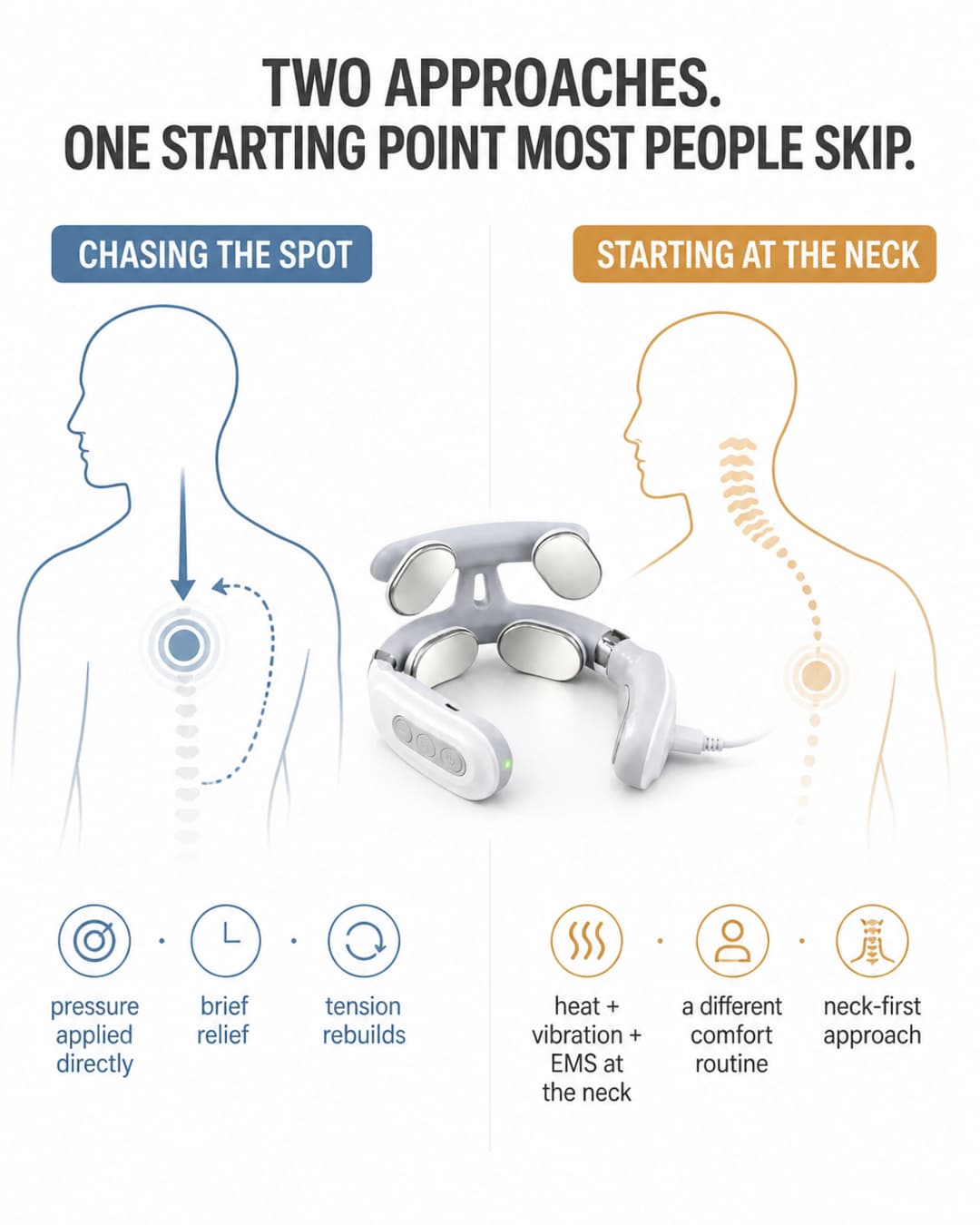
Linda — a woman of 58, silver hair in a loose bun, wearing a soft teal cardigan over a floral blouse — spent about ten minutes once, after yet another session with a massage stick, actually listing what her current approach required: getting up from wherever she was, finding the tool, contorting to reach the right angle, pressing hard enough to matter, holding it, standing up, and then waiting to see whether it held this time. The whole thing was awkward, a little uncomfortable, and required her to stop whatever she had been doing. She did it anyway, because it was the only option she knew.
The comparison below is not meant to dismiss direct-pressure tools as universally wrong — for some people, used appropriately, they may be part of a useful routine. But the specific experience Linda describes — the awkwardness, the impermanence, the repetition — is common enough that it is worth naming clearly.
A neck-first approach with KnotEase looks different in practice: the device sits around the neck, applies its combination of heat, massage and vibration, and electrical stimulation to the cervical region, and runs while the user stays where they are. There is no contortion required. The starting point is different. The area targeted is different. The routine is different.
Whether that different starting point produces a meaningfully different experience is exactly what this kind of product is designed for someone to find out for themselves.
What It Looks Like When You Stop Reaching for the Ball
Maya — a woman of 34, shoulder-length dark hair, wearing a light grey fitted crewneck over a white undershirt — still works at the same desk. The laptop is still open. The same overcast light comes through the same window. But the lacrosse ball is not in her hand. It is on the shelf across the room, roughly where it has been for the past few weeks — not thrown away, not retired permanently, just no longer the first thing she reaches for.
KnotEase sits at her neck. She put it on about eight minutes ago, the way she now does a couple of times during the workday: the device on, the heat starting almost immediately, the combination of sensations something she has started to anticipate rather than dread. She is not twisted in her chair. She is facing the screen. The knot between her shoulder blades is still something she is aware of — this is not a story about instant and total resolution — but the urgency of it has quieted enough that she is not thinking about the wall and the ball for the first time in a while.
That is the actual shift the Neck-First Approach is meant to create. Not the dramatic disappearance of every knot. The quieting of the chase. The feeling that the routine is starting from a different place — a place that requires less effort, less contortion, less standing-up-and-grabbing-the-thing.
It is a different starting point. And for the people who have been chasing the same spot long enough to recognize the story above, it is one worth trying.

If you want to see the full details of how KnotEase works — how it sits, what the three functions actually do, and whether it is suited to what you have been dealing with — the product page has the complete breakdown.
What Customers Are Saying
★★★★★
"I had been rolling on a lacrosse ball for so long it felt normal. Trying something that starts at the neck instead felt strange at first, but it made sense once I actually used it. The heat kicks in quickly and the whole thing is easy to put on."
Renee T., Portland, OR
★★★★☆
"I was skeptical because the knot I feel is between my shoulder blades, not at my neck. But the idea of a different starting point actually made sense to me, and the device is comfortable and well made. Glad I tried it."
M.K., Chicago, IL
★★★★★
"Practical and does what it says. I use it at my desk a couple of times a day now. The combination of heat and vibration is noticeable and it fits comfortably. Easy to work into a routine without stopping what you're doing."
David S., Austin, TX
The Ball Is Still on the Shelf. The Knot Is Still in the Same Place. Tomorrow Morning, You Will Reach for One of Them.
You have done the reading. You know what the chase looks like from the outside now — the tool, the wall, the two minutes of relief, the return. You know there is a different kind of starting point. You know why the neck, and not the exact spot, might be where a different routine begins.
What you have not done yet is stop.
Here is what the next version of tomorrow morning costs you if you do not:
- Another session pressing directly on the spot that has been there for months — and has returned every time before
- Another five to fifteen minutes of a routine that manages the problem without changing the direction of it
- Another tool that finds the knot and watches it come back
- Another week in which the neck — the upstream area, the one that most people with this specific frustration have never specifically addressed — gets no attention at all
- The same conversation, in six months, about what to try next
KnotEase does not promise you that the knot disappears. It offers you a different starting point — a wearable device that brings heat, massage and vibration, and electrical stimulation to the neck, so that the next time you feel that familiar tightness between your shoulder blades, you have somewhere new to begin.
The people who get the most from a different approach are the ones who recognized themselves in the scene above: the ball in the hand, the brief relief, the return. If that is you, then what is on the other side of this page is worth looking at.