You Spent Hundreds Trying to Fix Your Hair. What If Your Hair Isn't the Problem?
The shampoos, the masks, the dermatologist, the supplements — and yet your hair still feels coated every morning. There is one thing you almost certainly haven't tested.
The cabinet under Maya's bathroom sink is a small museum of failed experiments.
There's a $44 shampoo from a Japanese brand her friend swore by. A deep-conditioning mask that cost $38 and smelled like coconut and hope. A bottle of biotin capsules — the large, economy size, because if you're going to try something you may as well commit. A chelating shampoo she used twice before it made her scalp feel like sandpaper. A clarifying spray. A scalp serum with a dropper top and a clinical-looking label.
Every one of them was bought because something about her hair had gone wrong after she moved to the Bay Area two years ago — and every one of them, used faithfully and sometimes expensively, did roughly nothing. Her hair still felt coated by the time she left for work. Still felt like straw under her fingers when she ran them through at her desk. Still looked flat and dull in the afternoon light in a way it never had when she lived in Boston.
Her dermatologist said it was probably stress. A hair specialist suggested her hormones were shifting. A well-meaning colleague blamed her new air conditioning. Maya accepted each explanation, adjusted her routine accordingly, and watched the problem continue. She blamed herself, quietly and persistently, for not finding the right answer yet.
She hadn't looked at the water.
That turns out to be an extremely common place not to look — and the reason is almost architectural. The entire conversation about hair care is built around what you put onto your hair. The products. The ingredients. The routine. There is almost no cultural space for the question of what you are washing your hair in every single morning. And yet that water — whatever chlorine or metal load it carries, whatever it leaves behind on each strand after the shower — is present at the start of every single hair-care routine you will ever run. Every expensive product you apply goes on over it. Every claim on every bottle is made without accounting for it.
This piece is about what happens when you change that variable.
Reason 1 — The Finger Test You Keep Failing Without Knowing Why
Run your fingers through your hair right now, if you're somewhere you can do it without looking strange.
Not from root to tip in one smooth sweep — that's how you check for length. Start midshaft, close the fingers gently around a small section, and pull toward the ends. If your hair is clean and in reasonable condition, your fingers should glide. Not fast, not with resistance, just — through.
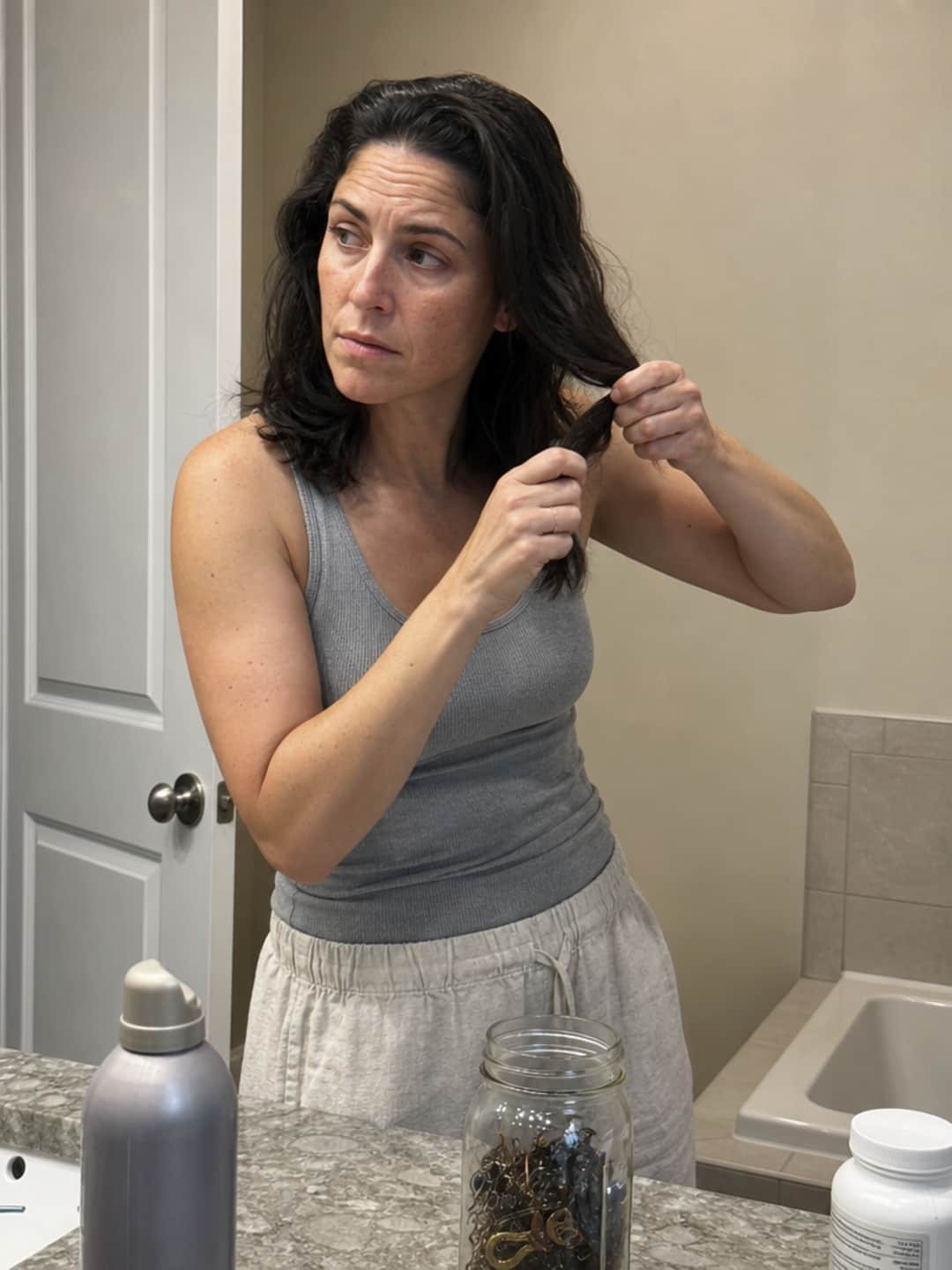
If instead your fingers catch, stall, snag halfway, and your hand arrives at the ends with a slight gummy feeling? That is what chlorine and heavy metal residue left behind on the hair shaft actually feels like from the outside. It isn't damage in the clinical sense. It isn't breakage. It isn't what the deep-conditioning mask is trying to fix. It is a physical coating — mineral and chemical residue from unfiltered water that bonds to the outer surface of the hair and doesn't wash off, because you are rinsing with the same water that put it there.
Maya had done this test dozens of times in the mirror and assumed the result meant her hair was somehow broken — that she was missing the right product, or the right technique, or the right frequency of washing. She had never considered that she was doing the test correctly, reading the signal correctly, and drawing entirely the wrong conclusion about the cause.
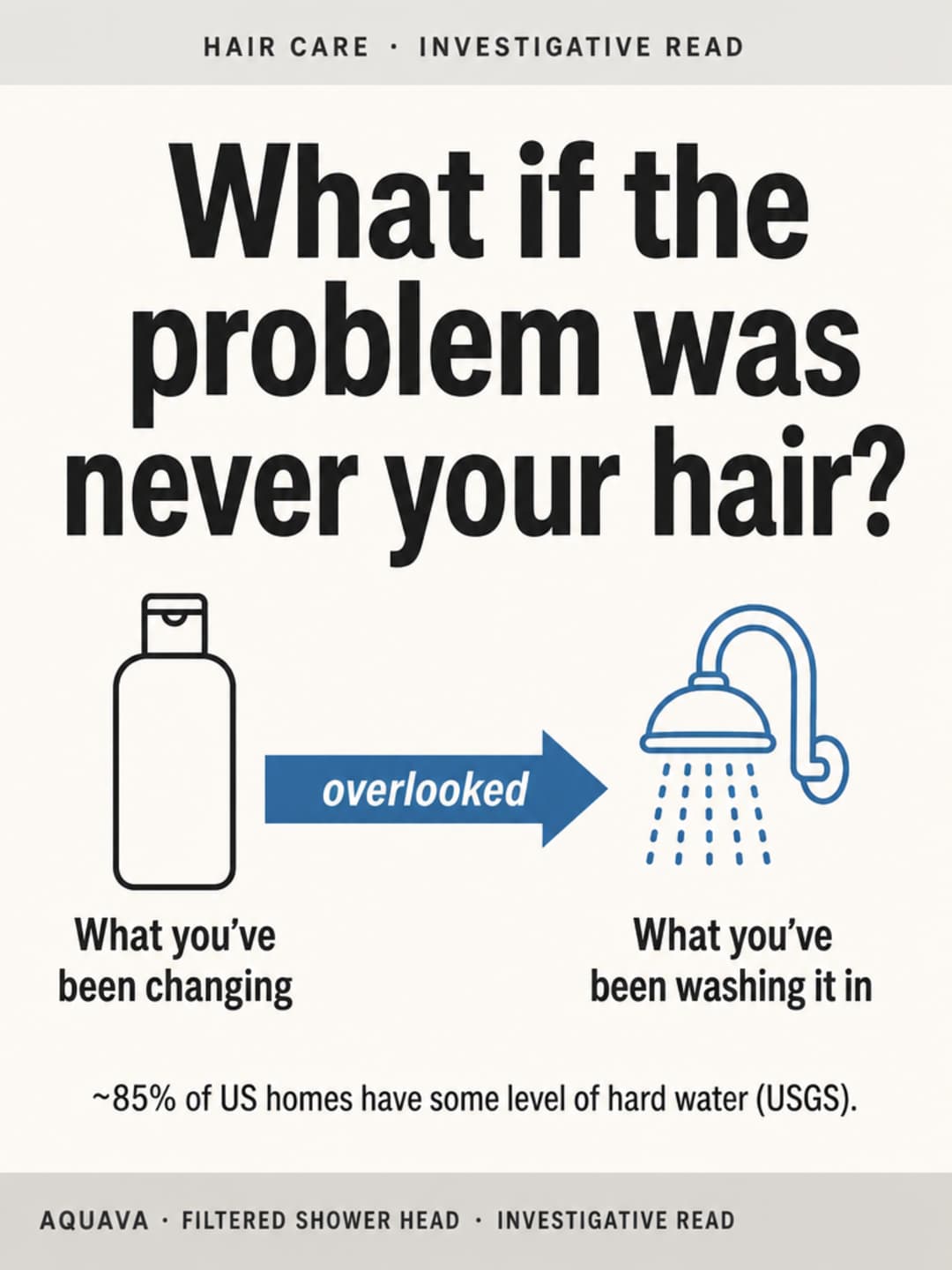
Here is the mechanism in plain terms. Most US municipal water is chlorinated — the EPA's own treatment history data puts roughly 64% of community water systems using chlorine or chloramine as a disinfectant. Both agents do exactly what they are designed to do, which is kill biological matter. They are somewhat indiscriminate about it. When chlorinated water runs over hair, it strips the natural oils from the cuticle and leaves the outer layer of each strand slightly raised — a textural change that registers as roughness under your fingers and dullness in the mirror. Hard water compounds this. Approximately 85% of US homes have some measurable level of mineral hardness, according to USGS data compiled by Forbes Home. Calcium and magnesium ions in hard water bind to the hair shaft the same way they bind to the inside of your kettle. The coating you feel when your fingers snag is, in large part, that mineral residue.
No shampoo formulated for normal use was designed to remove that coating, because no shampoo company built its product assuming its customer would be rinsing with water that redeposits the problem at the end of every wash cycle. The products aren't failing because they're bad products. They're failing because the water is doing something upstream that the product was never designed to address.
The phrase that shows up, again and again, in the words of women who eventually figure this out: "My proven methods did nothing to help." It sounds like a personal failure. It isn't. It's an accurate description of what happens when you aim the solution at the wrong variable.
But if the coating is coming from the water — there's a more direct place to intervene than the shampoo aisle. Which is where the question of what the water actually contains starts to matter quite a lot.
Reason 2 — The Part of the Shower Nobody Told You to Filter
There is a reasonable question sitting under everything in this piece, and it is worth stating plainly: if the water is the problem, why hasn't anyone mentioned this before?
The honest answer is that it has been mentioned — in the context of drinking water. The whole-home filtration conversation, the countertop Brita, the under-sink reverse-osmosis unit — the premise that tap water contains things worth removing before you consume it is now close to mainstream. A meaningful portion of American households run their drinking water through some kind of filter as a matter of routine.
The shower has, almost universally, been left out of that conversation.
This is partly historical — the drinking-water filtration market developed around consumption (what goes in), not contact (what touches skin and hair). And it is partly physiological assumption: we assume skin and hair are barriers that can handle whatever the water contains. For most people, most of the time, that assumption is roughly correct in a survival sense. The question isn't whether you will be harmed. The question is whether the chlorine and metal load in unfiltered shower water is actively working against the results you are trying to get from your hair-care routine.
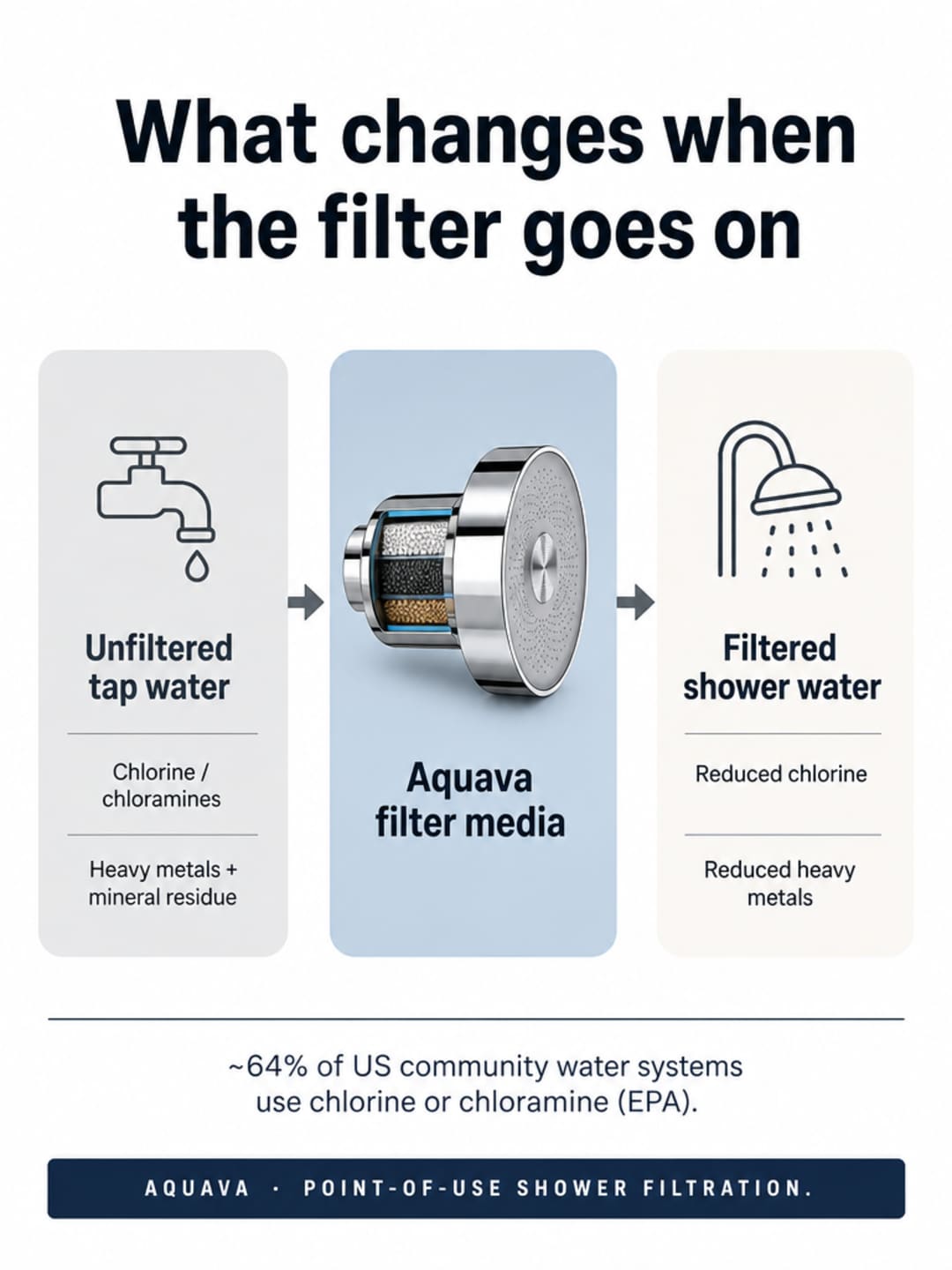
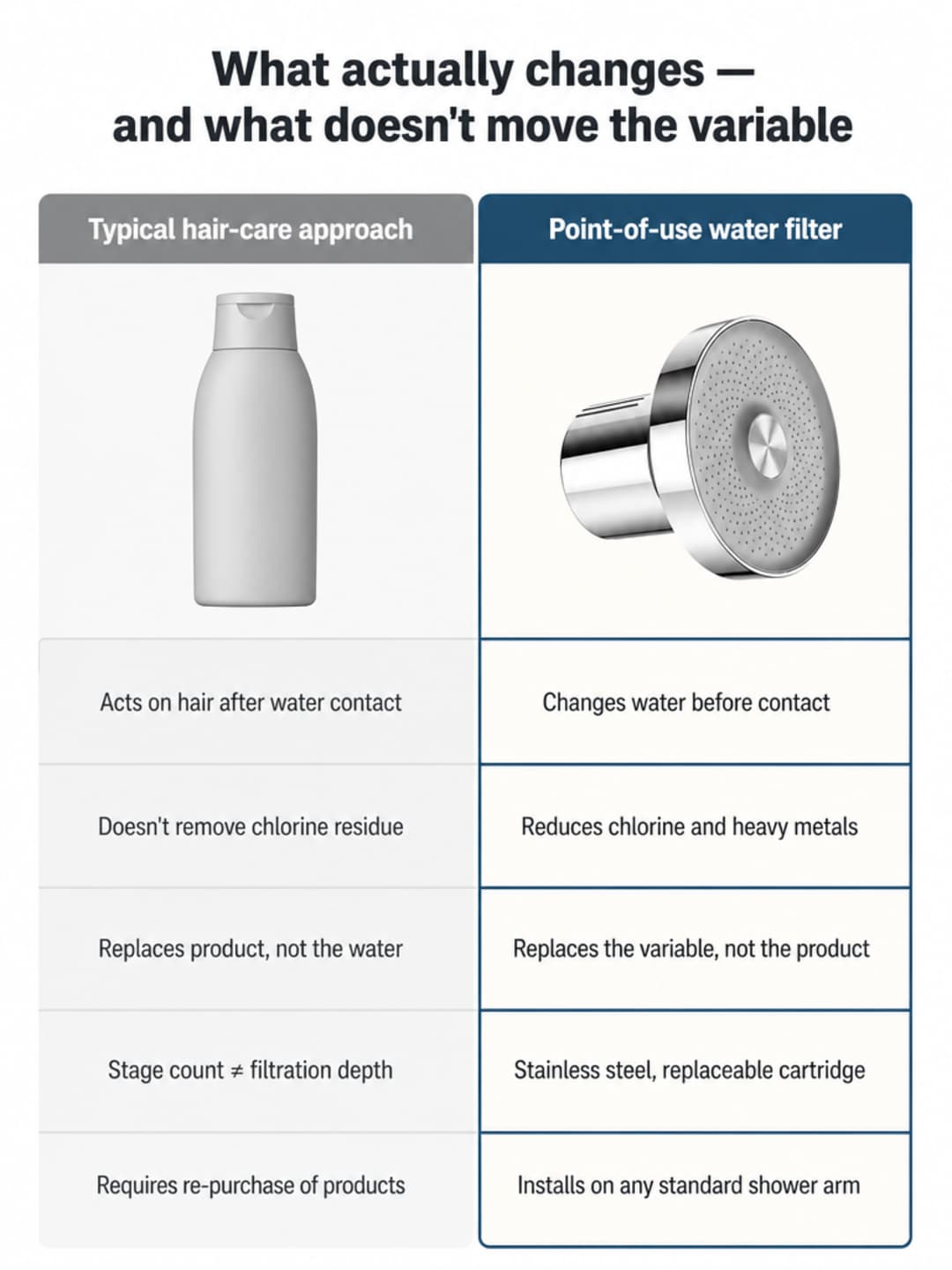
When Aquava's filter is installed on a standard shower arm — a process that takes a few minutes and requires no tools, no plumber, and no landlord's awareness — it interposes a filter medium between the municipal supply and the water that contacts your hair and skin. The result is shower water with measurably lower chlorine, reduced heavy metals, and fewer of the other contaminants that contribute to the coating and dryness described in the previous section. The mechanism is not complicated. The water that leaves the shower head has passed through the filter. The chlorine and metal load that was there before is significantly reduced. The water reaching your hair and skin is different in a specific, functional way.
The stainless-steel body is worth noting here, not for aesthetic reasons but as a credibility cue in a category where this matters. Most shower filters on the market — including the $15–20 category standbys that turn up in search results — are made of ABS plastic. Plastic housings are not inherently ineffective, but they do something the stainless body does not: they flex, they degrade under daily hot-water exposure over time, and they contribute nothing to the story of durability. The brushed stainless steel of the Aquava unit is the material choice of something built to stay in the shower indefinitely, in a way that a white plastic cylinder that arrived in a padded mailer is not.
The filter cartridge is a separate and replaceable component — which is the right design. A filter that captures chlorine and heavy metals over weeks and months is accumulating something. That accumulation is the sign the filter is working. The right behaviour is to replace the cartridge; the stainless housing continues.
What this means practically: Aquava is not a cosmetic intervention. It is a point-of-use water treatment device that changes the water's composition before it reaches you, which is a different category of action than anything in the shampoo aisle. That difference is worth understanding fully — because the same water that's coating your hair is doing something to your skin at the same time, and the two problems share an origin.
Reason 3 — The Dermatologist Visit That Cost $400 and Solved Nothing
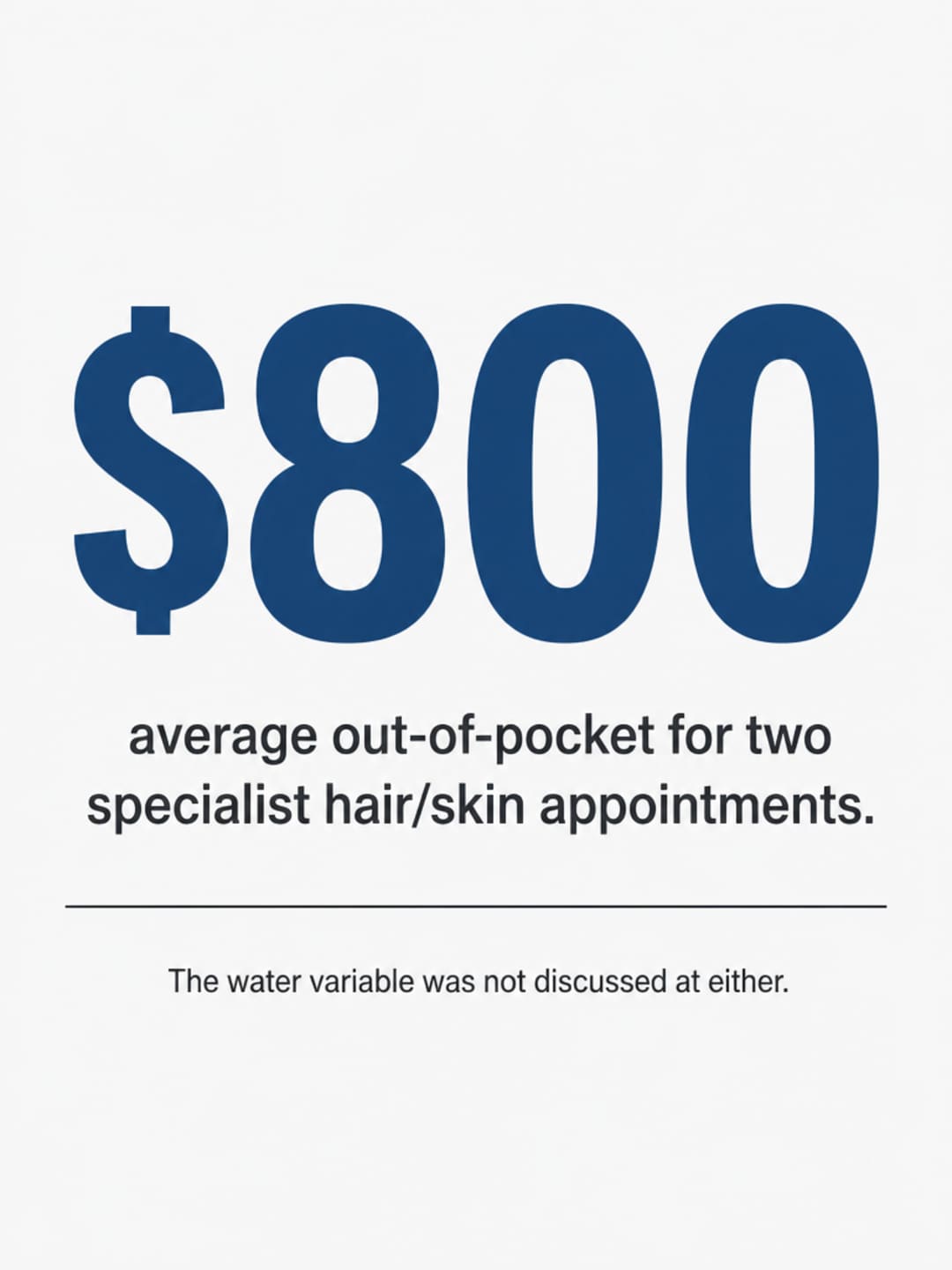
Diane is fifty-two and lives in Phoenix, and she has a folder on her phone labelled "hair stuff" that contains seventeen screenshots from dermatology websites, three photos of her shower drain, and the notes from two specialist appointments that together cost her just over $800 out of pocket.
The first appointment ended with a diagnosis of telogen effluvium — a clinical term for a form of stress-related shedding that can be triggered by hormonal changes, illness, or significant life disruption. The dermatologist recommended a topical treatment and suggested she consider whether her stress levels had increased. Diane had recently retired, which she experienced as mostly positive, but she accepted the explanation. The shedding continued.
The second appointment produced a slightly different framing — perimenopause was discussed, iron levels were checked, the results were borderline, a supplement was suggested. The shedding continued, and now her scalp also felt tight and slightly itchy every morning after her shower. She started avoiding black tops.
What neither appointment addressed was the Phoenix municipal water supply, which uses chloramine — a compound used in place of chlorine in many large US water systems, including Phoenix and Las Vegas, because it is more stable and dissipates more slowly through the distribution network. More slowly dissipating, in this context, also means more persistent on hair and skin at the point of contact.
The AAD notes that it is normal to shed between 50 and 100 hairs per day — a threshold that is easy to catastrophise when you are watching a drain fill in a city with notoriously hard, heavily treated water. The distinction the research consistently surfaces is between shedding, which is a follicular process, and breakage, which is a structural one. Chlorine and mineral buildup on the hair shaft increase brittleness. A hair that breaks at midshaft when you brush it looks, in the drain, identical to a hair that shed at the root. They are not the same event, and they do not have the same solutions.
The cost of the wrong diagnosis is not only the $800. It is two years of Diane managing a problem that the dermatologist correctly identified as real but attributed to a cause that had nothing to do with the water she was standing in for eight minutes every morning. The topical treatment addressed the follicle. The iron supplement addressed a borderline lab value. The chloramine running over her scalp and down her skin every day addressed nothing at all, because nobody thought to name it as a variable.
This is not a criticism of dermatology. It is an observation about where the conversation about hair and skin care tends to start and stop — and about a variable that sits outside the clinical conversation almost entirely because it is infrastructure, not biology.
The water cannot be negotiated with. But it can be filtered. And if you have ever sat in a waiting room hoping a specialist would give you an answer that finally made the numbers in the drain add up — the question worth asking, before the next appointment, is whether you know what is in your shower water.
Reason 4 — Why Everything Else You Tried Was Aimed at the Wrong Thing
There is a list that comes up, almost identically, across every platform where people talk about this problem. Reddit threads. TeamBlind posts from women who just moved to the Bay Area or Las Vegas. Thingtesting reviews. The list goes:
Better shampoo. Clarifying shampoo. Deep conditioning mask. Chelating shampoo. Biotin. A whole-home water softener (turns out those cost $7,500 and require a plumber). A $15 shower filter from a big retailer. Purple shampoo for the brassiness. Another shampoo.
The water softener entry in that list is worth dwelling on for a moment, because it contains an important piece of information about category honesty. Whole-home water softeners operate through ion exchange — they are genuinely effective at removing calcium and magnesium hardness from water throughout a house. They are large, expensive, permanent, and require plumbing. They are not, in their standard form, chlorine-removal devices. A water softener will not reduce the chloramine load in Phoenix tap water. A water softener is also not available to anyone who rents, which is a significant portion of the population in the cities — Bay Area, Vegas, Phoenix, Long Island, DC, Los Angeles — where the water complaint shows up most acutely.
The $15 shower filter category has its own story. The phrase that appears in reviews of this product tier, with the regularity of a refrain, is some variation of "I could detect no change." Pressure drops within weeks. Cartridges — which may contain a handful of activated carbon pellets inside a plastic housing — were never substantial enough to meaningfully treat the volume of water moving through a daily shower. The stage-count language ("15-stage," "20-stage," "36-stage") that covers the packaging of many of these units is, as one reviewer stated bluntly, a way of naming each pellet type separately to justify a marketing claim. The stage-count tells you nothing useful about actual chlorine or metal reduction.
Aquava is not positioned as a $15 filter with a better label. The stainless-steel body is not cosmetic — it is the starting point of a different product category. The filter medium reduces chlorine, heavy metals and other water-borne contaminants. The cartridge is designed to be replaced, which is how a filter that is working is supposed to behave. The install takes minutes on any standard shower arm. It comes with you when you move.
There is one thing Aquava will not do, and it is worth stating plainly here: it does not remove calcium and magnesium hardness from the water. It is a filter, not a water softener. If mineral hardness removal is the specific outcome you need, you need a whole-home softener, and no shower filter will substitute for that. What Aquava removes is the chlorine, heavy metals and chemical contaminants that produce the coating, the dryness and the itching that most of the people reading this piece have been trying to fix for months or years.
The reason that honesty matters: the one thing this category has taught its customers to be good at is detecting when a brand is overselling. The women who have cycled through the list above are not credulous. They have been burned before. They know what "did nothing" feels like from the inside. The claim that earns their attention is the narrow, specific, defensible one — not the broadest version, not the most impressive-sounding number, but the one that matches what the product actually does.
What the product actually does is change what the water contains before it touches your hair.
Reason 5 — The Morning After the First Shower Where the Water Was Different
Jess is not a person who describes things as "life-changing." She is forty-four, she has been getting balayage highlights for nine years, and she has a healthy suspicion of anything described in glowing terms by someone who just bought it. She held off on the shower filter longer than her friend suggested, partly because she had already tried the $15 version and felt nothing, and partly because she had grown used to managing the brassiness with a purple shampoo she applied once a week.
The thing she noticed first, about ten days after installation, was the finger test. She ran two fingers through a section of hair midshaft — a reflex by now, since she'd been doing it daily as a kind of baseline check — and her fingers moved through without catching. Not dramatically. Not transformatively. Just — through. She did it again. The same.
The second thing was that the purple shampoo sat mostly unused for six weeks running, because the brassy oxidation that she had been managing with it appeared to be progressing much more slowly. Her color, done eight weeks earlier, still looked reasonably close to what she had walked out of the salon with. The mechanism here is direct: chlorine is an oxidising agent. It does to hair what bleach does to fabric — gradually, over repeated daily contact. When the chlorine load in the shower water drops, the rate of color oxidation slows. The blonde does not hold forever, but it holds longer, and "longer" at the scale of a salon appointment frequency is a meaningful number.
The third thing was the skin. She had not bought the filter for skin reasons — this was a hair decision. But she noticed, stepping out of the shower around week two, that the low-level tightening sensation she had attributed to dry weather was not there. Then it wasn't there the next morning. She had not thought of it as related to the water; she started thinking of it that way.
This is the transformation that is hardest to describe without sounding implausible, because it is not dramatic. The hair does not suddenly behave differently in one shower. The skin does not reset overnight. What happens is subtler: the daily compounding contact with chlorine and heavy metals stops, and the absence of that contact accumulates in reverse. The coating that built up over months of unfiltered showers takes time to leave. The tightness that followed every shower takes a few sessions to resolve. The first unmistakable signal tends to be exactly what Jess noticed — the finger test glides, and you catch yourself doing it again to confirm.
The customer language that comes up, among people who have made this switch: "I don't feel that [itchiness] at all now." Not hyperbole. Not life-changing. Just the absence of something that was always there.
If the variable you never changed was the water, this is what changing it tends to produce.

— · —
If you've been reading this thinking it sounds like what you've been doing for the past year — running a full diagnosis on every variable except the water — the full details on how the Aquava filtration system works are worth looking through. It's the part of the story this article doesn't have space to cover.
— · —
What Customers Are Saying
"I'd been through four different shampoos in six months. After a couple of weeks with this I finally felt like my hair was actually clean when I stepped out. Practical and does exactly what it says."
Rachel M. — San Francisco, CA
"The install was genuinely five minutes. My skin stopped feeling tight after showers within the first week. Well made — it doesn't look or feel cheap at all."
T.K. — Phoenix, AZ
"I was skeptical after wasting money on a plastic one that did nothing. The stainless steel made a difference to me before I even turned the water on — it just feels like a serious product. Happy with it."
Diana L. — Las Vegas, NV
You've Changed Everything Except the One Thing Running Over Your Hair Every Morning
This is what you already know, having read this far: the water is not a neutral medium. It is not just the thing that carries the shampoo down the drain. In most US cities — Phoenix, the Bay Area, Vegas, Long Island, DC, Los Angeles — it is an active variable in what your hair feels like every single day. Chlorine, chloramine, heavy metals, mineral residue. Binding to the outer layer of each strand. Undoing, daily and quietly, the work of every product in that cabinet.
Here is what is now on the table:
- Hair that passes the finger test — both hands, midshaft to ends, without catching — because the water isn't coating the shaft before the shampoo touches it
- Skin that doesn't tighten the second the shower stops — because the chlorine no longer strips the surface moisture at the start of every morning
- Color that holds longer than two weeks — because chlorine, which oxidises hair the same way bleach oxidises fabric, is no longer running over it daily
- A filter that installs on any standard shower arm in minutes, with no tools, no plumber, and no landlord's involvement
- A cartridge that replaces in three steps — because a filter that fills up is a filter that is doing its job
The $800 in dermatologist visits didn't find it. The $44 shampoo didn't fix it. The $15 filter did nothing measurable. The variable that none of them addressed was the water itself — the thing that every product you have ever used on your hair had to work through, every single morning, before it had a chance to do what the label claimed.
That variable can be changed at the shower arm. The filter medium reduces chlorine, heavy metals and other contaminants at the point of use. The stainless-steel body is built to stay in the shower for years. The cartridge is replaceable. The install is genuinely five minutes.
Every morning you don't change that variable is another morning the coating gets a head start on whatever you're about to apply.