You Filter the Water You Drink. You Never Thought About the Water Your Hair Lives In Every Morning.
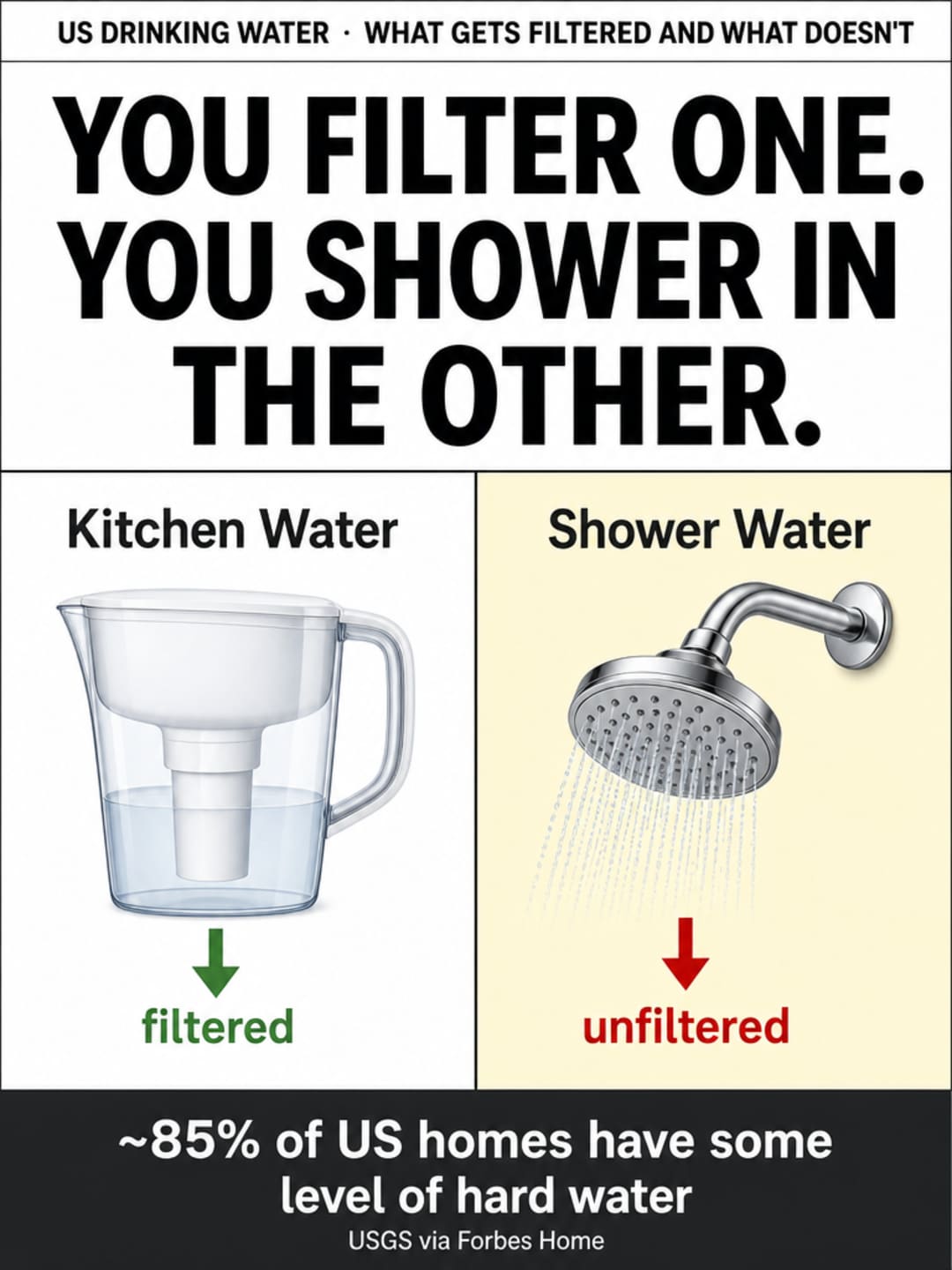
You have a filter on your pitcher. Maybe a filter on your faucet. You wouldn't drink a glass of straight tap water without thinking twice about it — not in most American cities, and definitely not if you know anything about what municipal treatment actually puts in the water.
So you filtered the water going into your body.
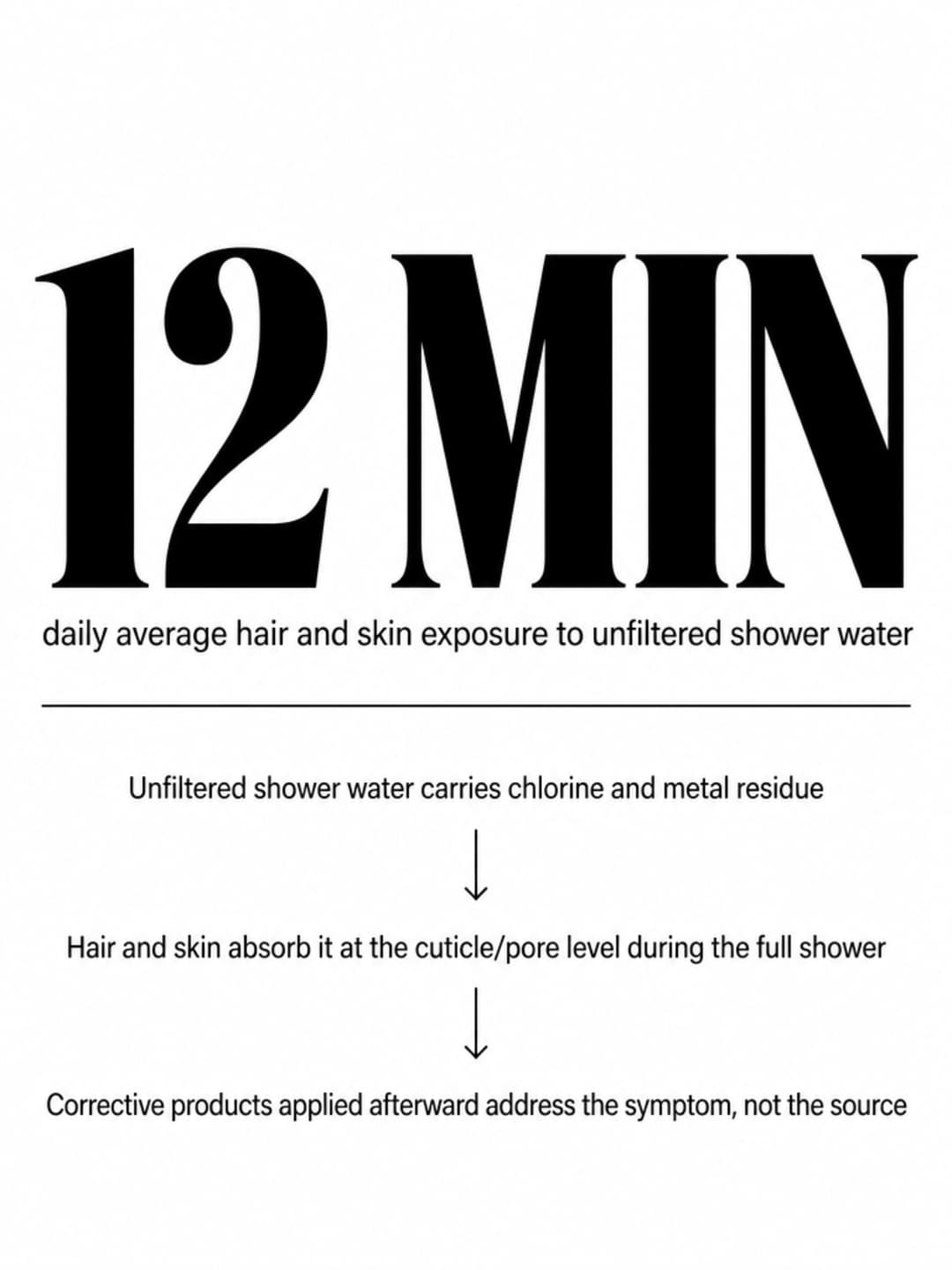
You just never filtered the water going onto your body. Every morning, for years, probably decades — the same unfiltered tap water your kitchen filter was installed to avoid has been hitting your hair and your skin for eight to twelve minutes straight. Not a sip. A full soaking. And then it sits there while you towel off.
Most people who hear this stop for a second. There's a specific beat — a half-second of wait, that's actually true — before the brain moves on. The interesting question isn't whether the thought landed. It's what you do with it now that it has.
What's actually in the water coming out of a standard American shower, why a kitchen filter doesn't touch it, and how a small brushed-steel fixture on your shower arm changes what your hair and skin are washed in every single day — that's what the rest of this article covers.
Reason 1 — The One Water Source Nobody Filtered
The kitchen filter gets changed on schedule. The pitcher in the fridge gets refilled with care. And then every morning, without a second thought, the same person turns on a shower and stands under eight minutes of the rawest water in the house.
There's nothing irrational about how this happened. Drinking water filtration made sense as a health habit and it stuck. Shower water never came up as a category — there was no Brita for the shower head, no obvious retail prompt, no moment when someone handed you the two ideas side by side and asked why you treated them differently. The gap didn't form because of carelessness. It formed because no one pointed at the shower and said: this is also a water source.
It is, though. And by volume, it isn't even close. The average American shower runs somewhere between fifteen and sixty gallons of water. The average person drinks about half a gallon a day. The shower isn't a sip — it's a sustained, full-surface exposure, and it runs hotter than anything you'd put in your mouth, which matters because heat opens the hair cuticle and dilates skin pores, making both more receptive to whatever the water is carrying.
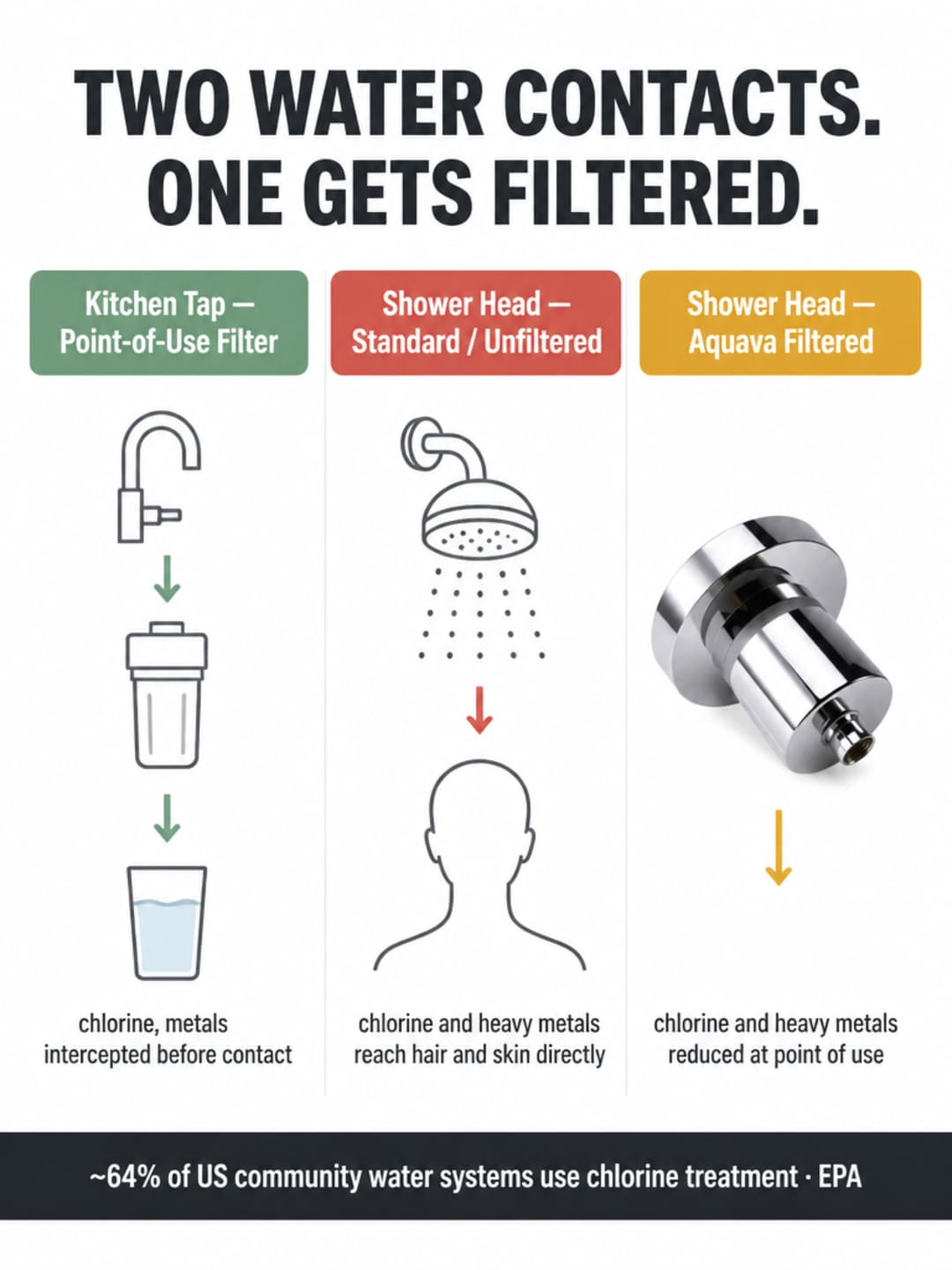
What the water is carrying is not the same thing your kitchen filter addresses. Most US municipal systems — the EPA estimated roughly 64% of community water systems — use chlorine or chloramine as a disinfectant. That process happens upstream, before the water reaches your kitchen filter. The filter handles taste and some contaminants at the point of use. But the shower head on your wall? There's nothing on it. The water arrives exactly as it left the treatment plant.
That's the gap. It was sitting there the whole time.
And the thing is — you already understood, at some level, that tap water without filtration was something worth paying attention to. You just hadn't turned around and pointed the same thought at the shower yet.

Reason 2 — What Your Shower Head Is Delivering That Your Kitchen Filter Isn't
Here is what it's useful to understand about what travels from a water treatment plant to a shower head.
Chlorine — or in many cities, chloramine, a chlorine-ammonia compound — is added deliberately. It kills biological contaminants in transit through the pipe network. By the time it reaches your shower, it has done its job. It no longer needs to be there. But it is. And unlike at a kitchen faucet, where a point-of-use filter strips it before contact, at the shower head there is nothing to intercept it.
Chlorine is a known skin irritant at concentrations well below what municipal systems use. At shower temperatures — typically 100 to 110 degrees Fahrenheit — chlorine volatilizes, meaning it transitions partly into a gas you also breathe during the shower. The skin surface, warmed and softened by heat, is directly exposed to the water for the full duration.
Heavy metals are the second half of the picture. Water travels through miles of aging pipe infrastructure before it reaches the house. Lead, copper, iron and other metals leach into the water supply at joints, fittings, and corroded sections — especially in older housing stock and urban buildings where the infrastructure is original to the last century. None of that is removed by chlorination. It arrives intact.
What Aquava's filter does is intercept the water at the point of use — at the shower head itself, before any of it contacts hair and skin. The stainless-steel body houses a replaceable filter cartridge; the water passes through the filtration media and exits with reduced chlorine, reduced heavy metals, and reduced contaminant load. The mechanism is the same logic as a kitchen point-of-use filter — applied to the water source that actually has the highest daily contact with the human body.
The stainless-steel housing matters more than it might initially seem. The rest of the category builds these units from plastic. Plastic bodies degrade with heat and water pressure over time; the material that contacts your water is the housing itself. A brushed-steel body is chemically inert to hot water in a way that plastic isn't. It also doesn't look like a $12 Amazon find installed on the wall — which has its own quiet effect on how seriously you take the filter inside it.
Christine, in Phoenix, ran a carbon filter on her kitchen faucet for years. The idea that the same logic applied to the shower had simply never surfaced — no one had explained that the two water contacts were governed by entirely different infrastructure, and that treating one left the other completely untouched.
Reason 3 — The Morning Routine That Costs More Than the Filter
This is a practical question rather than an alarming one, but it helps to have it in front of you in concrete terms.
If the water hitting your hair and skin every morning carries chlorine and metal residue that a filter would otherwise intercept — and you haven't had a filter on the shower — then every hair product, every skin product, every moisturizer applied after the shower is working on a surface that the shower itself just spent eight minutes conditioning in the opposite direction.
The mask that's supposed to restore moisture. The leave-in that's meant to smooth the cuticle. The toner applied to calm skin. All of them are downstream of the shower. If the shower water is the friction, applying product after it isn't the solution — it's the correction. And the correction has to be repeated every single time.
Danielle, in Las Vegas, had spent eighteen months running through a rotation of hair masks, a dermatologist-recommended moisturizer at roughly $60 for a four-month supply, and two different scalp serums. The results never held. She would get a good week after a fresh application, and then the dull, tight feeling would creep back. The expense wasn't the frustrating part. The frustrating part was the sense that her body was simply refusing to hold improvement — that whatever she put in was being quietly undone.
It was. Every morning.
The AAD notes it is normal to shed 50 to 100 hairs per day. When hair feels like it's thinning or breaking more than that, the first question is usually hormones, stress or age — rarely the mechanical brittleness that accumulates when the hair shaft is repeatedly stripped by unfiltered water and then asked to absorb product designed for a cleaner starting point.
The math on the product spend alone, over a year, for someone running the kind of corrective-product cycle the category documents, sits north of several hundred dollars. The filter on the shower arm retails for under a hundred. That comparison isn't made to trivialize the products — some of them work well in the right conditions. The comparison is made because the conditions start in the shower, and the shower is the one variable most people haven't addressed.
Reason 4 — Why Most Shower Filters Don't Deserve the Trust You'd Put in a Kitchen Filter
The shower filter category has a credibility problem that is worth naming directly, because understanding it is the reason Aquava's approach is different — and the reason the category's track record is not a reason to dismiss the underlying idea.
The standard play in shower filtration is to inflate the stage count. "15-stage." "20-stage." One manufacturer on a major retail platform lists 36 stages. The stage-count is not a regulated metric. It is not meaningful in the way that, say, an NSF certification is meaningful. A stage can be as simple as a handful of loose mineral beads — each bead variety technically constituting its own "stage" — producing a claim that sounds rigorous and describes almost nothing. Reviewers who understand this have said it plainly: "Most have a handful of useless pellets… to justify calling each pellet type a 'filtration stage'… Don't fall for this scam!" — that quote is from a verified purchaser review on a major retail platform, and it is representative of what the informed end of the market already knows.
The second issue is the housing material. The majority of units at the $15 to $35 price point — the reflex-buy tier — are white plastic. At shower temperatures, over weeks of use, pressure drops. The cheap units that line the category have a documented failure pattern: fine for the first two weeks, then the water pressure declines, then the unit either clogs, leaks, or stops producing any perceptible difference.
Aquava doesn't play the stage-count game. The body is brushed stainless steel — not because it photographs better, though it does, but because it's the right material for sustained hot-water use. The cartridge is replaceable via a three-step process, which means the filter is designed to be maintained rather than abandoned when performance drops. A filter filling up is not a failure. It is the filter doing what it was built to do.
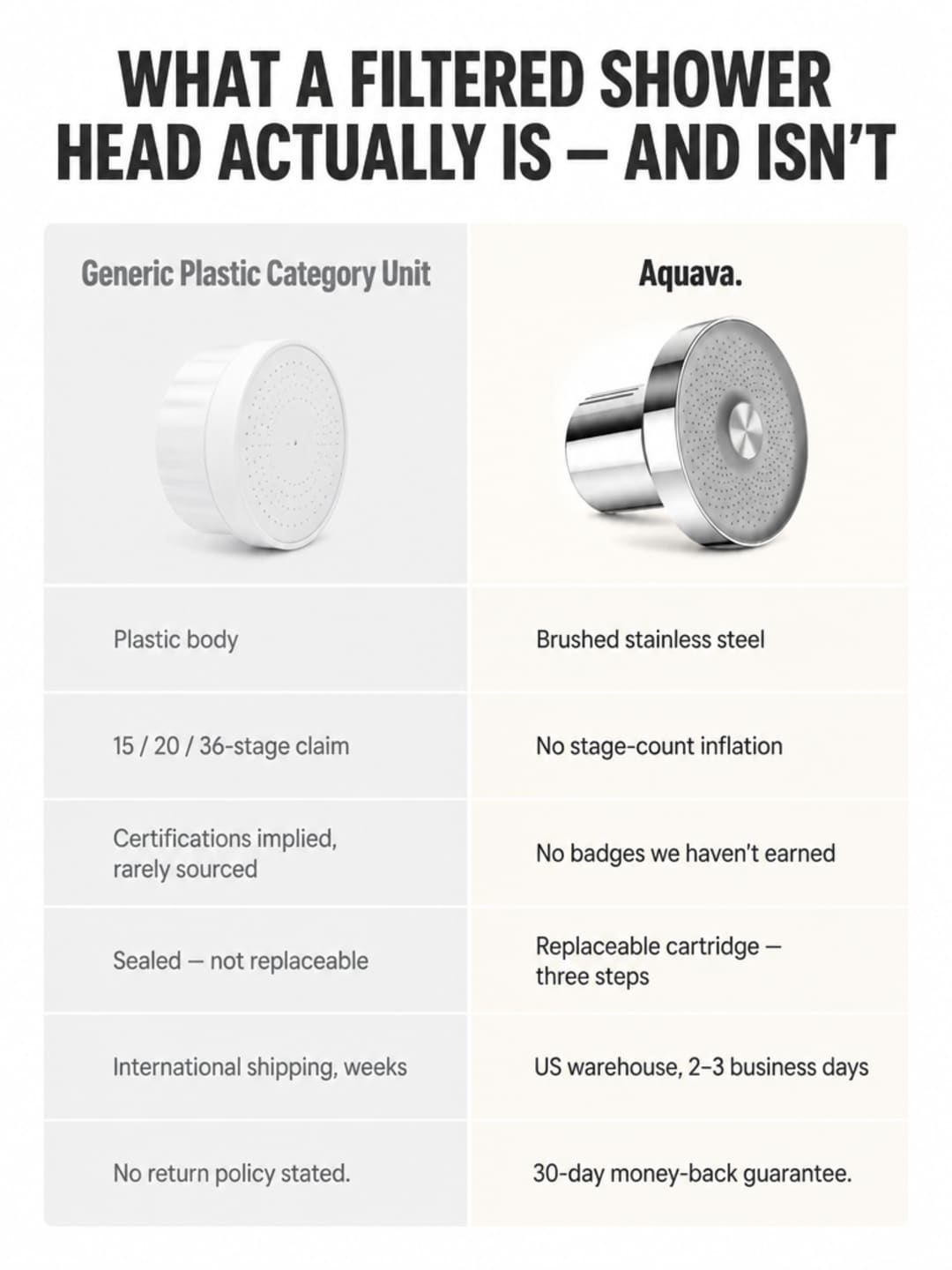
The honest comparison looks like this:
| Generic Plastic Category Unit | Aquava Filtered Shower Head | |
|---|---|---|
| Body material | Plastic | Brushed stainless steel |
| Stage-count marketing | 15 / 20 / 36 (inflated) | Not used |
| Certifications claimed | Often implied, rarely verified | None claimed (no invented badges) |
| Filter longevity design | Sealed, not replaceable | Replaceable cartridge |
| Shipping | Often 3-week international | US warehouse, 2–3 business days |
| If it "does nothing" | No recourse | 30-day money-back guarantee |
One more thing worth stating, because the category avoids saying it: Aquava is a filter, not a water softener. It reduces chlorine, heavy metals and other water-borne contaminants. It does not remove calcium and magnesium hardness — that requires a whole-home water softening system, which runs to several thousand dollars and requires plumbing. If calcium is the specific target, the filter is not the product. If chlorine and metal reduction at the shower point of use is the target — if the goal is to stop soaking hair and skin in the same water the kitchen filter was installed to avoid — the filter is exactly the product, and a whole-home softener won't address it.
That distinction is not a limitation. It is the accurate description of what the product solves. The category tends to blur this line, and the blur is one reason the category has a credibility problem. Aquava's position is to draw it clearly.
Reason 5 — What Actually Changes When the Shower Water Changes
The transformation isn't dramatic enough to require documentation. It doesn't need before-and-after photography or a lab report. It is, largely, a subtraction — the removal of something that was adding friction every morning — and subtractions tend to announce themselves quietly.
Hair that was perpetually dull or difficult to run fingers through without snagging becomes less so. Skin that tightened the moment the towel came off becomes less reactive. The corrective products that never seemed to hold their effect start to hold longer, because the surface they're applied to isn't being re-exposed to the same stressor every twenty-four hours.
Maya, in the Bay Area, had attributed most of her hair's behavior to the city's water being "just bad" — a vague complaint with no specific mechanism attached to it. The specifics: chlorine and metal residue accumulating on the hair shaft after each unfiltered shower, partially counteracted by the products in her routine, partially not. Once the shower water changed, the accumulation stopped being added. The products stopped having to correct for it.
Christine, in Phoenix, had been through three different dermatologist-recommended moisturizers in three years, each generating about a month of improvement before her skin returned to feeling dry and itchy by evening. The shower ran every morning before she applied them. When the shower water changed, the evening dryness retreated. She still uses the moisturizer. It simply lasts now.
Danielle's hair — in Las Vegas, where the municipal water is notably hard and chloramine-treated — had changed texture since the move in a way she'd attributed entirely to desert climate. Dry air is a real factor. Unfiltered shower water carrying chloramine every morning is also a real factor. The two aren't in competition. Addressing the one you can actually address — the shower head — is the available action.
None of these are medical outcomes. They are the ordinary functional consequences of reducing what the water carries into direct daily contact with hair and skin. It's not a cure. It's the removal of a daily source of friction that most people never knew was there, because the kitchen filter was already on the list and the shower head never came up.
The Aquava installs on any standard shower arm. No plumber, no landlord's permission, no permanent modification to the apartment. It comes off if you move; it goes onto the next shower arm. For renters — the segment of the population most exposed to variable water quality across cities, most likely to have moved into a new water system recently, and least able to address the infrastructure — it is the available version of the fix.

What Customers Are Saying
"I've had a Brita in my kitchen for years and genuinely never thought about the shower. Once I read that the same unfiltered water was hitting my hair every morning it made complete sense. The install took about five minutes and the stainless steel looks a lot better than the plastic thing I had before."
Rachel M. — San Francisco, CA
"My skin has been tight and itchy after showers for as long as I can remember. I figured it was just sensitive skin. The difference after switching was gradual but real — by the second week my legs weren't as uncomfortable when I stepped out. Practical, well made, and easy to swap the cartridge."
Diana K. — Phoenix, AZ
"Moved to Las Vegas eighteen months ago and my hair has never felt right since. I tried a cheap one from Amazon that did nothing. This one is different — the build quality alone is obvious the moment you hold it. Hair feels less rough at the ends, and the 30-day guarantee meant I had nothing to lose trying it."
Tamara J. — Las Vegas, NV
The Shower Was the One Thing on the List You Never Checked
You went through the kitchen tap. You went through the pitcher. You read labels on bottled water. And every morning — while all of that was running in the background as a health habit — the water hitting your hair and skin for eight to twelve minutes arrived completely unaddressed.
That's not a failure. The category didn't exist in your kitchen filter aisle. Nobody handed you the comparison. But it exists now, and the gap is one brushed-steel fixture on your shower arm from closing.
Here is what changes when it does:
- The chlorine and heavy metals that your kitchen filter was installed to avoid stop being the daily environment for your hair and skin
- The products in your morning routine work on a surface that isn't being re-conditioned against them every twenty-four hours
- The corrective loop — product applied, result fades, product reapplied — has a chance to actually hold
- Renters bring it to the next apartment; it installs in minutes on any standard shower arm, no tools and no landlord conversation required
- The filter is designed to be replaced, not discarded — when it fills up, it is working
You have spent real money and real attention on every other water source in your life. The one that has the most daily contact with your body has been sitting on the wall, standard-issue, for as long as you've lived there.
This article exists because the gap is genuinely easy to close once you know it's there. The mechanism is straightforward, the honesty policy is built in — it's a filter, not a softener, and that distinction is stated up front — and the question of whether it makes a felt difference for you specifically is answered by your own shower over thirty days, not by anyone else's testimony.
The full details — how the filtration works, what the stainless-steel body changes, and the specifics of the renter-friendly install — are on the next page.