You're Not Pressing on the Knot. You're Pressing on a Bruise.
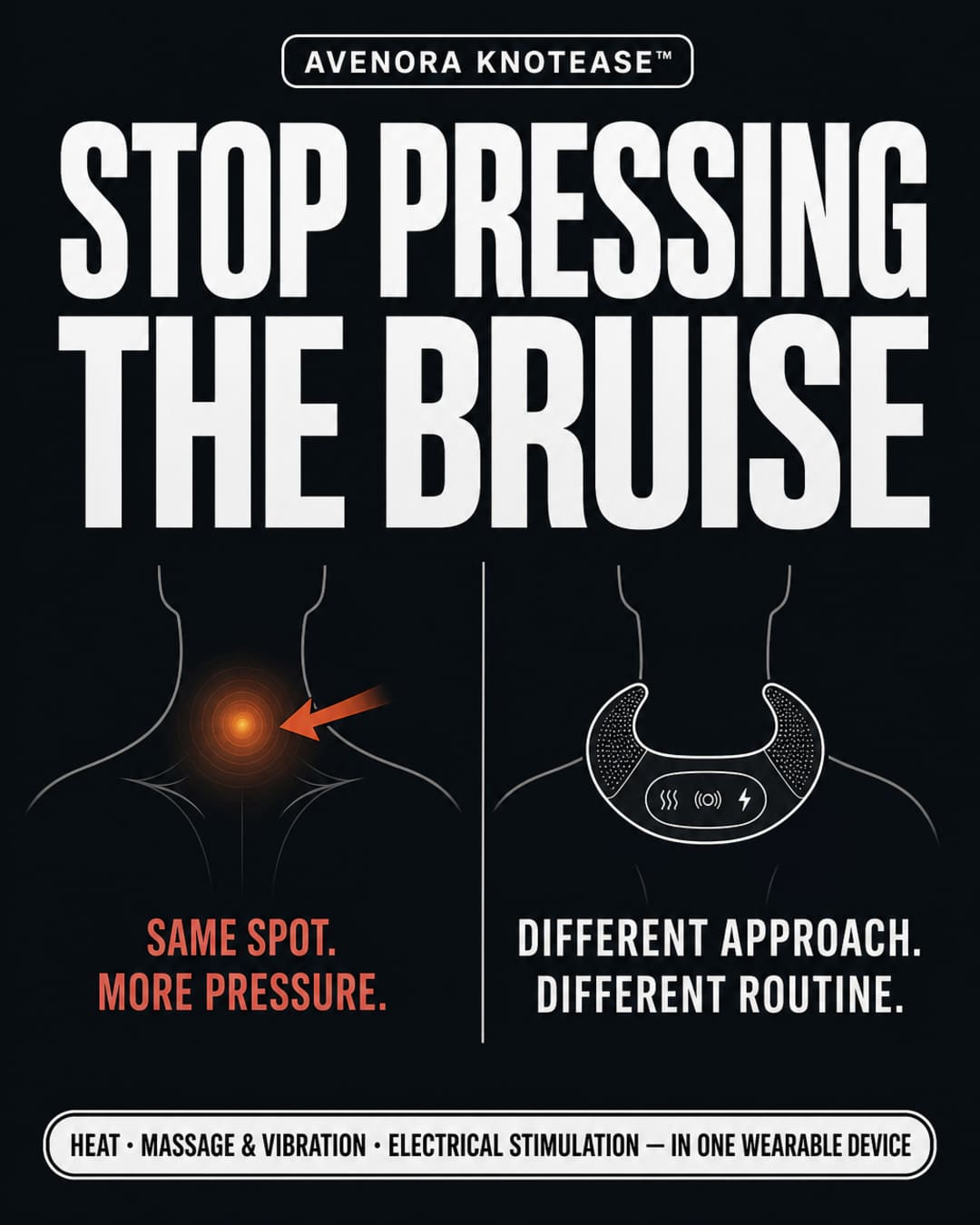
Every time you dig into that spot, you're giving yourself more of what's already not working — and your neck knows it. Here's what to try instead.
There is a particular kind of frustration that only people who carry a stubborn knot in the neck or upper trap will recognize. It is not the frustration of ignoring the problem. It is the frustration of someone who has been trying — who reaches for the lacrosse ball, who angles their thumb into the tender spot before bed, who pays close attention to what the body is signaling — and still wakes up the next morning with the same marble of tightness exactly where it was yesterday.
The conventional logic goes like this: you feel the knot, you find the knot, you press the knot. You apply pressure until it feels like something is happening, then you stop, and you wait for relief. It feels industrious. It feels like the right kind of effort — targeted, deliberate, responsive to the problem.
The problem with that logic is what it leaves out.
By the time a spot in your neck or upper trap is sensitive enough that you can point to it with one finger, it has already been under some degree of stress. The tissue is not waiting for more load. And yet the standard response — the ball against the wall, the thumb grinding in, the elbow from a helpful partner — is to add exactly that. Not because it is a bad instinct, but because nobody has offered a compelling alternative. The cycle continues. The spot stays. The pressing continues. The spot sometimes feels rawer the next day, not resolved, and still the response is to press harder.
That cycle has a name now, and a different choice. Avenora KnotEase™ is a wearable device combining heat, massage and vibration, and electrical stimulation — worn at the neck — designed as a different kind of comfort routine for people who are tired of attacking the spot that already hurts. This is what the research into that frustration points toward, and it is the only question worth answering: what if the approach itself is the problem?
Reason 1 — The Habit That Feels Like Progress and Isn't
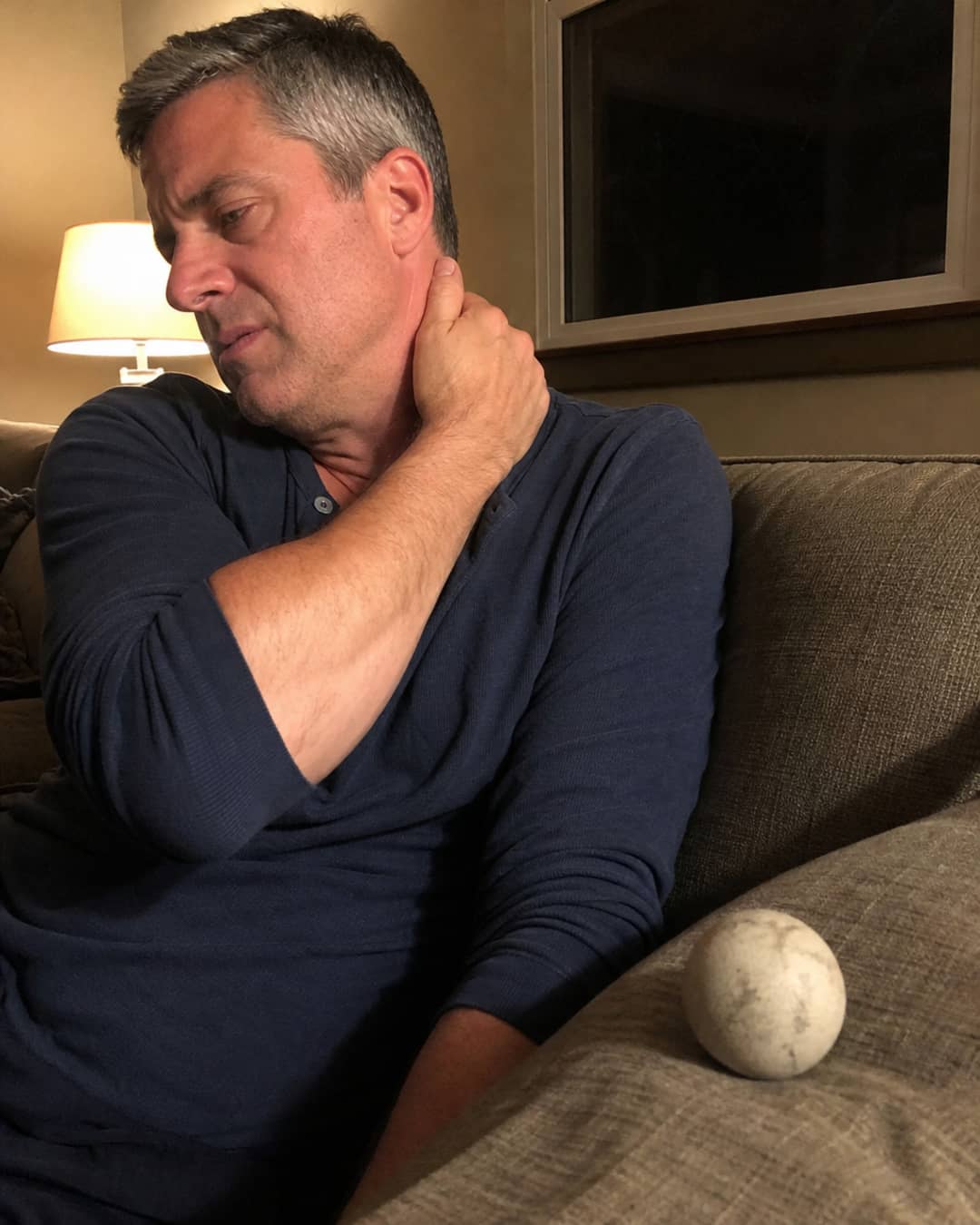
Derek knows exactly where the knot is. He has known for three weeks. He can find it in the dark — a dense, hot spot just below the right side of his neck where it slopes into the trapezius, roughly the size of a grape. Most evenings he sits on the couch, reaches up with his left thumb, and pushes in. He pushes until there is a kind of fierce satisfaction in the pressure, that almost-painful signal that feels like something being addressed. Then he stops. Then he checks in the morning. Then the spot is still there.
This is not a failure of attention or effort. This is a failure of the framework. The framework says: locate the problem, apply force directly to it. It is the same logic used on a stuck bolt or a splinter. It works for stuck bolts and splinters. The neck-trap junction is neither.
What that area is, when it feels like a knot, is tissue that has already been doing something it was not designed to do for a long time — bracing, guarding, holding a posture the skeleton did not fully intend. The sensitivity you feel when you press is not a marker telling you where to drill. It is more like a warning light telling you the system is already running hot. Pressing harder on a warning light does not reset the system.
Sandra — fifty-eight, retired, carrying tightness across both traps since roughly the second decade of her teaching career — described the ritual this way in a product review that reads like a confession: "I knew I was doing something wrong. The spot would feel almost inflamed after I pressed it for a while. But stopping felt like giving up. So I'd press again."
That word, inflamed, is not incidental. It is the word a lot of people use when they describe the experience honestly. Not "relieved." Not "looser." Inflamed.
The reason that keeps happening — the reason the approach produces that particular feeling for some people — is not mysterious once you understand what direct point-pressure actually does, and what it does not do, to tissue that is already under stress. That mechanism is worth understanding before you reach for the ball again.
Reason 2 — What Direct Pressure Actually Does (and the Step It Skips)
Here is what most self-massage frameworks implicitly assume: that the sensitive spot is the origin of the problem, and that applying enough mechanical force to it will break it up, release it, and restore the tissue to normal function. That assumption is intuitive. It is also, for a meaningful number of people, the reason the routine keeps failing.
Direct point-pressure, applied repeatedly to a sensitive area, does not automatically dissolve what caused the sensitivity in the first place. At best, it temporarily changes the local sensation — creating what some people describe as a "release," which can feel satisfying in the moment. At worst, for some users in some situations, it aggravates tissue that was already under load, producing exactly the inflamed-feeling aftereffect Sandra and Derek and Maya have all described.
The step the framework skips is the neck.
The neck — the cervical region, the musculature that supports the head and connects the shoulder girdle — is not simply the place above the knot. It is a dense convergence of the structures that govern tension in the surrounding area. An approach that starts there, rather than diving directly onto the most painful point, is a different kind of logic. Not magical. Not a guarantee. But genuinely different in its starting premise: instead of attacking the symptom directly, you begin with a broader comfort routine centered on the neck, and let the tissue respond from that context rather than from direct assault.
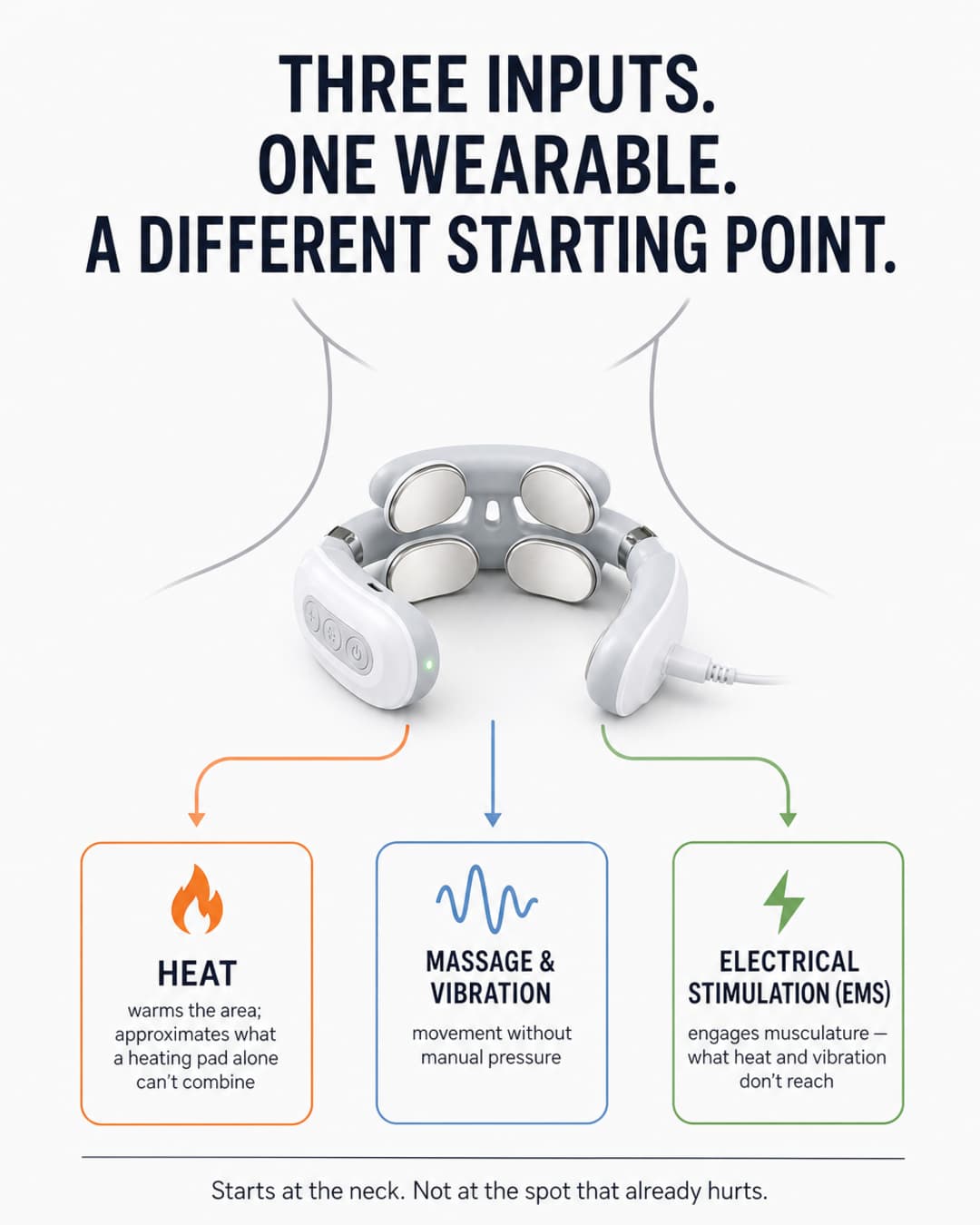
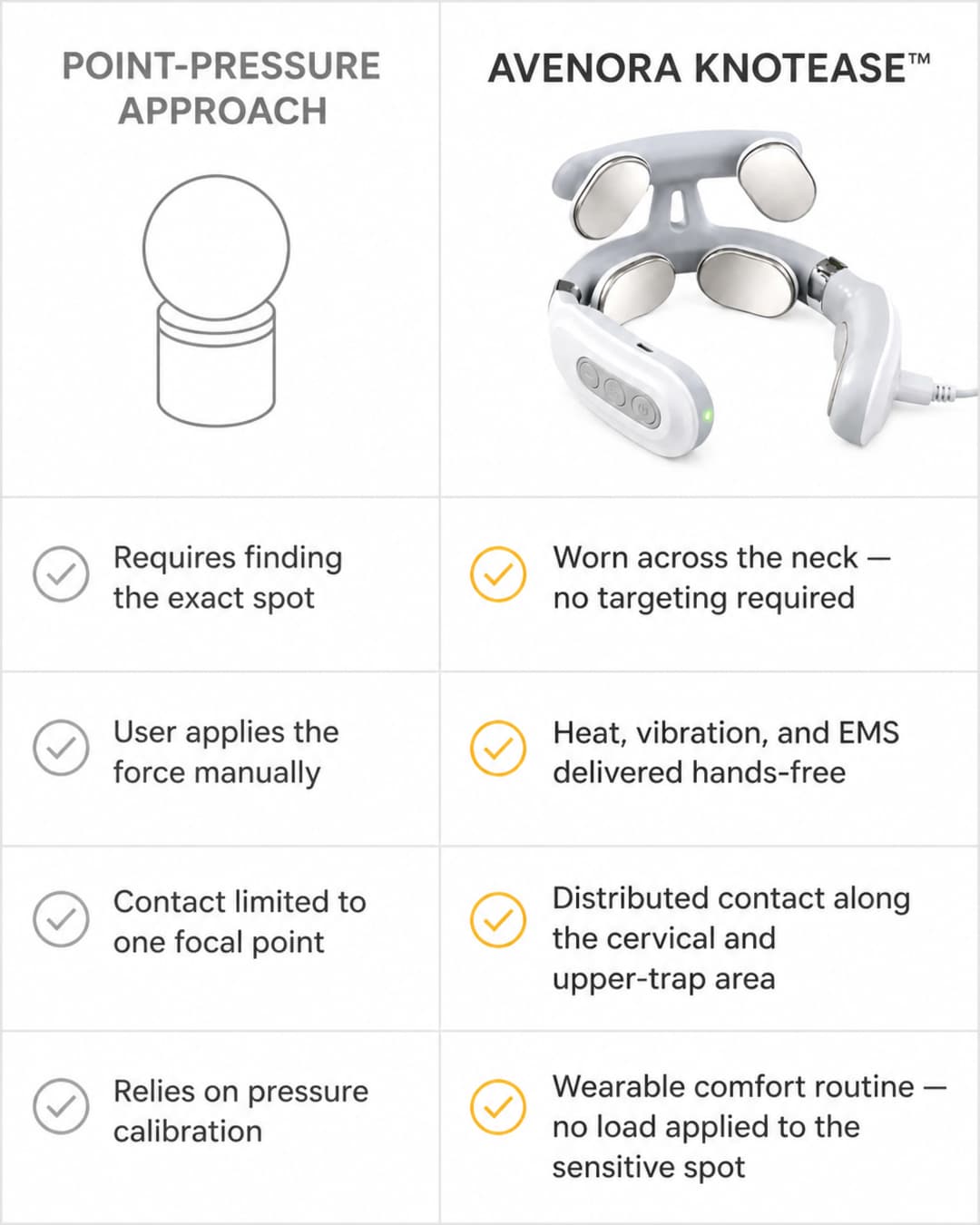
This is what KnotEase is designed around. The device sits across the back of the neck — the horseshoe shape rests at the cervical level on both sides — and delivers three inputs simultaneously: heat, which draws blood and warmth to the area and is the thing most people reach for a heating pad to approximate; massage and vibration, which creates movement and sensation in the tissue without requiring you to find an angle and hold it; and electrical stimulation (EMS), which engages the musculature in a way that neither heat nor vibration alone produces. All three, at the neck, where the approach begins rather than at the spot that already hurts.
It is not chasing the knot. It is starting somewhere else entirely.
Reason 3 — The Cost Nobody Adds Up
There is a number worth sitting with. Not a dramatic statistic — just a simple, honest accumulation.
Think about how long the knot has been present. Most people who are reading this and recognizing themselves in Derek or Maya or Sandra are not dealing with a knot that appeared two days ago. They are dealing with something that has been in the same spot, roughly, for weeks. Often longer. Often much longer.
Now add up the time spent on the routine that isn't resolving it: the minutes each evening with the ball against the wall, the thumb pressing in during the commute, the YouTube tutorial about trigger-point release that felt promising and produced two good days and then the spot returned. That is not just time. That is a tax levied on every single day the problem persists — paid in discomfort, paid in distraction during work, paid in the background cognitive load of a body that is signaling something to you continuously and receiving the same ineffective response.
Maya, the 34-year-old with the lacrosse ball on her desk, put it precisely in the kind of product review that lands harder than any marketing copy: "I didn't realize how much mental energy I was spending on a problem I was also making worse. It was always there. I was always aware of it. And my solution was making me more aware of it."
That is the actual cost: not just the tightness, but the sustained, low-grade attention tax of carrying a problem you are actively managing and not solving. At some point the question stops being "does my current approach feel like it's doing something?" and starts being "is this approach getting me anywhere different?"
That is the only question worth asking before you reach for the ball again tonight.
Reason 4 — What a Wearable Neck Device Does That a Ball Doesn't
A massage ball is a passive object. It does exactly what the user's applied force tells it to do — nothing more. Its value is entirely dependent on finding the right spot, the right angle, the right pressure, and holding all three simultaneously. That is a skill. Some people develop it. Many people don't, and the ball ends up doing one of two things: not quite reaching the area that needs attention, or hitting it too hard because the feedback loop between "enough" and "too much" is difficult to calibrate when you're working awkwardly behind your own neck.
A handheld percussive device has more power. It also has the same fundamental limitation: it requires you to find the spot, hold the tool at the right angle, and press it in. You are still, functionally, attacking the same point — now with a motor behind the force instead of a thumb.
KnotEase does not ask you to find the spot. It sits across the back of the neck — worn, hands-free, fully in contact with the cervical and upper trapezius area simultaneously — and delivers heat, vibration, and electrical stimulation without requiring you to identify a target and apply a load to it. The experience is not one of pressing. It is one of the area receiving input from a broader, more distributed contact surface while you sit, work, or simply rest.
That is a categorically different mechanical proposition. Not a more powerful version of the same tool. A different tool for a different approach.
Reason 5 — What Stops First
Derek does not describe the change in dramatic terms. That matters. The people who find a routine that works for them almost never describe it dramatically, because the point of a working routine is that it becomes unremarkable — it recedes into the background, which is the exact opposite of what the problem was doing.
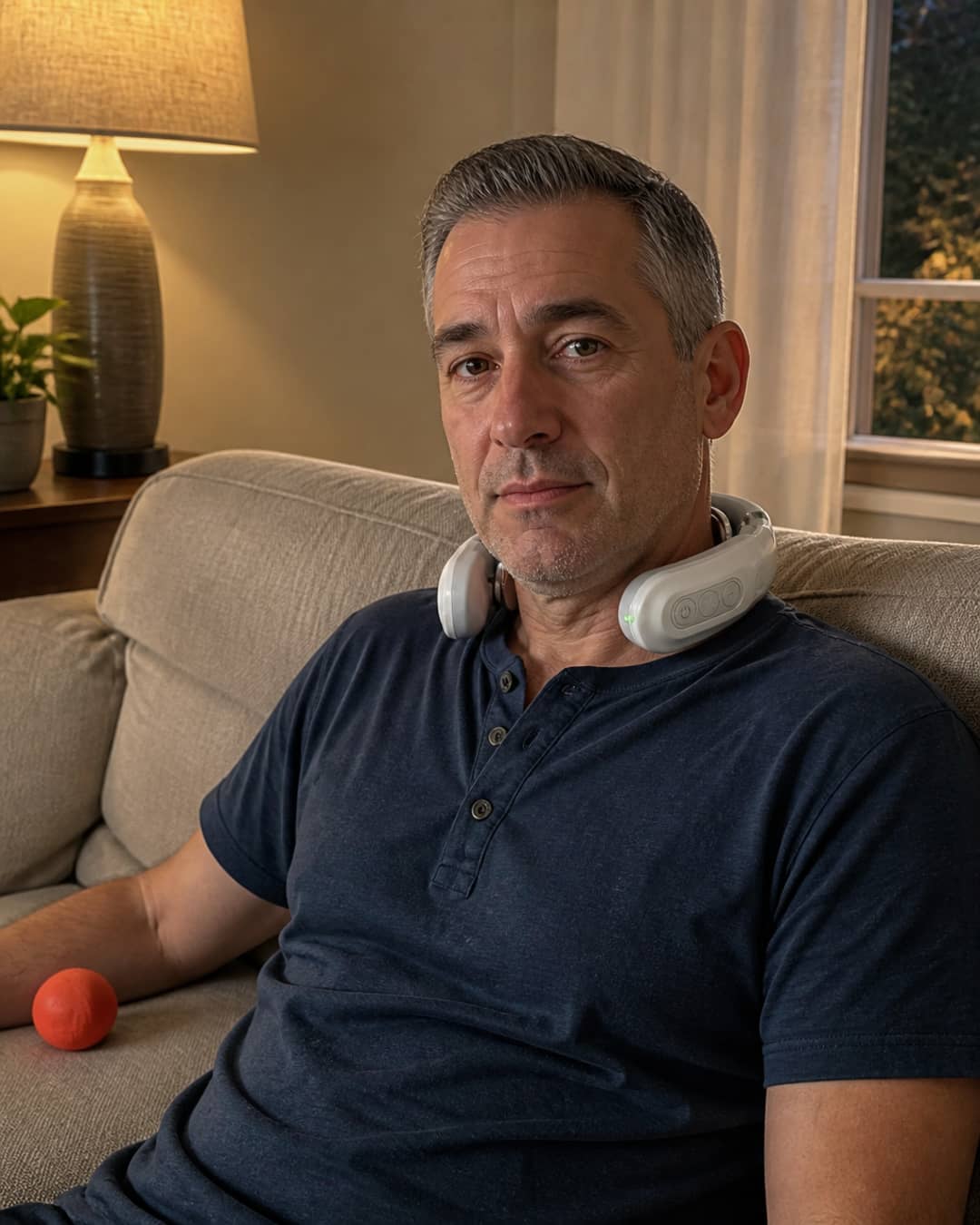
What he says is that the thing that stopped first was the reaching. The reflex to dig in with his thumb while watching TV simply — declined. Not through willpower. Because the routine that had been filling that slot felt like it was doing something, and the urgency behind the reaching faded. The spot became less like a problem he was actively managing and more like something he had incorporated into a daily habit that cost him nothing in effort and did not leave the area feeling rawer than before.
Maya describes a version of the same thing: the lacrosse ball is still on her desk. She does not reach for it in the same way. The ritual of looking for the knot with pressure has been replaced by the ritual of wearing the device for a set period — heat, vibration, and EMS working at the neck level — and then getting on with the rest of the workday without the low-grade awareness she had come to accept as normal.
Sandra is blunter: "I stopped arguing with my neck. That's the whole thing, really. I stopped treating it like a problem I was going to press my way out of."
Stopping pressing the spot that hurts is not giving up on comfort. It is the first decision in a different kind of routine.
What Customers Are Saying
"I'd been using a lacrosse ball for months and nothing really changed. KnotEase feels like a completely different approach — wearing it is just easier and less frustrating than trying to find the right angle every single time."
Rachel M., Portland, OR
"Well made and straightforward to use. The heat and the vibration together feel like a proper routine rather than just poking at the problem. I use it at my desk now instead of waiting until I get home."
James T., Chicago, IL
"I appreciated that it doesn't require me to find the exact spot. It sits where it sits and does what it does — that simplicity is actually the point. Practical and worth it."
D.K., Austin, TX
The Knot Isn't the Problem. The Approach Is.
Every morning you wake up with the same spot in the same place — and every evening you give it the same response — is another day the loop continues, unchanged. That is not persistence. That is the cost of a framework that has not been updated.
Here is what the people who have moved on from that loop have in common: they stopped trying to solve the problem by adding more of what was already not working, and they started with the neck instead of the spot.
What changes when the approach changes:
- The reflex to press and dig fades — not through willpower, but because the routine filling that slot is actually doing something.
- The area stops feeling inflamed or rawer the morning after a self-care session.
- The cognitive tax of carrying an unresolved problem you are actively managing begins to lift.
- The comfort routine stops requiring you to find the right angle, apply the right load, and hold it — it becomes something you wear.
- The neck gets a distributed, heat-plus-vibration-plus-EMS input rather than a single point absorbing all the force.
You have already spent weeks — probably longer — on the approach that produces the same result. You understand the mechanism now. You have seen what the alternative looks like and what it does differently. The only remaining question is whether you keep reaching for the ball tonight, or whether you read the full details on what KnotEase is and how it works.
The ball will still be there if you decide to go back to it. But the information is worth having first.