He Can Drive Himself. He Should Be Able to Get Out Himself, Too.
For anyone watching a parent quietly adapt around a problem that shouldn't exist — and wondering if there's a better answer than stepping in.
There's a particular kind of moment that's easy to miss if you're not watching for it.
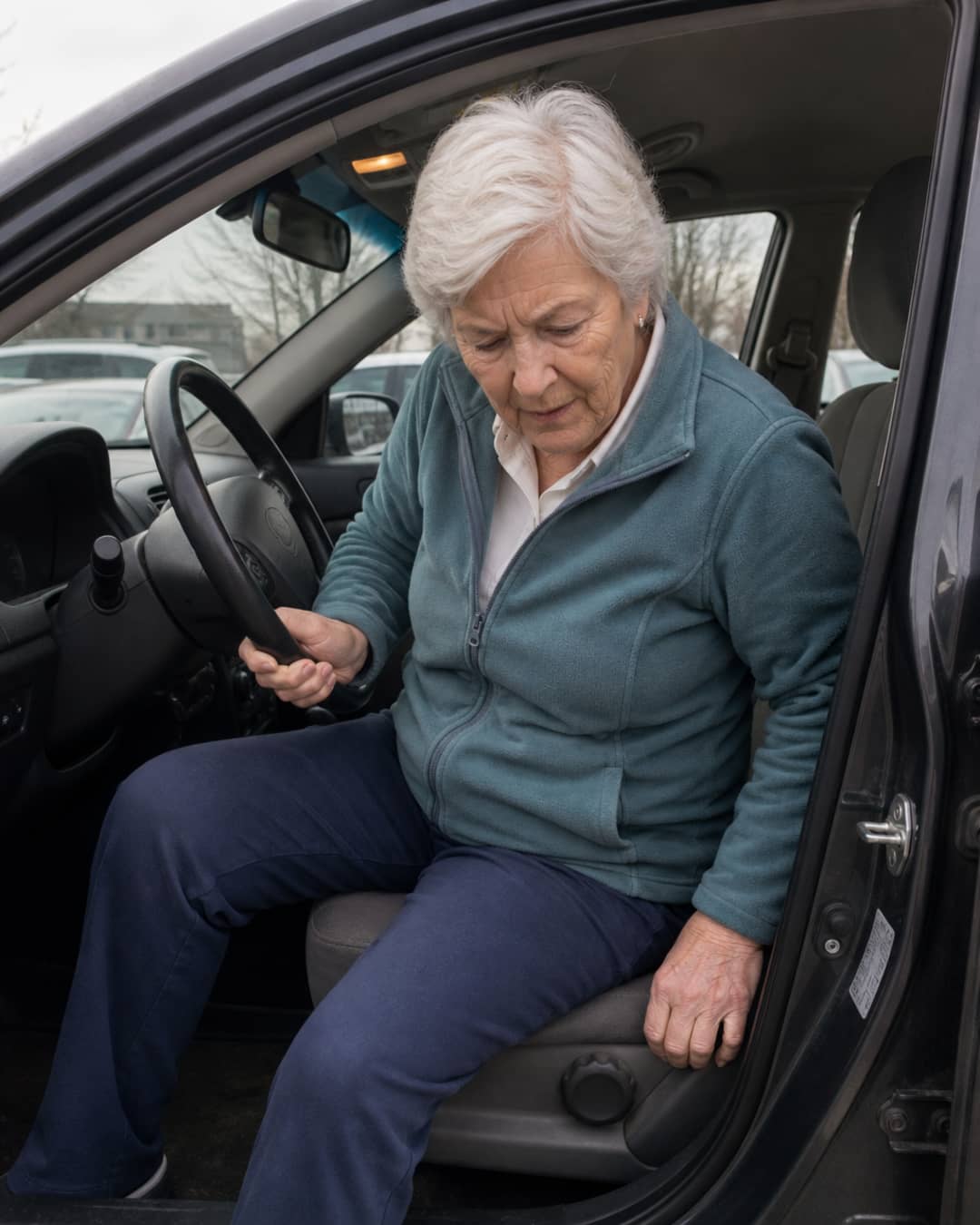
Your dad — or mom — gets back from wherever they went. Grocery store, doctor's office, a friend's house, wherever. They pulled in, parked the car, turned the engine off. And now there's this pause. A beat longer than it used to be. Their hand goes to the door frame, or the steering wheel, or wherever seems like the sturdiest thing nearby, and they pull themselves up and out with a little more effort than the movement should actually require.
They don't say anything about it. They've adapted. They've found a workaround. And honestly, the workaround is fine — until it isn't.
What makes this particular moment stick is that they're not asking for help. They're not waiting for you. They drove themselves there, they handled whatever they went to handle, and they're getting themselves back out. That's independence, almost all the way through. The car door and the steering wheel just weren't built for this job.
The question isn't whether they can keep doing it themselves. They're already doing it themselves. The question is whether they're doing it with something that was actually designed for the job — or improvising with whatever their hand lands on first.
That difference is smaller than it sounds. And it matters more than it looks.
Reason 1: The Car Was Never Designed for This Part of the Trip
Getting in and out of a vehicle is one of those movements nobody thinks about until it starts requiring thought.
The engineering inside a car is extensive. Seat positioning, steering response, safety systems, sightlines — an enormous amount of design attention goes into what happens while you're driving. Almost none of it goes into what happens in the five seconds before and after. Getting in and out is treated as a given.
For a lot of people, for a lot of years, it is. Then one day it isn't, and the car provides exactly nothing to help.
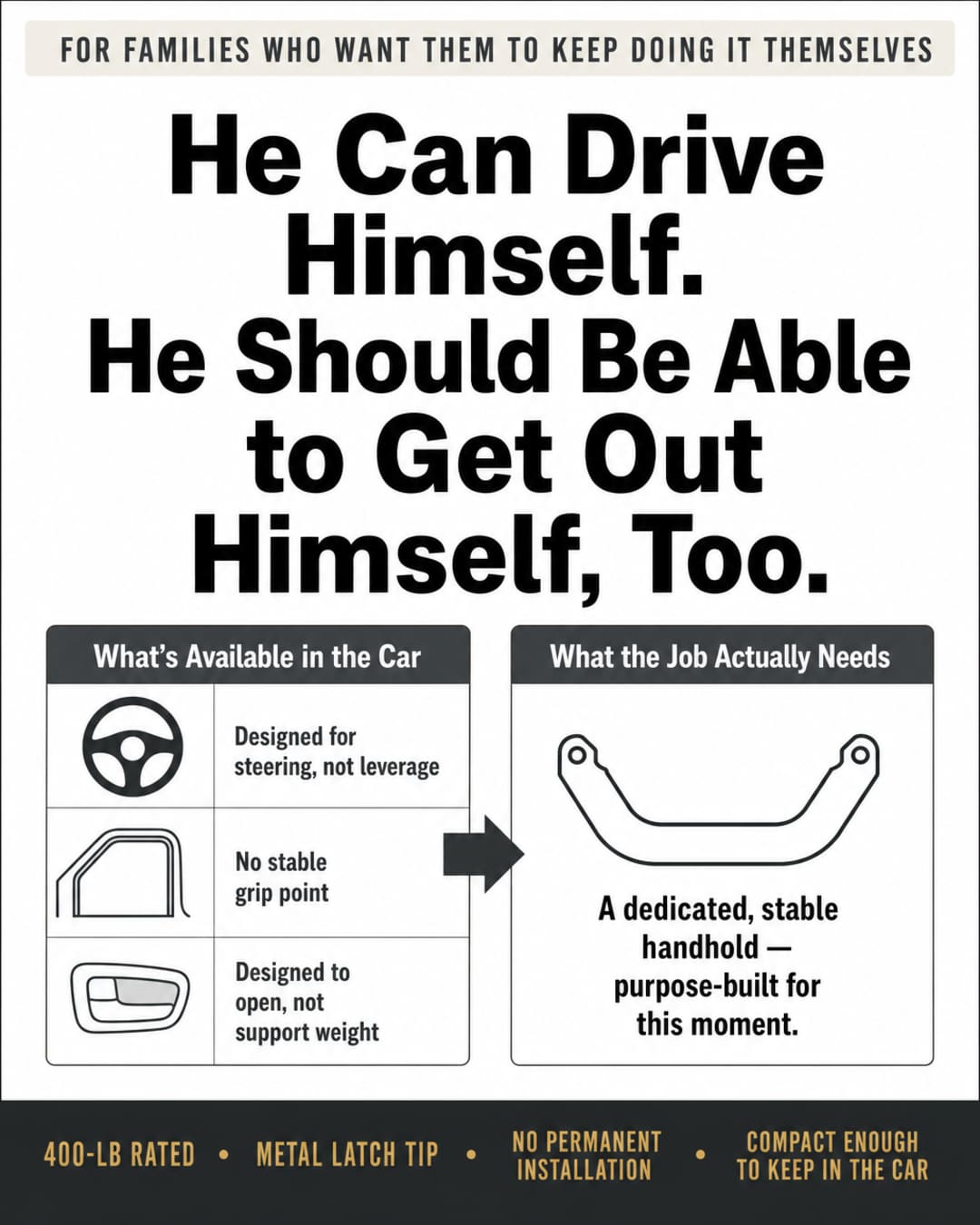
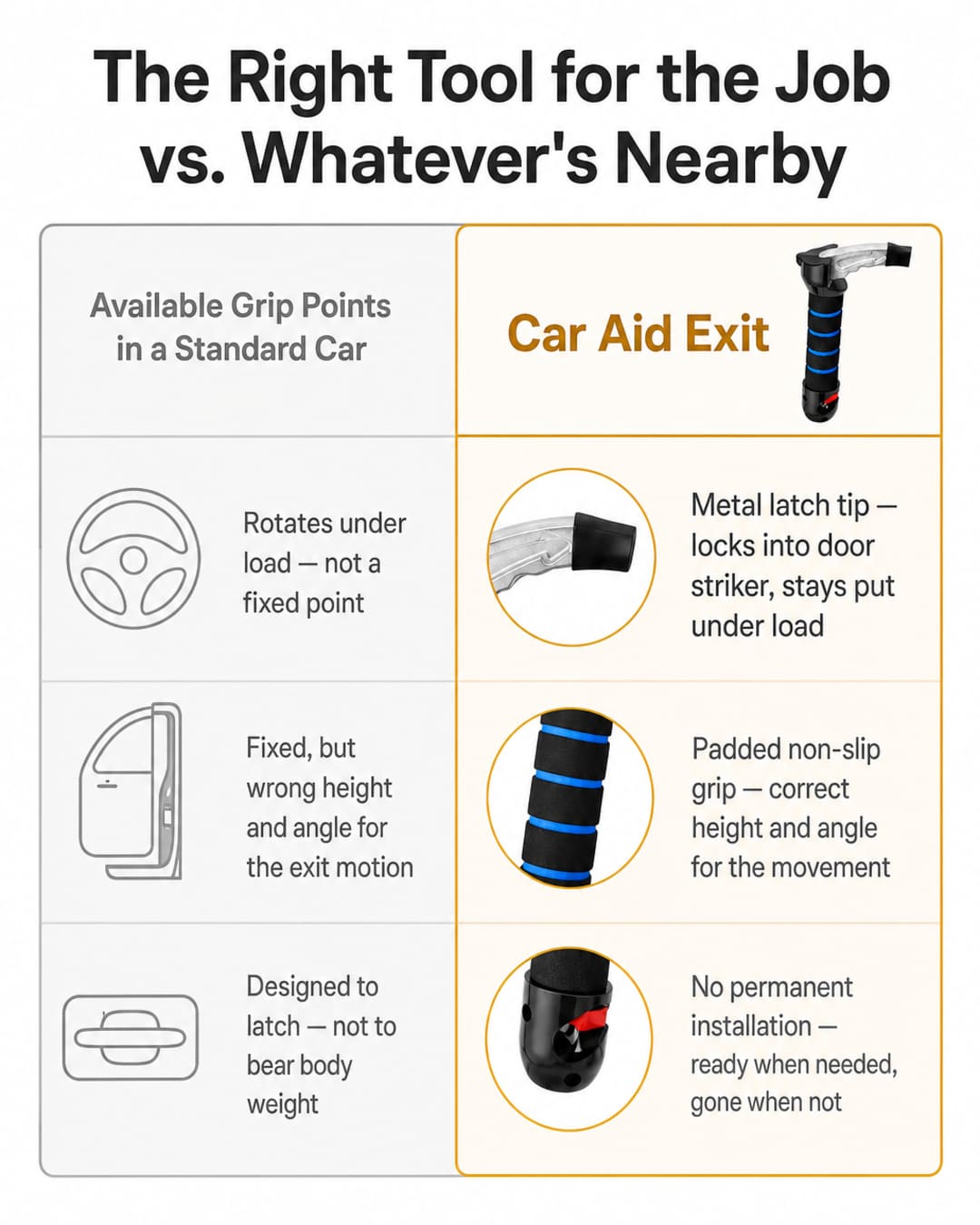
The steering wheel is the closest solid object, so the hand goes there. The problem is that a steering wheel rotates — it's not a fixed point. Pulling on it means pulling on something that can move, on a surface (the seat) that can slide, in a space (the foot well) that doesn't give you room to set your feet properly. The door frame is rigid, but it's at the wrong height and the wrong angle for the movement the body actually needs to make. The door handle is designed to latch, not to bear weight.
None of these are failures of the person getting out. They're failures of available geometry. The car simply doesn't have a stable, correctly positioned handhold for this specific motion — and the body, when it needs to push up and rotate out of a low seat, needs exactly that.
What the parent is doing in that pause — that beat before they pull themselves out — is searching, in real time, for the least bad option. Every time.
That's the part that doesn't have to stay that way.
Reason 2: What a Dedicated Handhold Actually Changes About the Movement
Here's the mechanical reality that makes this worth understanding.
Getting out of a low car seat is a compound movement. The body needs to rotate, push up against gravity, shift its center of mass over the feet, and stand — all in a relatively confined space, often with reduced hip flexibility, and without the kind of leg-spring that made the whole thing effortless at 35.
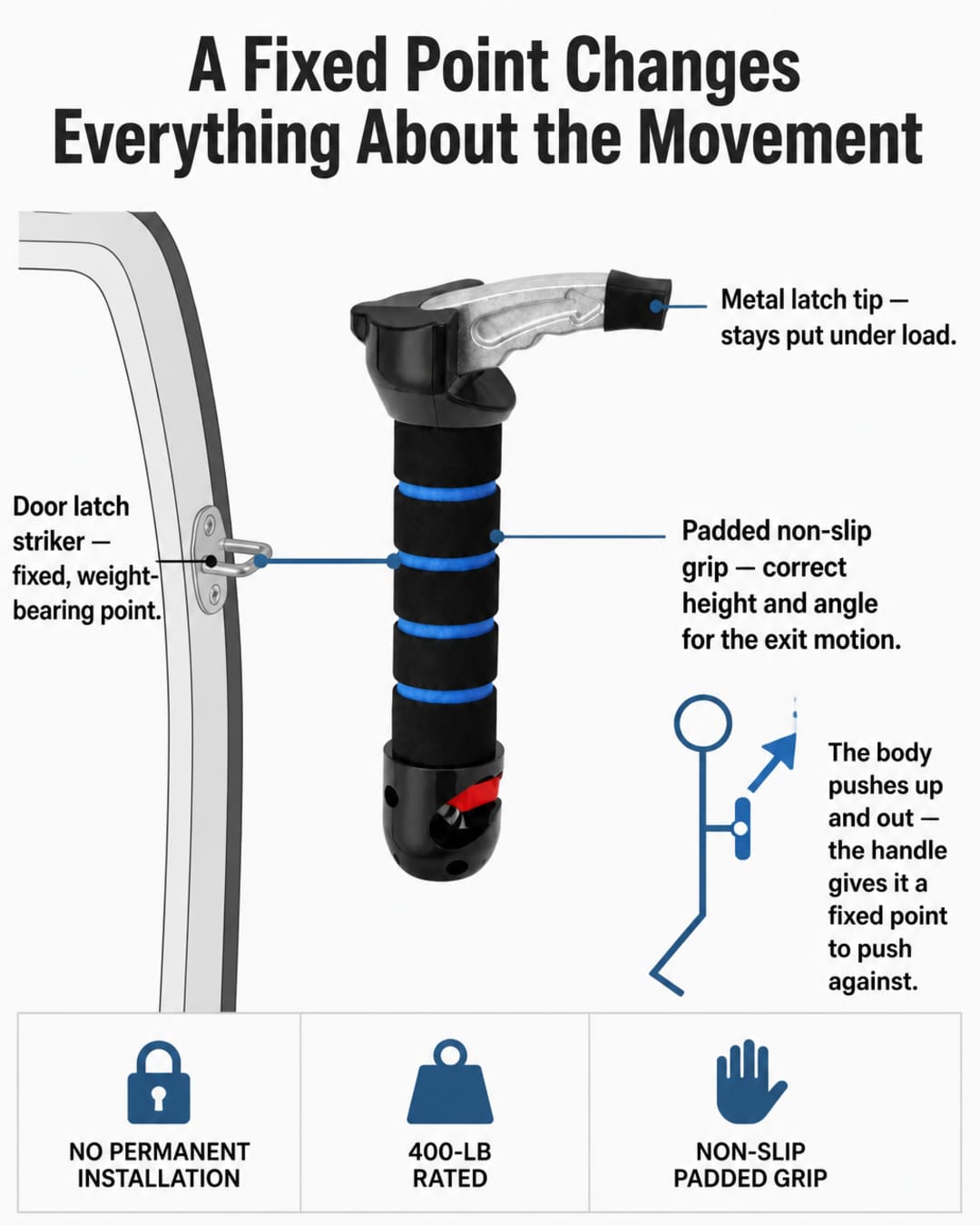
When that movement has a stable, correctly positioned anchor point — something fixed, at the right height, at the right angle — the muscular work required drops significantly. The body isn't guessing where to put the load. It's got a fixed point to push against, and it can use that point to control the movement rather than muscle through it.
Car Aid Exit works by latching into the door latch striker — the metal receiver built into the door frame of compatible vehicles. The latch tip is metal, not plastic, and the fit is designed to stay put when weight is applied to it. The handle extends from the latch point at an angle that puts a padded, non-slip grip at roughly the right height and position for the outward-and-upward motion the body needs to make. There's no installation. No tools, no permanent modification. You close the car door with the handle in place, and the latch holds it there while it's being used.
The padded grip matters more than it might sound. Hands — especially in cold weather, or with reduced grip strength — need a surface that doesn't require them to clench hard just to hold on. The padding keeps the grip secure without demanding effort the hand may not have available.
What changes for the person using it isn't dramatic. There's no transformation montage. They simply have a fixed, solid thing to hold, positioned correctly for the movement they're making, and the movement gets easier. That's the whole mechanism. It doesn't need to be more complicated than that.
What happens after, though — and this is the part most people don't think about ahead of time — is that a movement that used to require a pause starts requiring less of one. And movements that require less effort get skipped less often.
Reason 3: What Getting Skipped Quietly Costs
There's a version of this problem that looks like a handle issue. There's another version that takes longer to name.
When a routine movement becomes effortful enough — when it starts requiring planning, or energy, or a good moment — it starts getting avoided. Not consciously, not in a dramatic way. Just quietly. A trip that would have happened doesn't. An errand that could have been run gets postponed. A visit to a friend gets skipped because parking is awkward and the lot has no curb to push off.
None of these are decisions that anyone announces. They accumulate.
The research on what mobility restriction does to older adults over time isn't subtle: reduced independence of movement is consistently associated with reduced social contact, reduced physical activity, and reduced quality of life. This isn't a claim about Car Aid Exit preventing any of that. It's a claim about what the alternative looks like when a solvable problem doesn't get solved.
A parent who can get in and out of their car without effort — without that pause, without searching for a grip — is a parent who keeps going to the places they were already going. The car stays an instrument of independence rather than becoming one more thing that requires negotiating.
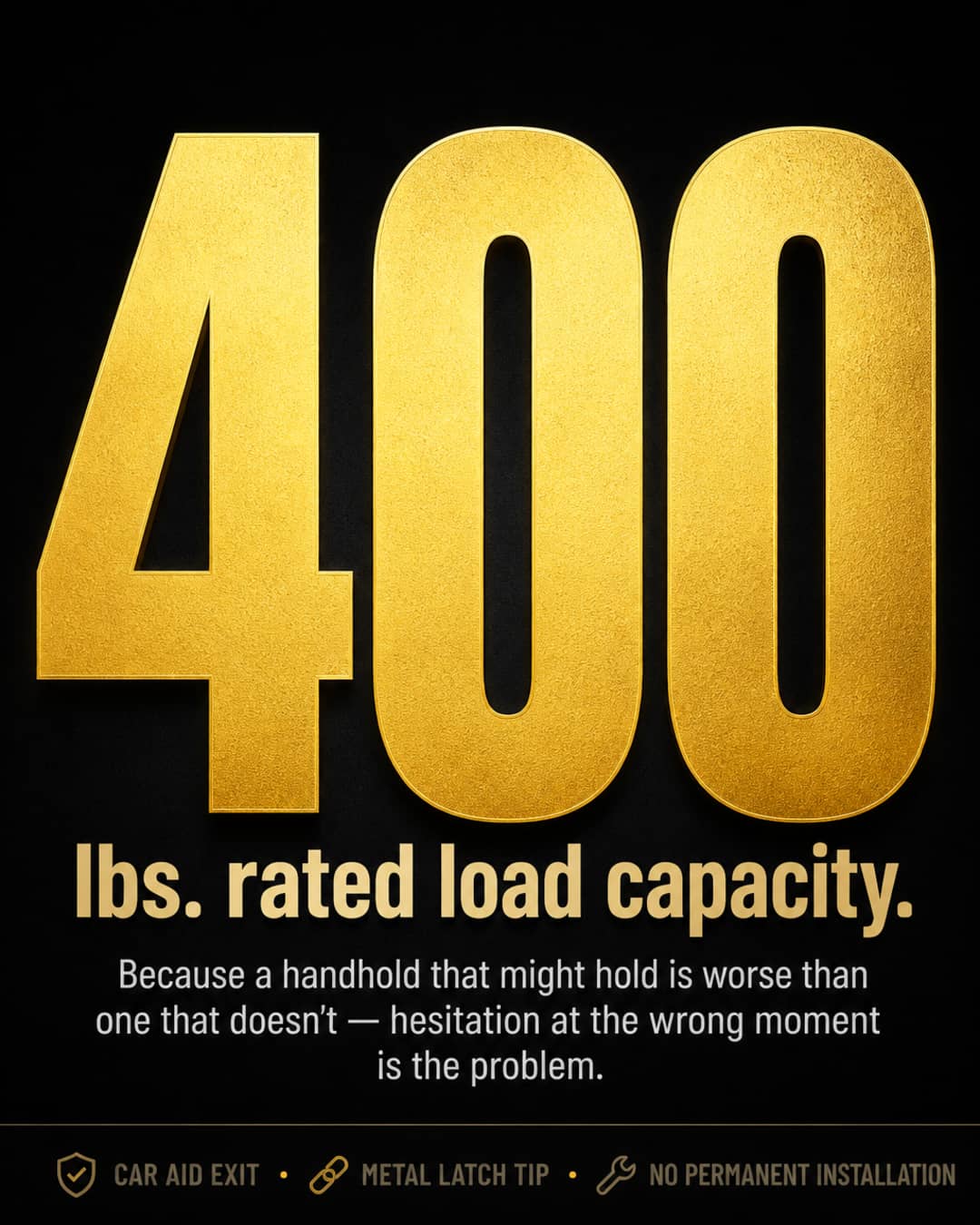
400 pounds of rated capacity means the handle is built to take weight without question. That's not a marketing number — it's the load rating, and it means that when someone leans on this thing, genuinely leans on it, it doesn't flex, give, or surprise them. A handhold that might hold is worse than no handhold at all, because it introduces hesitation at exactly the wrong moment. This one doesn't introduce hesitation.
The cost of not solving this isn't dramatic. It doesn't arrive in one moment. It arrives in a hundred small decisions, each one reasonable, each one slightly smaller than the last.
Reason 4: Not All Grip Points Are the Same Job
The objection that sometimes comes up here is a reasonable one: they've been managing. They use the door, or the steering wheel, or your arm on the days you're there. Why add something?
Because there's a difference between a grip point that happens to be present and a grip point that was designed for this specific motion.
A car door, used as a handrail, swings. It wasn't designed to bear body weight — it was designed to open and close. The hinge tolerances are built for that job, not for someone applying lateral and upward load against it while standing up. The door frame is fixed, but its geometry puts the available grip surface at the wrong height and angle for the exit movement, which means the person using it is compensating with their back and shoulders rather than letting their legs and arms do the work efficiently.
A steering wheel is rigidly mounted, but it rotates, and pulling on it applies torque to the steering column in a direction it wasn't designed to resist. In practice this is unlikely to cause a mechanical failure — cars are overbuilt — but a surface that can move, even slightly, is not the same as a surface that stays put.
Car Aid Exit is a different category of object. It's not already in the car serving another purpose. It's there for one job: to be a stable, padded, correctly-positioned handhold for getting in and out. The metal latch tip locks into the door latch striker — the same mechanism the door itself uses to stay closed — which means the hold point is rated for the kind of load the door frame is built to handle. The padded grip is sized and textured for a hand rather than for a door handle geometry.
This isn't a question of whether the improvised options work in the short term. They often do. It's a question of whether the tool available matches the job being done — and whether the person doing the job deserves a purpose-built option rather than a workaround.
Reason 5: She Gets Out on Her Own Terms. Every Time.
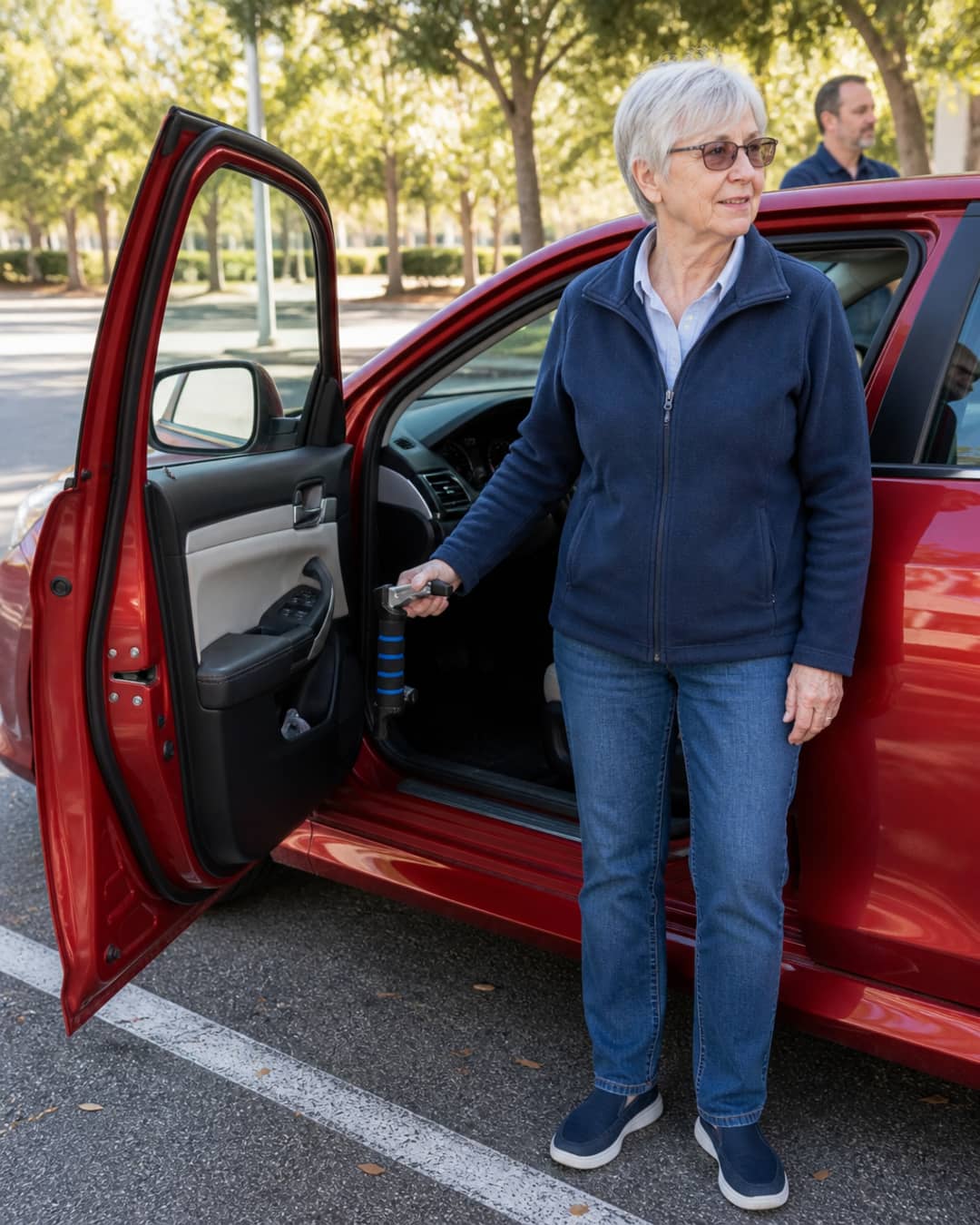
This is what it looks like when the right tool is in the car.
She pulls in, parks, turns the engine off. Opens the door. The handle is right there — she put it in place before she started driving, thirty seconds of habit. Her hand goes to the padded grip, which stays where it is because the metal tip is locked into the door striker. She pushes up and out, the handle gives her something solid to push against, and she's standing on the pavement without the pause. Without searching for a grip. Without calculating whether the steering wheel or the door frame is the better option today.
She closes the door behind her. The handle comes with her — it's compact enough to sit in a jacket pocket or tuck into the door pocket until the next time. No installation to undo. Nothing left behind in the car.
What didn't happen: she didn't wait for someone to come around and offer an arm. She didn't flag down a stranger in the parking lot. She didn't sit in the car for an extra thirty seconds managing the movement. She didn't go home earlier than she intended because the getting-out was going to take effort.
What happened instead was that the movement was just a movement.
That's what independence looks like in practice — not the absence of any challenge, but having the right tools available so that the challenges that don't need to be challenges, aren't. The car is still her car. The errand is still her errand. The trip to wherever she was going is still entirely hers.
One small thing in the door pocket. One less thing that requires negotiating.
The handle itself is simple — that's almost the entire point. The full details on how it works, what vehicles it fits, and what comes with it are on the product page.
What Customers Are Saying
★★★★★
"My mother was using the steering wheel every single time she got out of the car. I got her this and she said it felt solid right away. It does exactly what it says it does — nothing more complicated than that."
Karen T., Portland, OR
★★★★★
"Dad didn't want to make a big deal about it, but I noticed the pause every time. He's been using this for a few weeks and the pause is gone. He just gets out. Simple as that."
M. Okafor, Columbus, OH
★★★★☆
"Well made and compact — fits in the door pocket easily. My mom was skeptical but she keeps it in the car now. It's the kind of thing you don't realize you needed until you try it."
David R., Austin, TX
She's Still Doing It Herself. The Question Is Whether She Has the Right Tool.
Every trip she takes alone, she gets in the car and gets back out. That part hasn't stopped. But right now, the getting-out relies on whatever's in reach — a steering wheel that rotates, a door edge at the wrong angle, a grip improvised in the moment. That's the version of independence that's costing something, quietly, every time.
What changes with the right handhold in the car:
- The movement stops requiring a search. She reaches for the handle, not for whatever's nearest — because the handle is already there, in the right place, doing one job.
- The pause goes away. The beat before the push-up disappears when there's a fixed, padded, correctly-positioned point to push against.
- Trips she might have skipped, she takes. A movement that's effortful gets avoided. One that isn't, doesn't.
- She does it on her own terms. No arm to grab, no one to wait for, no moment of dependence built into an otherwise independent day.
- The car stays compact and unmodified. No permanent installation, no left-behind equipment — the handle comes with her and goes back in the door pocket.
The cost of not having this in the car isn't a single dramatic moment. It's the hundred small trips that get a little harder, the errands that get a little shorter, the days that get a little smaller — until independence isn't being lost all at once, just quietly trimmed at the edges.
The mechanism is understood. The tool exists. The only question left is whether it's in the car the next time she needs it.