The $80 Decision Every GM Truck and SUV Owner Should Make Before the Engine Decides for Them
If your vehicle runs AFM or DFM, there is a cost asymmetry hiding inside it — and most owners don't see it until they're already in the repair shop.
You saved for that truck. You made the payments. Maybe you paid it off, or maybe you're still making them — either way, it represents real money, a real asset, and a real dependency. It gets you to work. It hauls what needs hauling. It earns its place in the driveway every single day.
So when you start reading about AFM/DFM lifter issues — the forums, the repair estimates, the owners comparing notes on what their engine did before the bill arrived — there's a specific kind of dread that settles in. Not the abstract fear of a mechanical problem, but the very concrete math of what a major engine repair actually costs measured against what you have sitting in savings right now.
The repair figures that circulate in GM truck communities are not small. They're not a Tuesday afternoon inconvenience. Multiple sources cite repair ranges starting in the several thousands and running toward $8,000 or $12,000 depending on the severity of the failure and the vehicle. That range is wide. What isn't wide is the gap between that number and what it would have cost to take a proactive step earlier.
That's the asymmetry this article is about. Not a lecture on engine engineering. Not a guaranteed outcome in either direction. Just an honest look at the cost math that GM truck and SUV owners are weighing right now — and the simple, inexpensive step that a growing number of them are taking before their engine gives them a reason to wish they had.
The place to start is understanding exactly what's happening inside the engine every time you pull onto the highway.
You Already Own the Risk. You Just Haven't Priced It Yet.
Most GM truck and SUV owners know their vehicles have a fuel-saving feature. Some have heard the term AFM — Active Fuel Management — or its newer iteration, DFM, Dynamic Fuel Management. Fewer have thought carefully about what that system does in mechanical terms, or what happens when it begins to wear on components that are expensive to reach and expensive to replace.
Here's the short version. AFM and DFM are systems designed to shut down cylinders — typically half the engine's cylinders — under lighter load conditions like highway cruising, then reactivate them when power demand increases. The switch happens repeatedly, automatically, invisibly. The driver feels nothing. The lifters and valvetrain components involved in that switching cycle feel all of it.
The concern isn't hypothetical and it isn't invented by aftermarket sellers. It's visible in forum threads that go back years, in repair shops that recognize the failure pattern, in GM owners comparing notes on what their engine sounded like in the weeks before a major bill. The ticking. The misfires. The moment a shop tech explains what it's going to cost to fix.
What makes this genuinely unsettling isn't that the failure is guaranteed — it isn't, and anyone telling you every AFM/DFM engine will fail is overselling the fear. What makes it unsettling is that by the time the symptoms are obvious, the damage is already done and you're already past the point where a simple, inexpensive step could have mattered. You don't discover you were carrying this risk; you discover you were carrying it too late.
Derek — a man of mid-40s, brown hair greying at the temples, wearing a faded navy work jacket over a grey henley — paid off his half-ton last spring. He wasn't thinking about AFM/DFM when he did it. He was thinking about having one fewer monthly payment. Then a friend mentioned a forum thread. Then Derek spent an evening reading repair estimates and realized he had never thought of his truck as carrying a specific, quantifiable financial exposure. He thought of it as a paid-off asset. It still is — and he wants to keep it that way.
The exposure is already in your driveway. The question is whether you're going to price it before or after the engine makes the decision.

What the System Actually Does (and Where LifterGuard Comes In)
Before the cost math makes complete sense, the mechanism needs to be clear — because this is the part most owners don't have a crisp picture of, even if they've heard the term AFM.
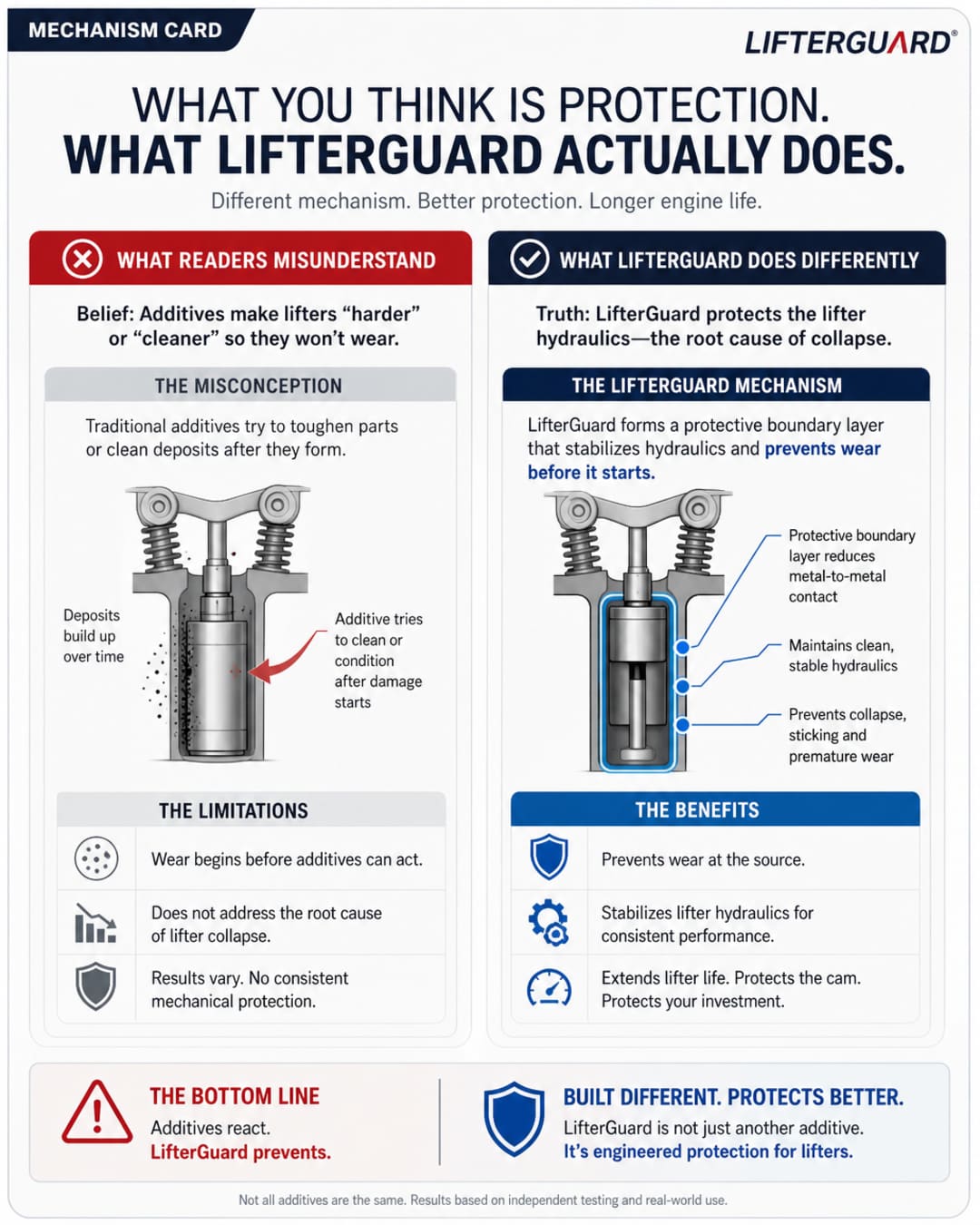
When your GM vehicle's engine management system commands AFM or DFM, it deactivates selected cylinders. It does this by disabling the lifters in those cylinders — specialized lifters that collapse when commanded, allowing the valves to stay closed while the piston continues its cycle. When power demand increases, the lifters reactivate, the valves return to operation, and the engine runs on its full cylinder count again. This happens on a continuous basis during certain driving conditions. Highway driving at steady speed is a common trigger.
The concern that drives owners to research this is the repeated cycling of those lifters. Each collapse-and-reactivate cycle is a mechanical event. Over time, and under certain conditions — oil type, oil change intervals, driving patterns — some owners report that the lifters involved in that process show accelerated wear, or fail outright. When a lifter fails in an AFM/DFM context, the repair is rarely minor. The components are deep in the engine. Labor hours are significant. Parts are not cheap.
LifterGuard is designed to interrupt that cycle at the source. It plugs into the OBD2 port — the same port a mechanic uses to read diagnostic codes — and is built to prevent the vehicle's computer from commanding AFM/DFM cylinder deactivation. The engine runs on its full cylinder count. The lifters associated with the deactivation cycle are no longer being asked to perform it.
No tune. No reflash. No permanent modification. If you decide to remove it, you unplug it. The installation is as simple as it sounds: locate the OBD2 port under the dash, plug the module in, drive. There are no tools involved and no technical knowledge required beyond knowing which end of the module faces the port.
The misunderstanding most owners bring to this is that disabling AFM/DFM requires a dealership visit or a software tune. It doesn't — not with this approach. The OBD2 port was designed for exactly this kind of vehicle communication. LifterGuard works within that existing architecture.
The Number That Changes the Conversation
Let's be direct about the math, because this is where the asymmetry becomes impossible to look away from.
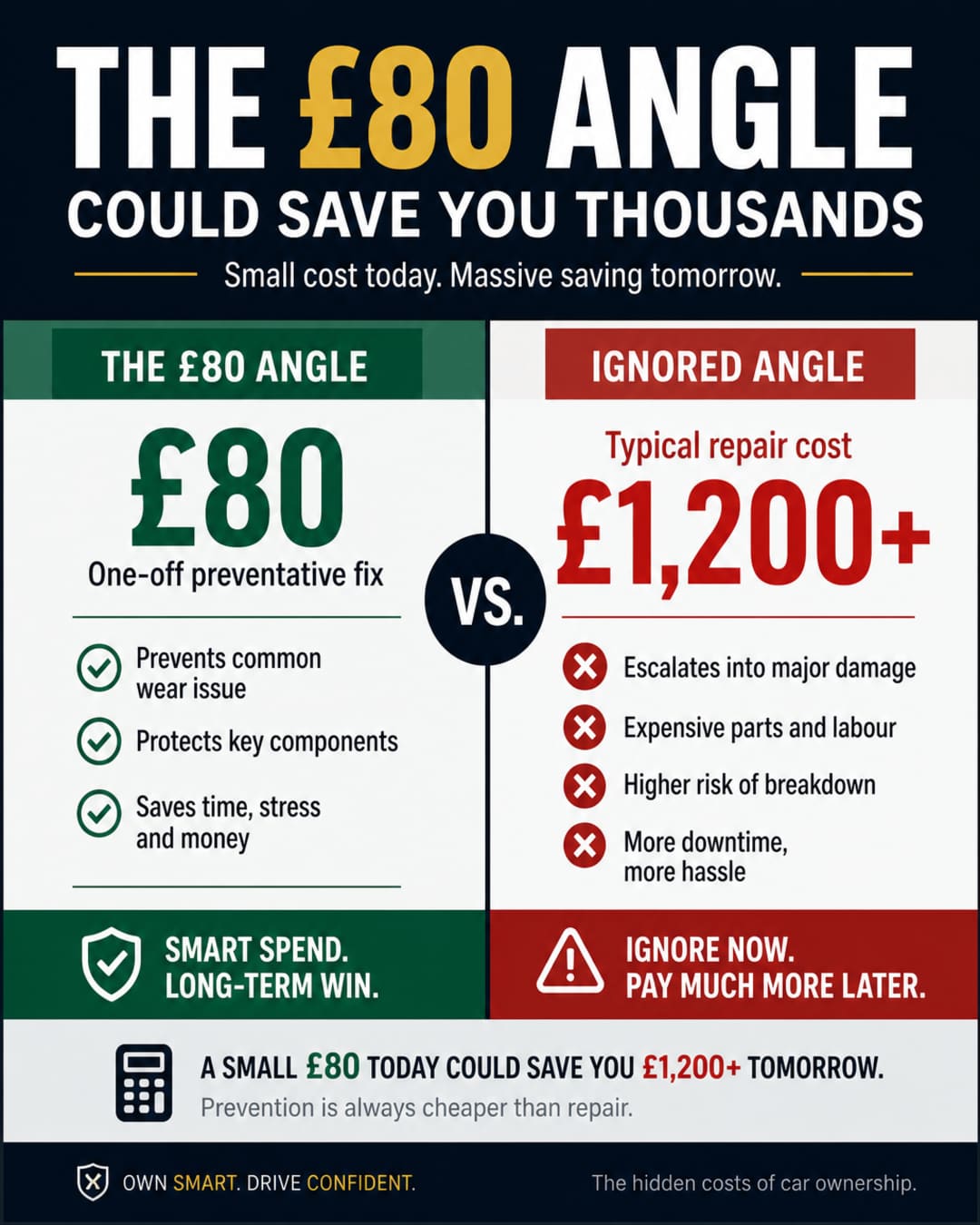
A LifterGuard module is priced at roughly $80. The repair costs that AFM/DFM-related lifter failures generate, based on figures circulating in GM owner communities and referenced by multiple sources in this space, range from several thousand dollars on the lower end to $8,000, $10,000, or $12,000 on the higher end depending on the extent of the failure, the labor rate at the shop, and whether related components have also been compromised.
That is not a small spread. And it is not a hypothetical. These are repairs that GM owners have paid for, documented, and discussed at length in enough forums and groups that the pattern is well established. The failure mode has a name. The repair has a known cost range. The owners who went through it are not abstract.
Now hold those two numbers next to each other: $80 and $8,000. The ratio is 1 to 100. Meaning: for the cost of a single routine service appointment — an oil change and a tire rotation — you can take a proactive step that addresses the specific mechanical process at the root of the concern. You are not buying certainty. No product in this space can promise you that. What you are buying is a documented intervention in the cycle that owners are worried about, at a price that is genuinely negligible compared to the alternative you are trying to avoid.
Marcus — a man of early 30s, close-cropped hair, wearing a dark green hoodie over a white t-shirt — ran this calculation on his phone at a gas station. He had the calculator app open next to the product page. He is not an automotive enthusiast. He does not enjoy reading about engine components. But he is entirely capable of comparing two numbers, and once he did, the decision was straightforward.
The repair fund that most GM owners carry — which is to say, the emergency fund that was not specifically set aside for a four-figure or five-figure engine repair — is not a comfortable cushion against that range of costs. The $80 question is not really about the $80. It's about what $8,000 feels like when it's unplanned.

Doing Nothing Is Also a Decision
There is a version of this conversation where a GM owner reads everything above, feels the weight of it, and then — because nothing has gone wrong yet, because the truck starts fine every morning, because the week is busy — does nothing. That is a completely understandable response. It is also a financial decision with a specific risk profile attached to it.
Doing nothing means the AFM/DFM system continues to operate exactly as it was designed to. The lifters continue to cycle. The pattern that concerns owners continues without interruption. And the truck continues to offer no dashboard signal, no audible warning, no indication that anything is happening — right up until it does.
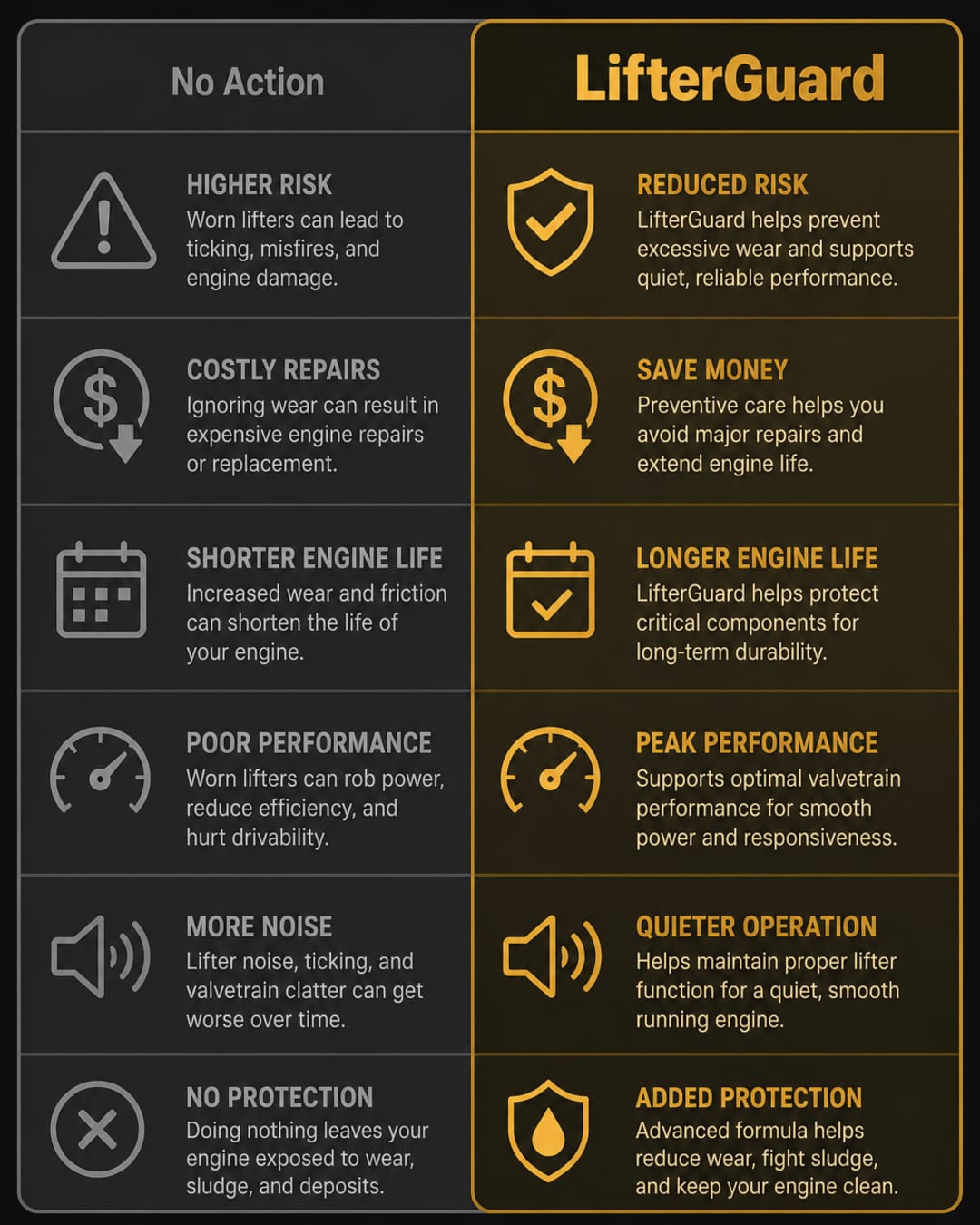
The comparison that matters is not between LifterGuard and some perfect engineering solution that eliminates the underlying concern entirely. The comparison that matters is between taking a simple, inexpensive, reversible proactive step right now and taking no step at all.
Here is what that comparison looks like in practice:
Taking no step: the AFM/DFM system runs as designed. The concern remains unaddressed. If a failure occurs, the repair cost lands at whatever the shop charges. There is no warning before it happens. The window for a proactive measure has closed.
Taking this step: plug LifterGuard into the OBD2 port. The vehicle's computer is prevented from commanding cylinder deactivation. The specific mechanical cycle at the center of the concern is no longer occurring. If you decide the product is not right for you, unplug it. Nothing permanent has been done to the vehicle.
One of these costs $80. One of them costs nothing today and potentially thousands later. Neither guarantees an outcome — engines are mechanical systems and mechanical systems involve variables. But the asymmetry of the risk is not ambiguous.
Marcus ran this comparison. So did Derek. So, right now, are roughly 30,000 GM owners who have made their own version of this calculation and decided that the proactive option was the more rational financial choice.
What the Truck Feels Like When You're Not Waiting for Something to Go Wrong
There is an experience that is hard to describe until you've had it — the low-grade, background anxiety of owning a vehicle you depend on and knowing there is a specific, documented concern inside it that you haven't addressed.
It's not dramatic. It doesn't stop you from driving. It just sits there. Every time the engine note changes slightly, every time you read another forum thread, every time someone in a GM group mentions what their repair cost — the math runs itself quietly in the background. You're not anxious in a way you'd name out loud. You're just aware.
Derek — a man of mid-40s, brown hair greying at the temples, wearing a faded navy work jacket over a grey henley — plugged LifterGuard into his half-ton on a Tuesday evening. He found the OBD2 port under the dash in about thirty seconds. The module seated cleanly. He started the truck. He drove it.
What changed was not the truck. The truck drove identically. What changed was that he was no longer carrying the specific, unresolved exposure he had been carrying for the two weeks since he read about AFM/DFM for the first time. He had priced the risk. He had compared the two numbers. He had made the decision that cost $80. And the background calculation — the one that ran quietly every time he considered a long drive — stopped running.
That is not a guaranteed engine outcome. LifterGuard is a proactive step, not a warranty. But the peace of mind that comes from knowing you addressed a specific concern, in the simplest possible way, for the price of an oil change — that part is immediate. You feel it on the first drive.
The engine you depend on is still doing its job. The difference is that you've done yours.

What GM Owners Are Saying
4.91 out of 5 · Based on 30,000+ customer reviews
"I'd been putting this off for months after reading about AFM issues on my Silverado. Finally plugged LifterGuard in and it took about 30 seconds. Straightforward and does exactly what it's described to do. Feels good to have taken that step."
— Jason T., Columbus, OH
"The install was genuinely as easy as they say. Found the OBD2 port, plugged it in, done. My truck runs the same as always — that's the point. Good value for the peace of mind it gives you as a GM owner."
— R. Morales, San Antonio, TX
"I did the math. Roughly $80 versus what I've seen people pay for lifter jobs on these trucks. It wasn't a hard decision. Arrived fast, fits perfectly, and the fitment checker made sure it was right for my year before I bought."
— Dave K., Grand Rapids, MI
The Repair Bill Doesn't Send a Warning. This Conversation Does.
You've seen the mechanism. You've seen the numbers. You know that AFM/DFM-related failures carry a cost range that lands well outside what most owners have sitting in an emergency fund, and you know that the window for a proactive step closes the moment a failure begins.
- AFM/DFM lifters cycle on every drive — the concern is mechanical, documented, and well-established in GM owner communities
- When failures occur, repair costs range from several thousand dollars to $12,000 depending on severity
- LifterGuard plugs into the OBD2 port and is designed to prevent the vehicle from commanding cylinder deactivation — no tools, no reflash, reversible
- The cost asymmetry is 1 to 100: roughly $80 against a repair range that starts in the thousands
- 30,000+ owners have made this calculation and chosen the proactive step; the product carries a 4.91-star rating across that base
What does staying exactly where you are cost? It costs nothing today. It costs the continued operation of the AFM/DFM system inside your engine, without interruption, every time you drive. It costs the knowledge that the specific mechanical concern you now understand in detail is still fully active — and that the first real signal of a problem may arrive not as a warning but as a bill.
You now know more about what is inside your engine than you did before you read this. The question is what you do with that.
The product page shows you exactly how it works, which vehicles are compatible, and what owners who have already made this decision are saying.