What's Happening Inside Your GM Engine Every Time You Drive — And Why Thousands of Owners Are Doing Something About It
If you own a GM truck or SUV with a V8, there's a system inside your engine that most owners were never told about. Here's what it does, why it has some owners worried, and what you can do about it before it becomes a costly conversation.
You're driving your GM truck. Everything feels normal. The engine sounds fine. The dashboard is clean.
But inside that engine, a system is working — quietly, automatically, and repeatedly — that you may have never been told about when you bought the vehicle.
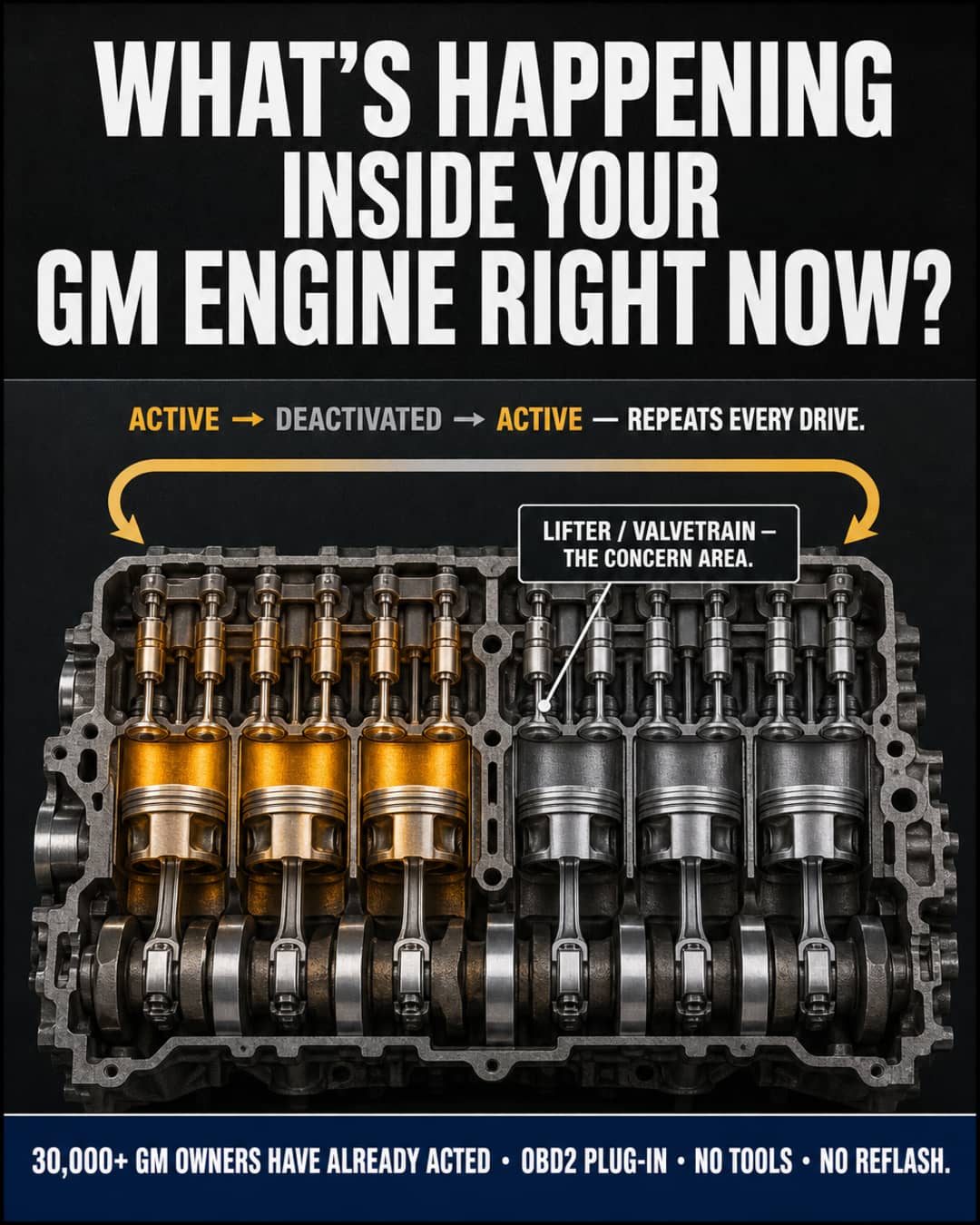
It's called AFM, or DFM on newer models. Active Fuel Management. Dynamic Fuel Management. The basic idea is straightforward: when the truck senses that it doesn't need full power, it deactivates some of the cylinders to save fuel. On a V8, you may be running on four cylinders without realizing it. Then the load changes, and the engine switches back. This can happen dozens of times on a single commute.
The system was designed with efficiency in mind. That part is true. But the reason tens of thousands of GM owners have been quietly researching this — on forums, on YouTube at midnight, in mechanic waiting rooms — is the question of what that repeated switching does to the lifters and valvetrain hardware that make it possible.
What most of those owners wish is simply this: that someone had told them sooner. Because the moment you understand what AFM/DFM actually does inside your engine, the next question is an obvious one.
Your Engine Is Doing Something You Can't See, Feel, or Hear — Until It's Too Late
There's a particular kind of mechanical problem that is uniquely expensive. Not because the part is rare. Not because the labor rate is unusually high. But because by the time you find out it's happening, it has already been happening for a long time.
AFM and DFM work by collapsing lifters on certain cylinders — small hydraulic components that allow the valvetrain to deactivate a cylinder on command. The system cycles based on throttle demand. Light load: deactivate. More power needed: reactivate. In normal highway driving, that cycle can run continuously.
The concern that has built up across GM owner forums, enthusiast communities, and independent mechanic shops isn't theoretical. It's the pattern: owners driving normally, no warning lights, engine sounding fine — and then a tick, or a misfire code, or the news from a mechanic that a lifter has failed. The hardware involved lives deep in the engine. Getting to it is not a minor job.
What makes this particularly difficult is that the wear, if it develops, doesn't announce itself at the beginning. It announces itself at the end.
Marcus — a man of 41, close-cropped dark hair going gray at the temples, wearing a faded gray work hoodie over a dark henley — found this out at 11 p.m. on a Tuesday, sitting at his kitchen table with his phone, after a second faint tick in two days. He hadn't known AFM existed. He'd owned the truck for three years. He read until 1 a.m.
Knowing what's happening inside your engine isn't about alarm. It's about the difference between making a choice with information and making a choice without it. And the choice becomes a lot more expensive once the tick has started.
But understanding the problem is only part of it. What the system actually does at the component level — and what it takes to stop it — is where the real question begins.

Here's What AFM/DFM Is Actually Doing — And What It Takes to Stop It
The mechanism itself is worth understanding clearly, because it changes the way you think about the solution.
When AFM or DFM commands cylinder deactivation, it uses what are called collapsible lifters — hydraulic lifters that can physically collapse when oil pressure is directed to them by a solenoid. When a cylinder is deactivated, its intake and exhaust valves stop opening. The piston still moves, but it's just pushing against trapped air. No combustion, no work, less fuel burn.
The concern is the lifter hardware itself. Collapsed lifters don't rotate the way normally operating lifters do. They sit against a moving camshaft lobe in a different mechanical state. Repeatedly cycling between those two states is the thing that owners and independent mechanics have documented as the origin of premature lifter wear in these engines.
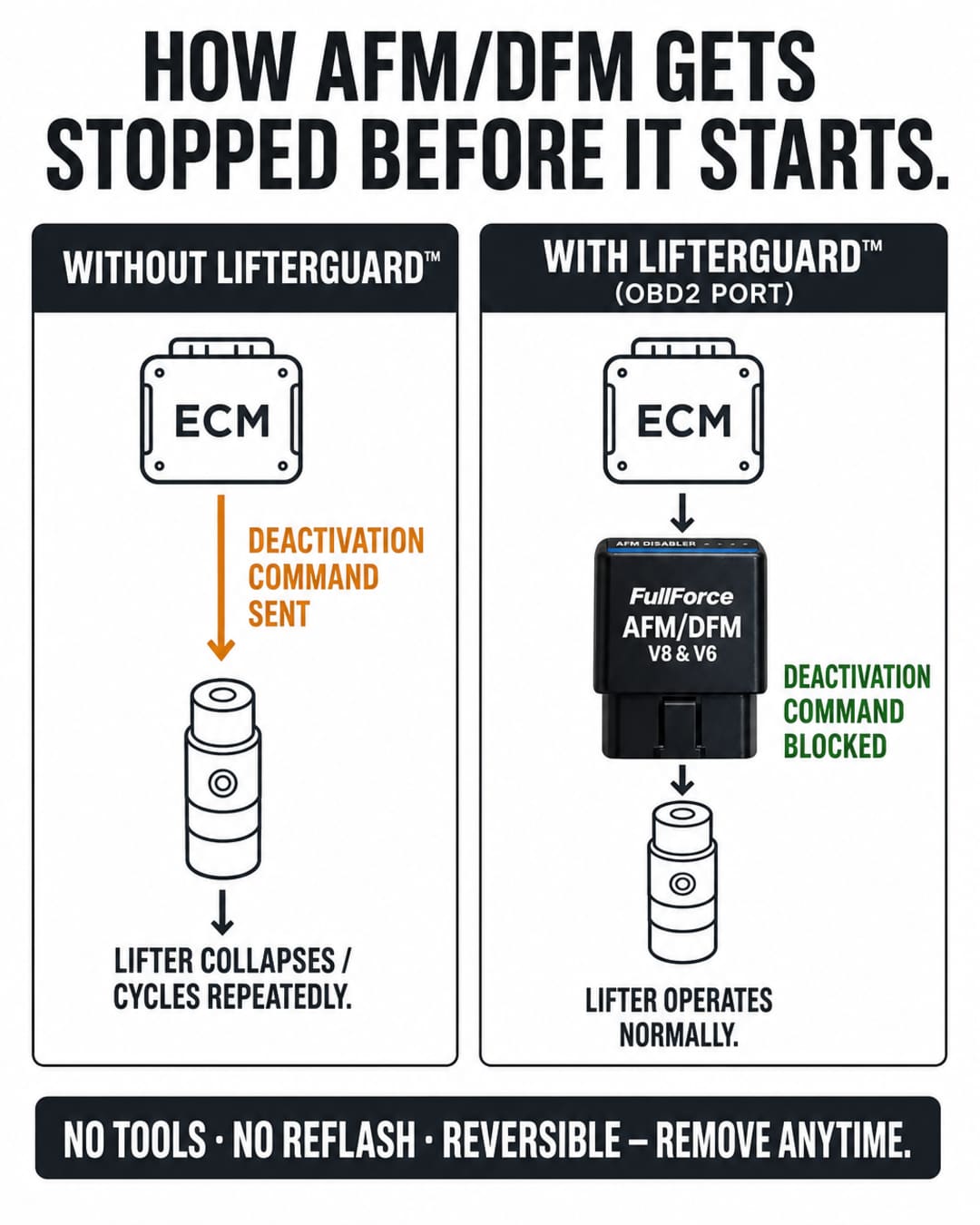
To disable AFM or DFM without touching the engine, you need to prevent the vehicle's computer from ever sending the command to deactivate the cylinders. That means communicating with the ECM through the OBD2 port — the same port your mechanic plugs a diagnostic scanner into. LifterGuard™ is designed to do exactly that: plug into the OBD2 port and instruct the vehicle not to command cylinder deactivation.
No tune. No reflash. No pulling the valley cover. The engine stays stock. The system just never activates.
This is the distinction that matters: LifterGuard™ doesn't modify the hardware or the ECM firmware. It communicates through the OBD2 interface in a way that prevents the deactivation command from being issued. If you decide to remove it, you remove it. The truck returns to its default behavior.
Understanding how it works makes the installation — which takes seconds — feel less like a product purchase and more like a deliberate mechanical decision. Which is exactly what it is.
The Number Nobody Wants to Calculate Until It's Too Late
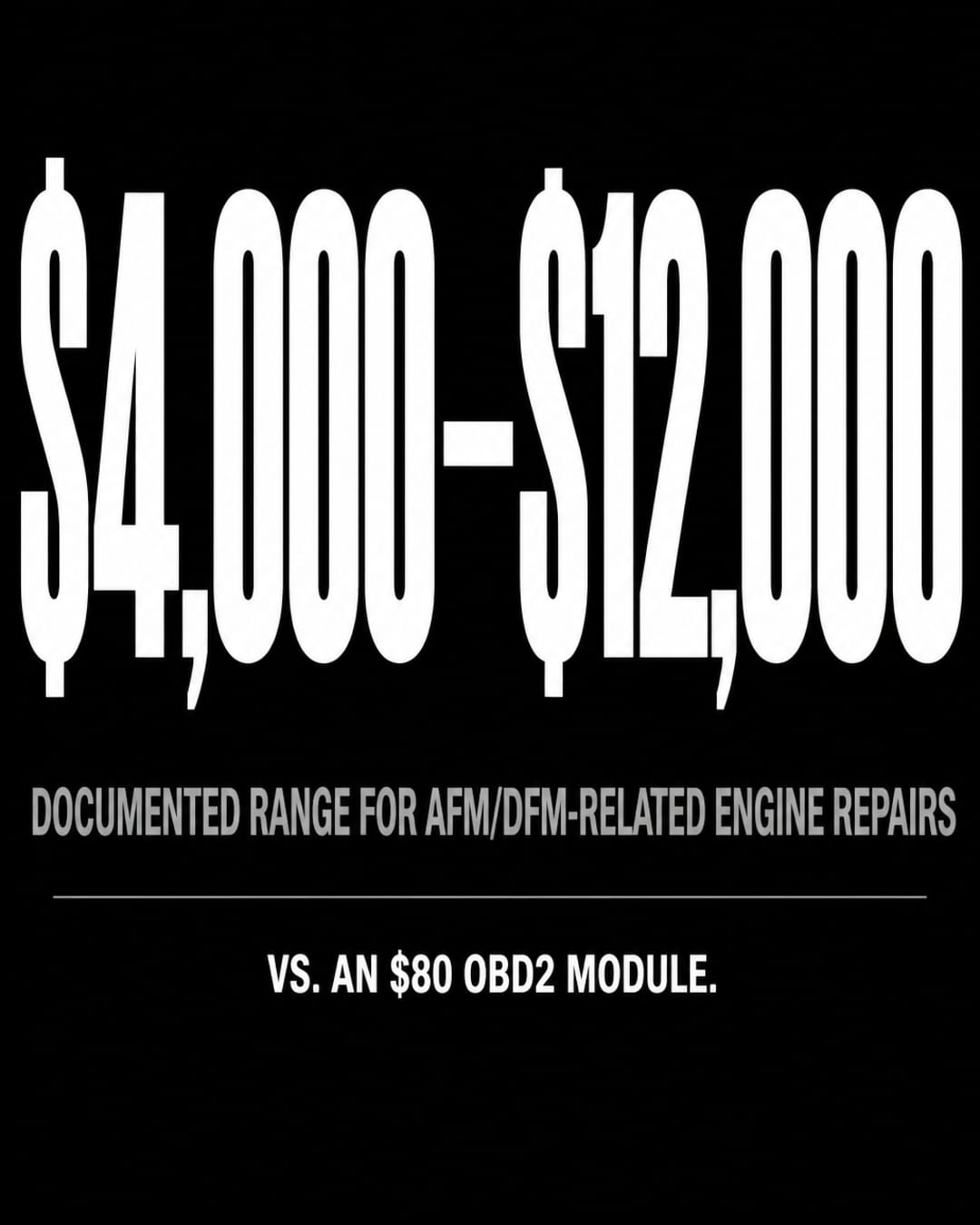
Here is what a lifter failure in an AFM-equipped GM V8 can cost to repair.
The range that shows up consistently across owner forums, independent shop invoices, and parts-and-labor estimates: several thousand dollars at the lower end. Eight to twelve thousand at the upper end, depending on the shop, the vehicle, and what else the failure has affected by the time it's found.
That number carries inside it: shop labor to pull the heads or the valley cover, replacement lifters and camshaft components, reassembly, and whatever supporting work the mechanic determines is necessary once they're inside the engine. An engine with significant lifter damage isn't repaired in an afternoon.
Derek — a man of 35, short sandy hair, wearing a dark blue mechanic's jacket over a white t-shirt — Googled this on his lunch break in the cab of his Yukon after a coworker mentioned his own repair. Derek uses the truck for work. Downtime means missed jobs. He's not in a position to absorb a four-figure engine bill on two days' notice, and he's definitely not in a position to absorb an eight-figure one.
The comparison that GM owners keep returning to is a simple one: the cost of a small OBD2 module versus the cost of the repair it's designed to help you avoid. That gap is large enough that even owners who aren't certain about the risk find it easy to justify the decision.
The financial logic is straightforward. But there's another layer to it — because when you look at what else is available for keeping AFM/DFM off your engine, the options start to look very different from one another.
The Plug-In That Changed the Calculation
Before OBD2 modules like LifterGuard™ existed, a GM owner who wanted to disable AFM or DFM had a few options — none of them simple.
The most common path was an ECM tune or reflash. That means either taking the truck to a performance shop or sending the ECM out and having someone rewrite the calibration file to disable the AFM/DFM tables. It works. But it modifies the firmware, it costs significantly more, and it isn't reversible in thirty seconds. If you need to return the truck to stock — warranty work, resale, dealer service — you're in a different situation.
The other path was hardware modification: pulling the valley cover, swapping out the collapsible lifters and related components for solid alternatives. Effective. Permanent. Also several thousand dollars in parts and labor if a shop does it, or a significant DIY commitment if you do it yourself.
LifterGuard™ is a different category of solution. It communicates through the OBD2 port. There's no firmware rewrite. No hardware touched. Nothing to remove before a dealer service visit except the module from the port — which takes about four seconds. The truck's computer returns to its default state the moment the module is unplugged.
The comparison isn't meant to disparage either of those other approaches. They're legitimate options for owners who want permanent solutions or more extensive modifications. The point is that for an owner who wants to address the AFM/DFM concern without altering the vehicle in any lasting way, LifterGuard™ occupies a space nothing else does.
No tools required. Compatible make, model, and year. Check fit, plug in, drive.

What Changes When You Know You've Done Something About It
There's a specific kind of quiet that comes from having made a deliberate decision about something that used to make you anxious.
Marcus — a man of 41, close-cropped dark hair going gray at the temples, wearing a faded gray work hoodie over a dark henley — still drives the same truck. Same commute, same roads. What's different is the 45 seconds it took to plug the module into the OBD2 port under the dash, and the fact that he hasn't thought about AFM since.
That's not the same as certainty. LifterGuard™ is a proactive measure — it's designed to stop the vehicle from commanding cylinder deactivation, and what that means for long-term engine health is something each owner has to think through for themselves. The point isn't that the module is a guarantee. No part is. The point is that the concern that was abstract — the system cycling somewhere inside the engine, every drive, for years — is now addressed. The command doesn't go out. The lifters don't cycle.
For owners with compatible vehicles, the installation takes less time than reading this article. No tools, no reflash, no appointment. The fitment checker on the LifterGuard™ site walks through make, model, and year. If it fits, it plugs in.
Thirty thousand drivers have done it. The average review sits at 4.91 stars. That's not a number drawn from a marketing brief — it's the accumulated response of owners who had the same question you have now and decided not to keep waiting for an answer.
The decision isn't complicated. The question is whether you make it before or after you have a reason to regret waiting.

At this point you've seen how the system works, what the risk of leaving it active has cost other owners, and how a simple OBD2 module gives you a way to address it in seconds. The one remaining question is whether your vehicle is compatible — and that's the first thing the product page will show you.
What GM Owners Are Saying
"Plugged it in under the dash in about a minute. Straightforward and does exactly what it says. Glad I didn't wait any longer to deal with this."
— T. Harmon, San Antonio TX
"I'd been reading about AFM for months and putting it off. This made the decision easy. Simple install, nothing complicated about it, and I feel better every time I drive now."
— R. Castillo, Columbus OH
"Well made, practical, and reversible. That last part mattered to me — I didn't want anything permanent. Does what it's supposed to do without touching anything else."
— D. Morrow, Boise ID
Every Mile You Drive With AFM/DFM Active Is a Mile You Can't Take Back
- AFM/DFM repeatedly cycles your engine between cylinder configurations — every drive, automatically, without notice
- The lifter and valvetrain hardware that makes it possible is the concern area documented across owner forums and independent shops
- Documented repair costs range from several thousand dollars to $8,000–$12,000 depending on how far the damage has progressed
- LifterGuard™ plugs into the OBD2 port in seconds — no tools, no reflash, reversible any time
- 30,000+ GM owners have already acted; the first step is checking whether your specific vehicle is compatible
If you've read this far, you already know what AFM/DFM does. You know the cycle — the deactivation, the reactivation, the hardware that makes it possible and the concern about what repeated use does to that hardware. You know the repair-cost range. You know that a small OBD2 module can stop the command from ever being issued.
What you don't know yet is whether your specific truck is compatible. That's the first thing the LifterGuard™ page will show you. Check your fitment. If your vehicle is compatible, you'll know in thirty seconds. The rest takes less time than you've already spent reading this.